Institute of Parasitic Diseases, Korea Association of Health Promotion, Seoul 07649, Korea.
Department of Tropical Medicine and Parasitology, Seoul National University College of Medicine, Seoul 03080, Korea.
Korean J Parasitol. 2021 Feb;59(1):47-53. doi: 10.3347/kjp.2021.59.1.47. Epub 2021 Feb 19.
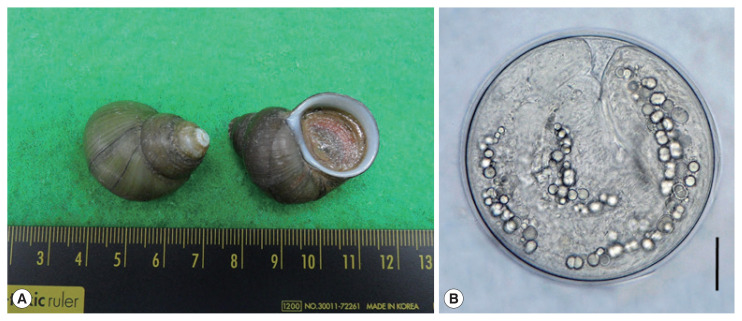
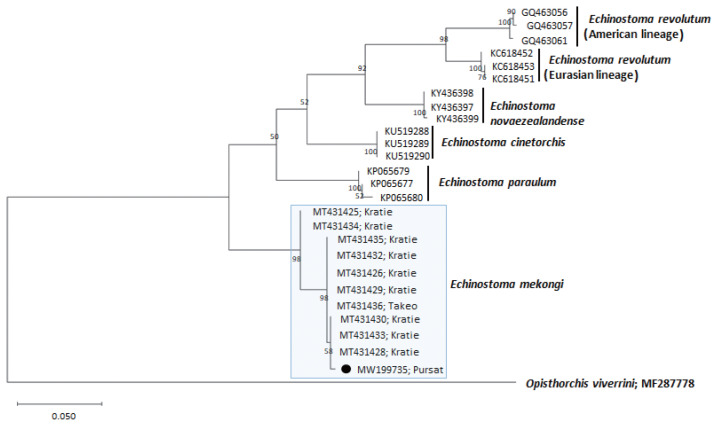
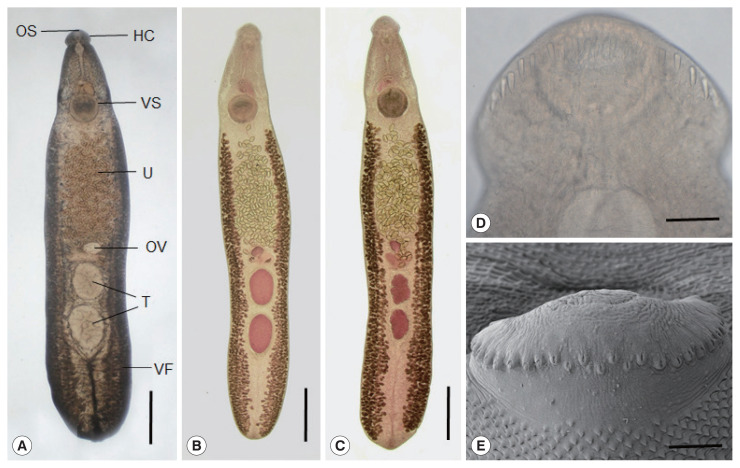
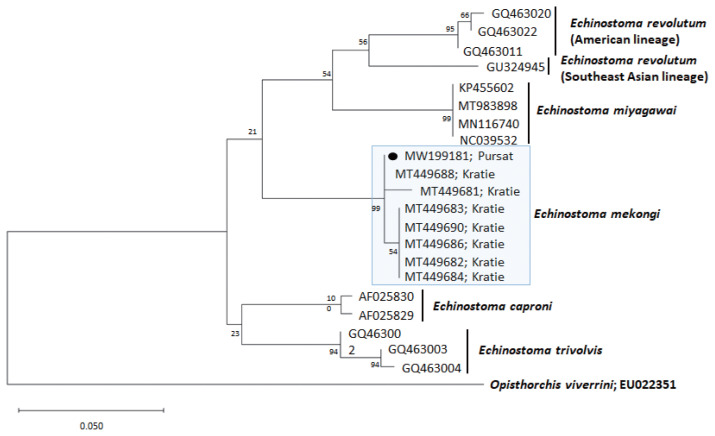
Echinostoma mekongi was reported as a new species in 2020 based on specimens collected from humans in Kratie and Takeo Province, Cambodia. In the present study, its metacercarial stage has been discovered in Filopaludina martensi cambodjensis snails purchased from a local market nearby the Tonle Sap Lake, Pursat Province, Cambodia. The metacercariae were fed orally to an experimental hamster, and adult flukes were recovered at day 20 post-infection. They were morphologically examined using light and scanning electron microscopes and molecularly analyzed by sequencing of their mitochondrial cox1 and nad1 genes. A total of 115 metacercariae (1-8 per snail) were detected in 60 (60.0%) out of 100 Filopaludina snails examined. The metacercariae were round, 174 µm in average diameter (163-190 µm in range), having a thin cyst wall, a head collar armed with 37 collar spines, and characteristic excretory granules. The adult flukes were elongated, ventrally curved, 7.3 (6.4-8.2)×1.4 (1.1-1.7) mm in size, and equipped with 37 collar spines on the head collar (dorsal spines in 2 alternating rows), being consistent with E. mekongi. In phylogenetic analyses, the adult flukes showed 99.0-100% homology based on cox1 sequences and 98.9-99.7% homology based on nad1 sequences with E. mekongi. The results evidenced that F. martensi cambodjensis snails act as the second intermediate host of E. mekongi, and hamsters can be used as a suitable experimental definitive host. As local people favor to eat undercooked snails, these snails seem to be an important source of human infection with E. mekongi in Cambodia.
湄公后槽棘口吸虫于 2020 年被报道为一个新物种,其依据为从柬埔寨桔井省和拉达那基里省采集的人体标本。本研究在柬埔寨磅湛省的洞里萨湖附近的当地市场上购买的圆萝卜螺中发现了其囊蚴阶段。将囊蚴经口投喂给实验仓鼠,感染后第 20 天收获成虫。使用光学显微镜和扫描电子显微镜对其进行形态学检查,并通过线粒体 cox1 和 nad1 基因的测序进行分子分析。在检查的 100 只圆萝卜螺中,有 60 只(60.0%)发现有 1-8 个囊蚴(共 115 个)。囊蚴呈圆形,平均直径为 174 µm(范围为 163-190 µm),具有薄的囊壁、头部环具 37 个环刺,并有特征性的排泄颗粒。成虫为长形,腹面弯曲,大小为 7.3(6.4-8.2)×1.4(1.1-1.7)mm,头部环具 37 个环刺(背刺呈 2 个交替行),与湄公后槽棘口吸虫一致。系统发育分析显示,成虫基于 cox1 序列的同源性为 99.0-100%,基于 nad1 序列的同源性为 98.9-99.7%,与湄公后槽棘口吸虫一致。结果表明,圆萝卜螺为湄公后槽棘口吸虫的第二中间宿主,仓鼠可作为合适的实验终末宿主。由于当地人喜欢吃未煮熟的螺,这些螺似乎是柬埔寨人感染湄公后槽棘口吸虫的一个重要来源。