Park Richard, El-Guindy Ayman, Heston Lee, Lin Su-Fang, Yu Kuan-Ping, Nagy Mate, Borah Sumit, Delecluse Henri-Jacques, Steitz Joan, Miller George
Department of Molecular Biophysics and Biochemistry, Yale University School of Medicine, New Haven, Connecticut, United States of America.
Department of Pediatrics, Yale University School of Medicine, New Haven, Connecticut, United States of America.
PLoS One. 2014 Apr 4;9(4):e92593. doi: 10.1371/journal.pone.0092593. eCollection 2014.
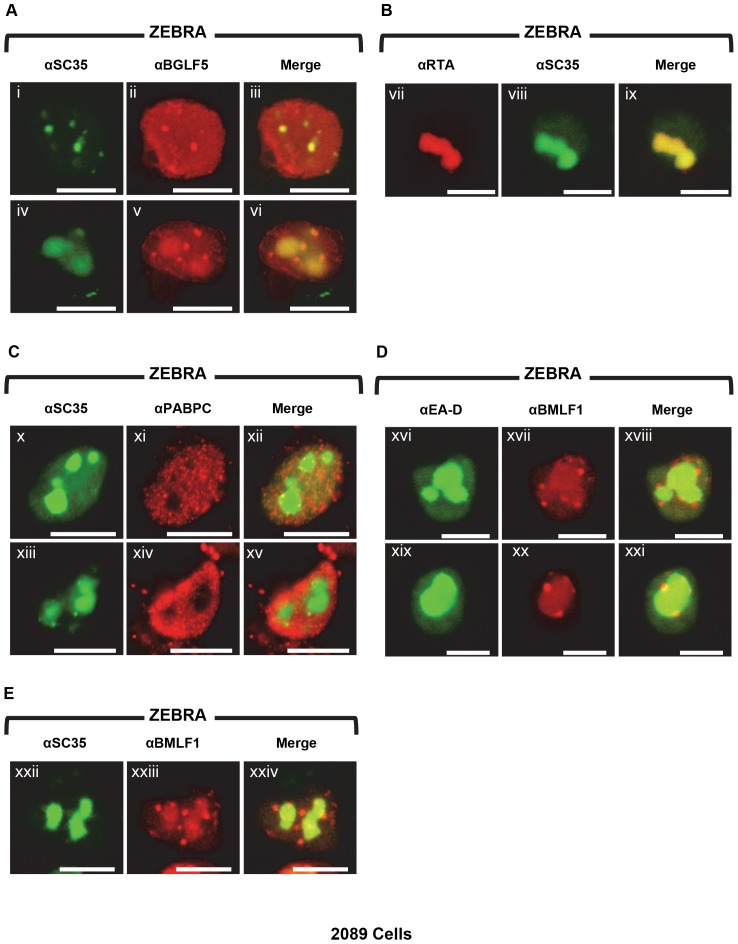
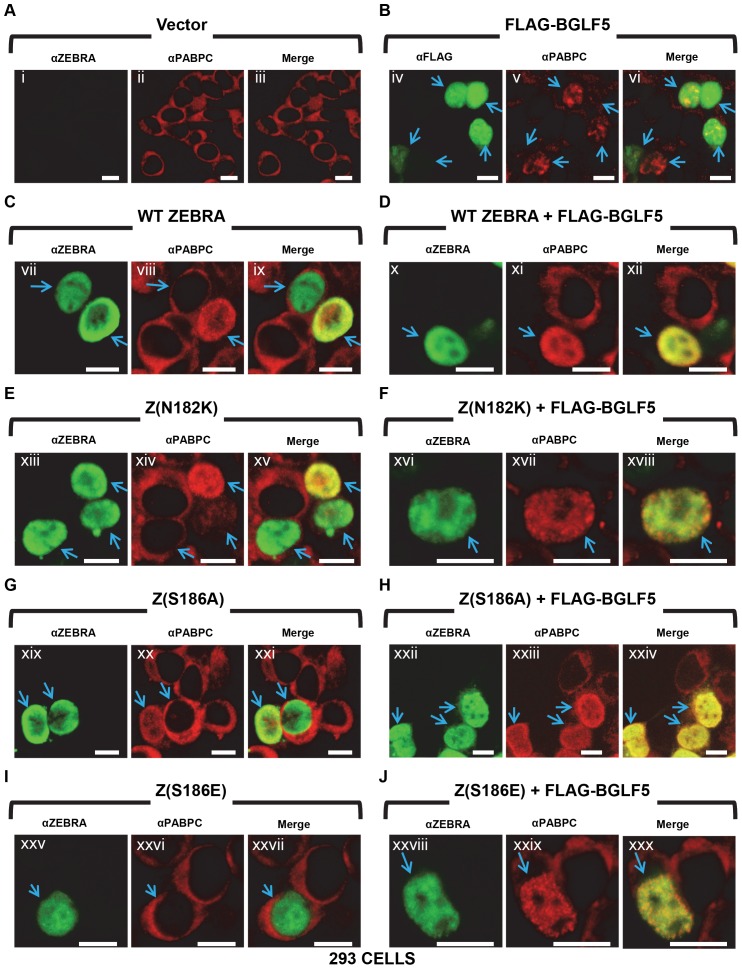
Many viruses target cytoplasmic polyA binding protein (PABPC) to effect widespread inhibition of host gene expression, a process termed viral host-shutoff (vhs). During lytic replication of Epstein Barr Virus (EBV) we observed that PABPC was efficiently translocated from the cytoplasm to the nucleus. Translocated PABPC was diffusely distributed but was excluded from viral replication compartments. Vhs during EBV infection is regulated by the viral alkaline nuclease, BGLF5. Transfection of BGLF5 alone into BGLF5-KO cells or uninfected 293 cells promoted translocation of PAPBC that was distributed in clumps in the nucleus. ZEBRA, a viral bZIP protein, performs essential functions in the lytic program of EBV, including activation or repression of downstream viral genes. ZEBRA is also an essential replication protein that binds to viral oriLyt and interacts with other viral replication proteins. We report that ZEBRA also functions as a regulator of vhs. ZEBRA translocated PABPC to the nucleus, controlled the intranuclear distribution of PABPC, and caused global shutoff of host gene expression. Transfection of ZEBRA alone into 293 cells caused nuclear translocation of PABPC in the majority of cells in which ZEBRA was expressed. Co-transfection of ZEBRA with BGLF5 into BGLF5-KO cells or uninfected 293 cells rescued the diffuse intranuclear pattern of PABPC seen during lytic replication. ZEBRA mutants defective for DNA-binding were capable of regulating the intranuclear distribution of PABPC, and caused PABPC to co-localize with ZEBRA. One ZEBRA mutant, Z(S186E), was deficient in translocation yet was capable of altering the intranuclear distribution of PABPC. Therefore ZEBRA-mediated nuclear translocation of PABPC and regulation of intranuclear PABPC distribution are distinct events. Using a click chemistry-based assay for new protein synthesis, we show that ZEBRA and BGLF5 each function as viral host shutoff factors.
许多病毒靶向细胞质聚腺苷酸结合蛋白(PABPC),以广泛抑制宿主基因表达,这一过程称为病毒宿主关闭(vhs)。在爱泼斯坦-巴尔病毒(EBV)的裂解复制过程中,我们观察到PABPC有效地从细胞质转移到细胞核。转移的PABPC呈弥漫性分布,但被排除在病毒复制区室之外。EBV感染期间的vhs由病毒碱性核酸酶BGLF5调节。将BGLF5单独转染到BGLF5基因敲除细胞或未感染的293细胞中,可促进PAPBC的转移,PAPBC在细胞核中呈团块状分布。ZEBRA是一种病毒bZIP蛋白,在EBV的裂解程序中发挥重要作用,包括激活或抑制下游病毒基因。ZEBRA也是一种必需的复制蛋白,它与病毒oriLyt结合并与其他病毒复制蛋白相互作用。我们报告ZEBRA也作为vhs的调节因子发挥作用。ZEBRA将PABPC转移到细胞核,控制PABPC在细胞核内的分布,并导致宿主基因表达的全面关闭。将ZEBRA单独转染到293细胞中,在大多数表达ZEBRA的细胞中导致PABPC的核转位。将ZEBRA与BGLF5共转染到BGLF5基因敲除细胞或未感染的293细胞中,可挽救裂解复制期间所见的PABPC在细胞核内的弥漫性模式。对DNA结合有缺陷的ZEBRA突变体能够调节PABPC在细胞核内的分布,并导致PABPC与ZEBRA共定位。一种ZEBRA突变体Z(S186E)缺乏转位能力,但能够改变PABPC在细胞核内的分布。因此,ZEBRA介导的PABPC核转位和细胞核内PABPC分布的调节是不同的事件。使用基于点击化学的新蛋白质合成检测方法,我们表明ZEBRA和BGLF5均作为病毒宿主关闭因子发挥作用。