Department of Oncology, McArdle Laboratory for Cancer Research, University of Wisconsin, Madison, WI 53705, USA.
Department of Medicine, Division of Infectious Diseases, University of Wisconsin, Madison, WI 53705, USA.
Viruses. 2023 Mar 11;15(3):726. doi: 10.3390/v15030726.
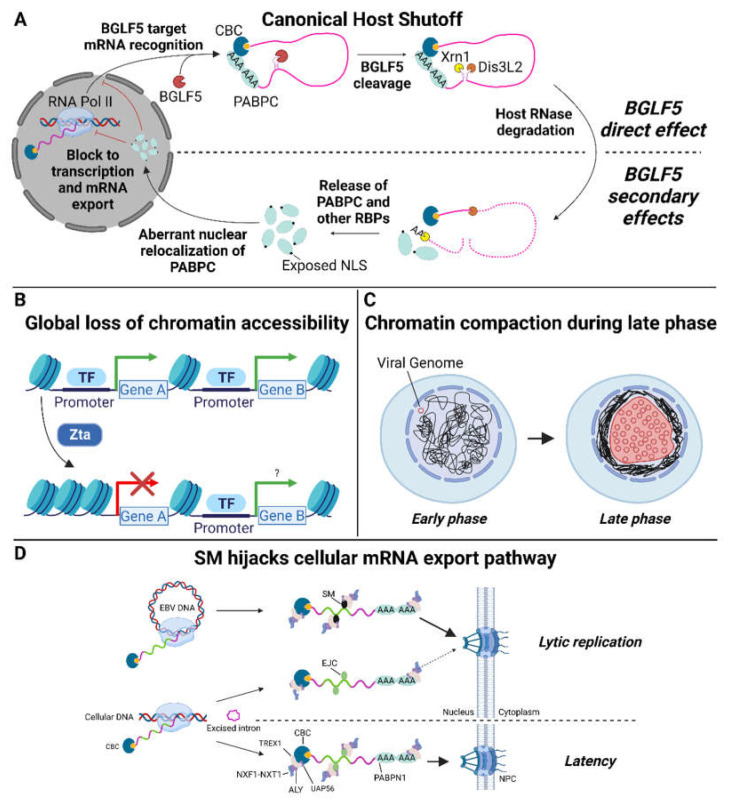
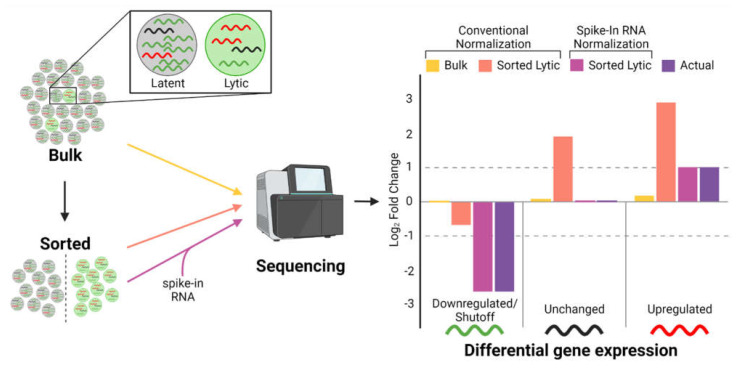
During reactivation from latency, gammaherpesviruses radically restructure their host cell to produce virion particles. To achieve this and thwart cellular defenses, they induce rapid degradation of cytoplasmic mRNAs, suppressing host gene expression. In this article, we review mechanisms of shutoff by Epstein-Barr virus (EBV) and other gammaherpesviruses. In EBV, canonical host shutoff is accomplished through the action of the versatile BGLF5 nuclease expressed during lytic reactivation. We explore how BGLF5 induces mRNA degradation, the mechanisms by which specificity is achieved, and the consequences for host gene expression. We also consider non-canonical mechanisms of EBV-induced host shutoff. Finally, we summarize the limitations and barriers to accurate measurements of the EBV host shutoff phenomenon.
在潜伏状态下重新激活时,γ疱疹病毒会彻底重构宿主细胞以产生病毒粒子。为了实现这一目标并挫败细胞防御,它们诱导细胞质 mRNA 的快速降解,从而抑制宿主基因表达。在本文中,我们综述了 EBV 和其他γ疱疹病毒的关闭机制。在 EBV 中,通过在裂解性重新激活期间表达的多功能 BGLF5 核酸酶的作用来实现经典的宿主关闭。我们探讨了 BGLF5 如何诱导 mRNA 降解、实现特异性的机制以及对宿主基因表达的影响。我们还考虑了 EBV 诱导的宿主关闭的非经典机制。最后,我们总结了准确测量 EBV 宿主关闭现象的局限性和障碍。