Shaoxing Second Hospital, 123 Yan An Road, Shaoxing, Zhejiang 312000, China.
Respir Res. 2014 Apr 4;15(1):39. doi: 10.1186/1465-9921-15-39.
Recent studies have demonstrated that mesenchymal stem cells (MSCs) modulate the immune response and reduce lung injury in animal models. Currently, no clinical studies of the effects of MSCs in acute respiratory distress syndrome (ARDS) exist. The objectives of this study were first to examine the possible adverse events after systemic administration of allogeneic adipose-derived MSCs in ARDS patients and second to determine potential efficacy of MSCs on ARDS.
Twelve adult patients meeting the Berlin definition of acute respiratory distress syndrome with a PaO2/FiO2 ratio of < 200 were randomized to receive allogeneic adipose-derived MSCs or placebo in a 1:1 fashion. Patients received one intravenous dose of 1 × 10⁶ cells/kg of body weight or saline. Possible side effects were monitored after treatment. Acute lung injury biomarkers, including IL-6, IL-8 and surfactant protein D (SP-D), were examined to determine the effects of MSCs on lung injury and inflammation.
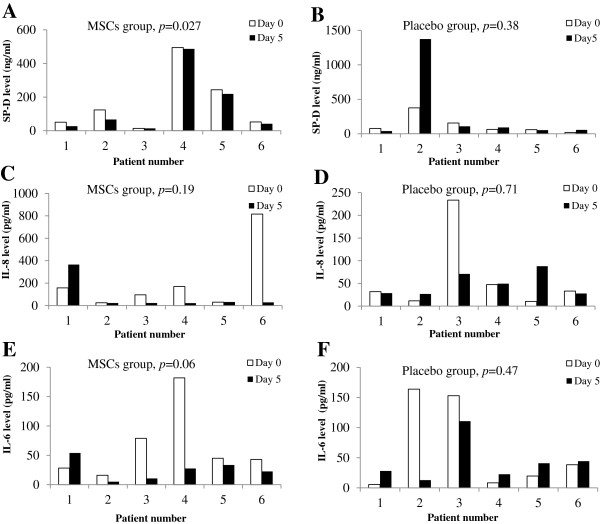
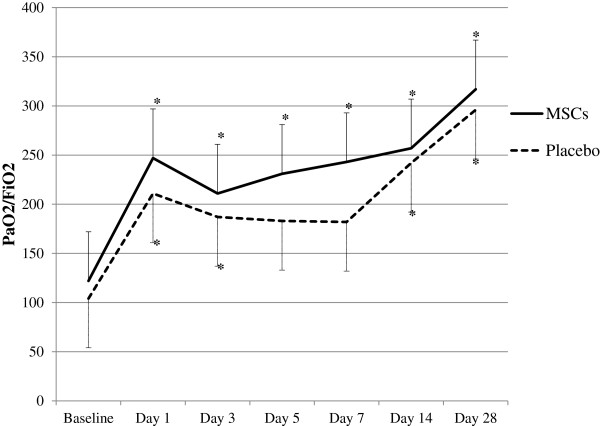
There were no infusion toxicities or serious adverse events related to MSCs administration and there were no significant differences in the overall number of adverse events between the two groups. Length of hospital stay, ventilator-free days and ICU-free days at day 28 after treatment were similar. There were no changes in biomarkers examined in the placebo group. In the MSCs group, serum SP-D levels at day 5 were significantly lower than those at day 0 (p = 0.027) while the changes in IL-8 levels were not significant. The IL-6 levels at day 5 showed a trend towards lower levels as compared with day 0, but this trend was not statistically significant (p = 0.06).
Administration of allogeneic adipose-derived MSCs appears to be safe and feasible in the treatment of ARDS. However, the clinical effect with the doses of MSCs used is weak, and further optimization of this strategy will probably be required to reach the goal of reduced alveolar epithelial injury in ARDS.
Clinical trials.gov, NCT01902082.
最近的研究表明,间充质干细胞(MSCs)可调节免疫反应并减轻动物模型中的肺损伤。目前,尚无关于 MSCs 在急性呼吸窘迫综合征(ARDS)中的作用的临床研究。本研究的目的首先是检查 ARDS 患者全身给予同种异体脂肪来源的 MSCs 后可能发生的不良事件,其次是确定 MSCs 对 ARDS 的潜在疗效。
12 名符合柏林急性呼吸窘迫综合征定义且 PaO2/FiO2 比<200 的成年患者随机接受 1×10⁶ 细胞/kg 体重的同种异体脂肪来源的 MSCs 或安慰剂,以 1:1 的比例给药。患者接受一次静脉注射。治疗后监测可能的副作用。检查急性肺损伤生物标志物,包括白细胞介素 6(IL-6)、白细胞介素 8(IL-8)和表面活性蛋白 D(SP-D),以确定 MSCs 对肺损伤和炎症的影响。
没有与 MSCs 给药相关的输注毒性或严重不良事件,两组之间的总体不良事件数量无显著差异。治疗后 28 天的住院时间、无呼吸机天数和无 ICU 天数相似。安慰剂组检查的生物标志物无变化。在 MSCs 组中,第 5 天血清 SP-D 水平明显低于第 0 天(p=0.027),而 IL-8 水平的变化不显著。第 5 天的 IL-6 水平较第 0 天呈下降趋势,但无统计学意义(p=0.06)。
在治疗 ARDS 中,给予同种异体脂肪来源的 MSCs 似乎是安全可行的。然而,使用这种剂量的 MSCs 的临床效果较弱,可能需要进一步优化这种策略,以达到减轻 ARDS 中肺泡上皮损伤的目标。
Clinicaltrials.gov,NCT01902082。