School of Electrical, Electronic and Communications Engineering, University College Dublin, Dublin, Belfield, Ireland.
J Neuroeng Rehabil. 2014 Apr 7;11:52. doi: 10.1186/1743-0003-11-52.
This study uses biomechanical modelling and computational optimization to investigate muscle activation in combination with applied external forces as a treatment for scoliosis. Bracing, which incorporates applied external forces, is the most popular non surgical treatment for scoliosis. Non surgical treatments which make use of muscle activation include electrical stimulation, postural control, and therapeutic exercises. Electrical stimulation has been largely dismissed as a viable treatment for scoliosis, although previous studies have suggested that it can potentially deliver similarly effective corrective forces to the spine as bracing.
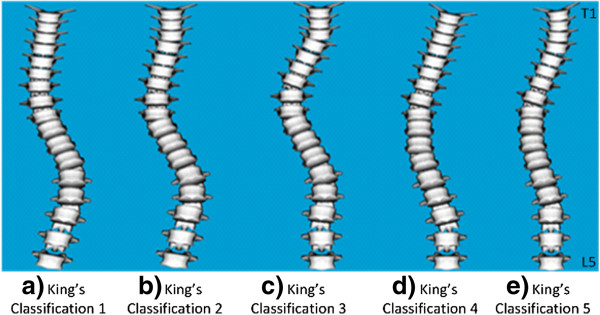
The potential of muscle activation for scoliosis correction was investigated over different curvatures both with and without the addition of externally applied forces. The five King's classifications of scoliosis were investigated over a range of Cobb angles. A biomechanical model of the spine was used to represent various scoliotic curvatures. Optimization was applied to the model to reduce the curves using combinations of both deep and superficial muscle activation and applied external forces.
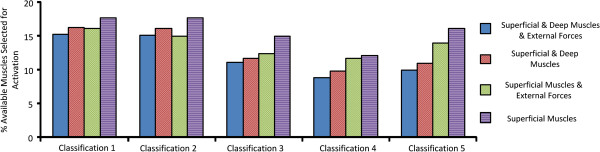
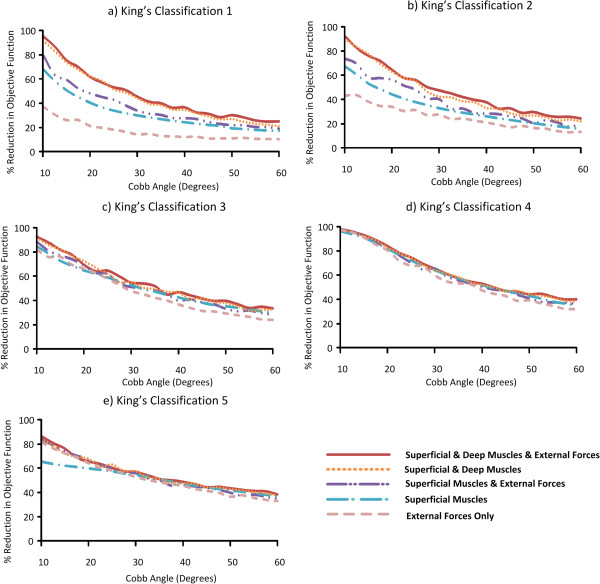
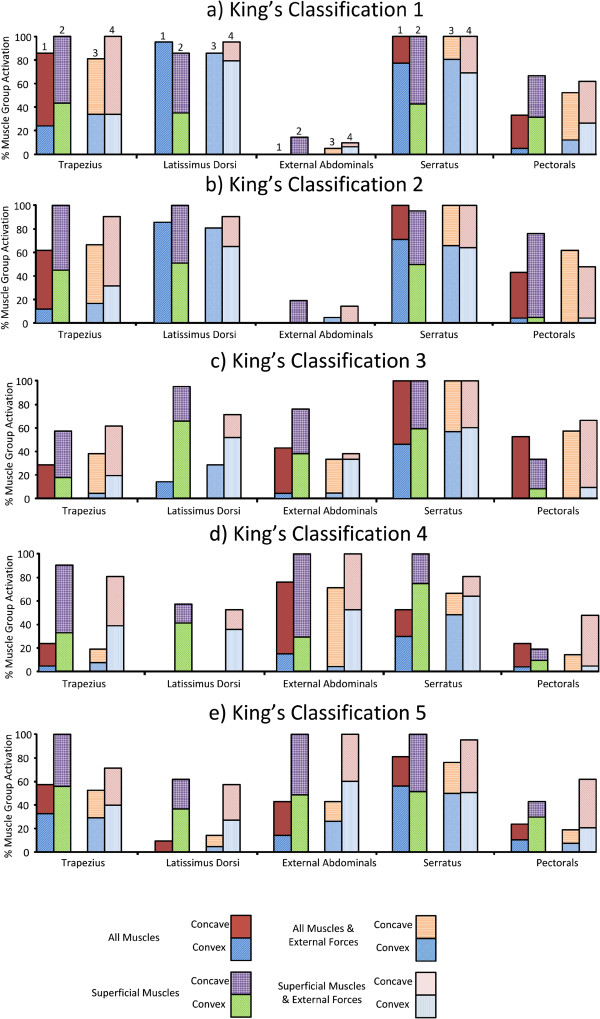
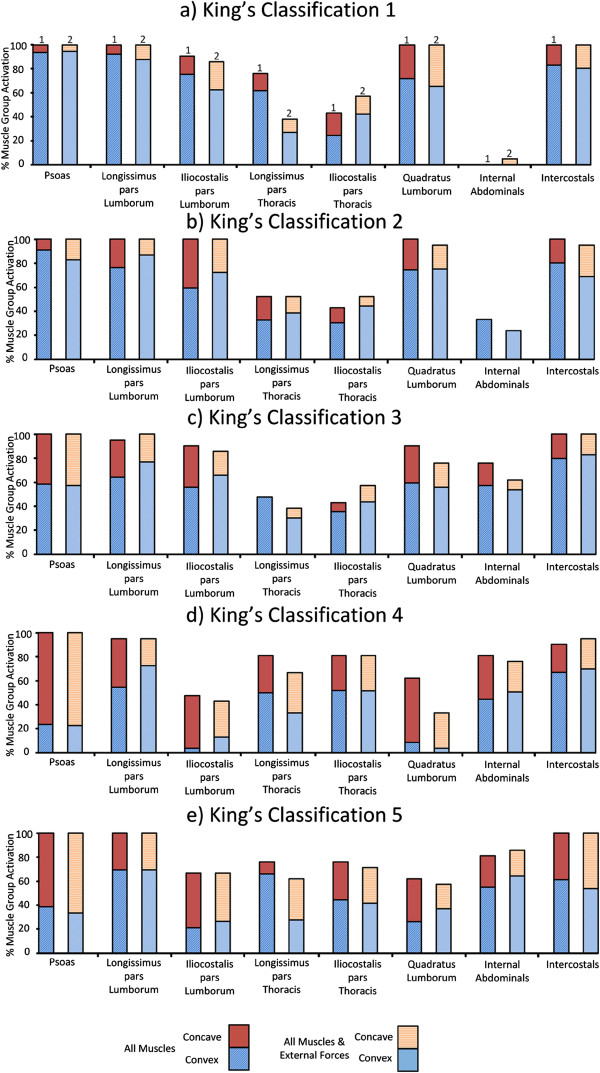
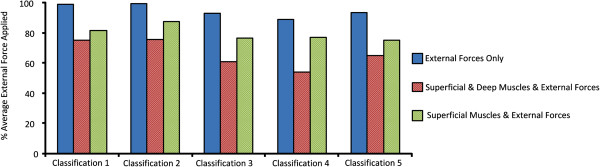
Simulating applied external forces in combination with muscle activation at low Cobb angles (< 20 degrees) over the 5 King's classifications, it was possible to reduce the magnitude of the curve by up to 85% for classification 4, 75% for classifications 3 and 5, 65% for classification 2, and 60% for classification 1. The reduction in curvature was less at larger Cobb angles. For King's classifications 1 and 2, the serratus, latissimus dorsi, and trapezius muscles were consistently recruited by the optimization algorithm for activation across all Cobb angles. When muscle activation and external forces were applied in combination, lower levels of muscle activation or less external force was required to reduce the curvature of the spine, when compared with either muscle activation or external force applied in isolation.
The results of this study suggest that activation of superficial and deep muscles may be effective in reducing spinal curvature at low Cobb angles when muscle groups are selected for activation based on the curve type. The findings further suggest the potential for a hybrid treatment involving combined muscle activation and applied external forces at larger Cobb angles.
本研究使用生物力学建模和计算优化来研究肌肉激活与应用外部力的结合,作为治疗脊柱侧凸的方法。支具结合应用外部力,是治疗脊柱侧凸最流行的非手术方法。利用肌肉激活的非手术治疗包括电刺激、姿势控制和治疗性运动。尽管先前的研究表明,电刺激有可能向脊柱提供与支具类似的有效矫正力,但它已基本被排除作为脊柱侧凸的可行治疗方法。
研究了在不同曲率下,结合和不结合应用外部力时肌肉激活对脊柱侧凸矫正的潜力。研究了五种 King 分类的脊柱侧凸在一系列 Cobb 角范围内的情况。使用脊柱生物力学模型来表示各种脊柱侧凸的曲率。通过应用优化,结合深部和浅部肌肉激活以及应用外部力来减少模型的曲线。
在 King 分类的 1 到 5 中,模拟低 Cobb 角(<20 度)下的应用外部力与肌肉激活相结合,可以将曲线的幅度减少高达 85%(分类 4)、75%(分类 3 和 5)、65%(分类 2)和 60%(分类 1)。在较大的 Cobb 角下,曲率的减少较小。对于 King 分类 1 和 2,优化算法在所有 Cobb 角下都会持续招募胸大肌、背阔肌和斜方肌进行激活。当肌肉激活和外部力联合应用时,与单独应用肌肉激活或外部力相比,减少脊柱曲率所需的肌肉激活水平或外部力水平更低。
本研究的结果表明,当根据曲线类型选择激活的肌肉群时,在低 Cobb 角下,深层和浅层肌肉的激活可能有效减少脊柱曲率。研究结果进一步表明,在较大的 Cobb 角下,联合应用肌肉激活和应用外部力的混合治疗具有潜力。