Lin Yinan, Xia Xiaoxia, Wang Ming, Wang Qianrui, An Bo, Tao Hu, Xu Qiaobing, Omenetto Fiorenzo, Kaplan David L
Department of Biomedical Engineering, Tufts University , 4 Colby Street, Medford, Massachusetts 02155, United States.
Langmuir. 2014 Apr 22;30(15):4406-14. doi: 10.1021/la403559t. Epub 2014 Apr 8.
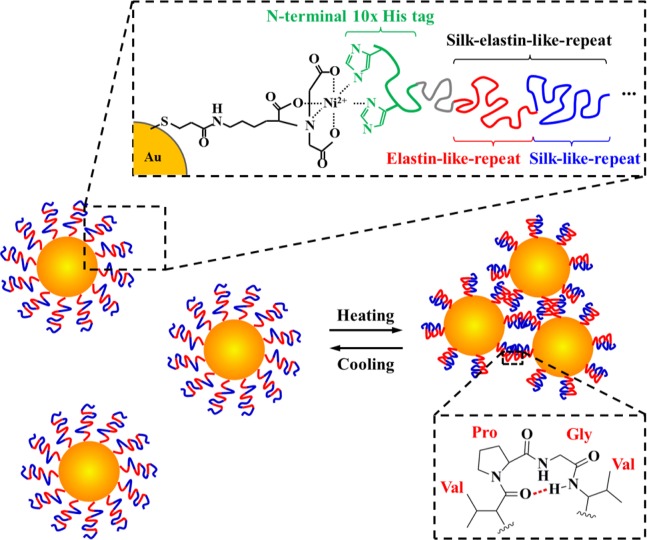
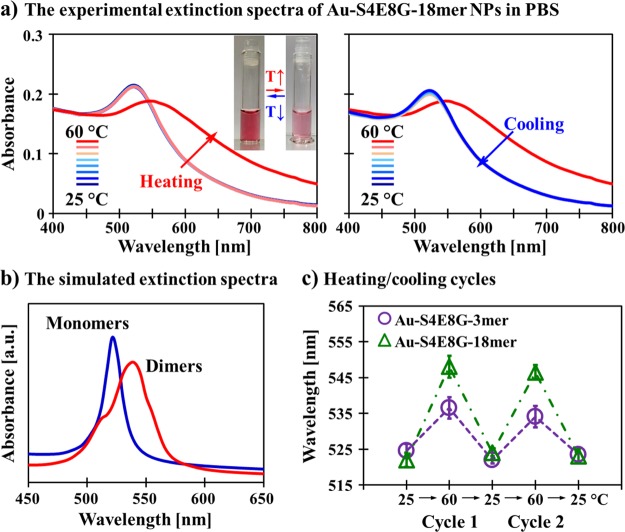
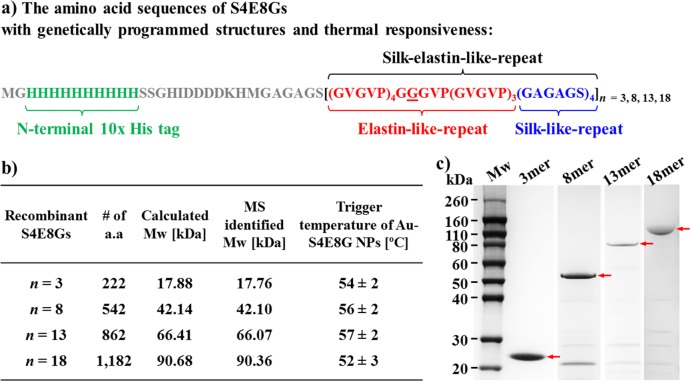
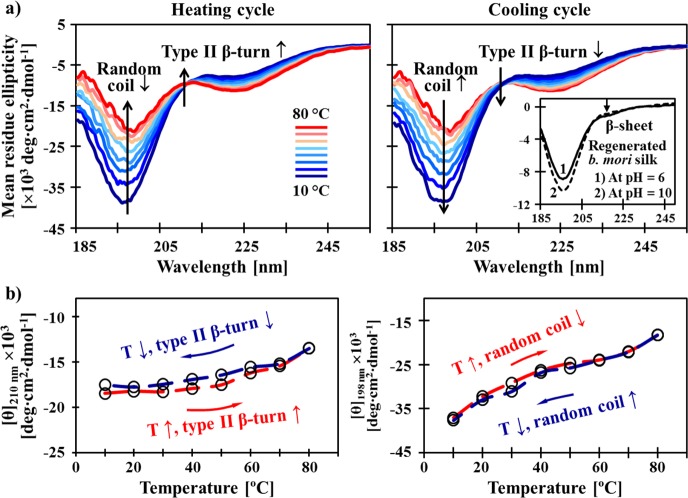
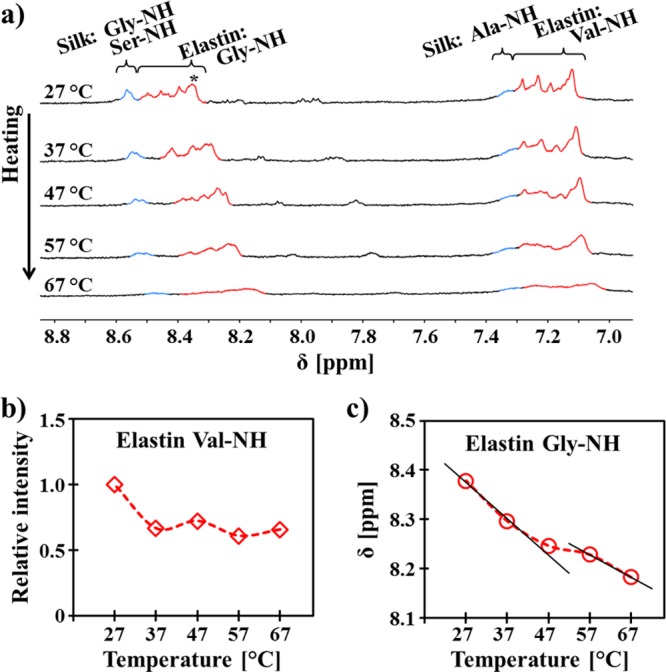
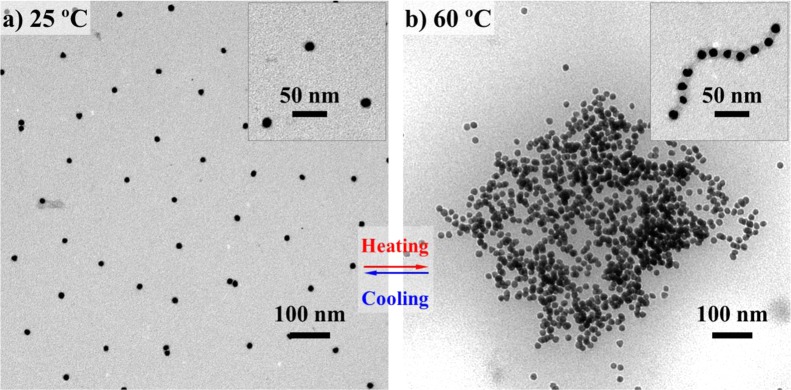
The design and development of future molecular photonic/electronic systems pose the challenge of integrating functional molecular building blocks in a controlled, tunable, and reproducible manner. The modular nature and fidelity of the biosynthesis method provides a unique chemistry approach to one-pot synthesis of environmental factor-responsive chimeric proteins capable of energy conversion between the desired forms. In this work, facile tuning of dynamic thermal response in plasmonic nanoparticles was facilitated by genetic engineering of the structure, size, and self-assembly of the shell silk-elastin-like protein polymers (SELPs). Recombinant DNA techniques were implemented to synthesize a new family of SELPs, S4E8Gs, with amino acid repeats of [(GVGVP)4(GGGVP)(GVGVP)3(GAGAGS)4] and tunable molecular weight. The temperature-reversible conformational switching between the hydrophilic random coils and the hydrophobic β-turns in the elastin blocks were programmed to between 50 and 60 °C by site-specific glycine mutation, as confirmed by variable-temperature proton NMR and circular dichroism (CD) spectroscopy, to trigger the nanoparticle aggregation. The dynamic self-aggregation/disaggregation of the Au-SELPs nanoparticles was regulated in size and pattern by the β-sheet-forming, thermally stable silk blocks, as revealed by transmission electron microscopy (TEM) and dynamic light scattering (DLS). The thermally reversible, shell dimension dependent, interparticle plasmon coupling was investigated by both variable-temperature UV-vis spectroscopy and finite-difference time-domain (FDTD)-based simulations. Good agreement between the calculated and measured spectra sheds light on design and synthesis of responsive plasmonic nanostructures by independently tuning the refractive index and size of the SELPs through genetic engineering.
未来分子光子/电子系统的设计与开发面临着以可控、可调谐和可重复的方式整合功能性分子构建块的挑战。生物合成方法的模块化性质和保真度为一锅法合成能够在所需形式之间进行能量转换的环境因子响应嵌合蛋白提供了一种独特的化学方法。在这项工作中,通过对壳层类丝素-弹性蛋白样蛋白聚合物(SELPs)的结构、尺寸和自组装进行基因工程,实现了对等离子体纳米颗粒中动态热响应的简便调节。采用重组DNA技术合成了一个新的SELP家族S4E8Gs,其氨基酸重复序列为[(GVGVP)4(GGGVP)(GVGVP)3(GAGAGS)4],分子量可调。通过位点特异性甘氨酸突变,将弹性蛋白嵌段中亲水性无规卷曲和疏水性β-转角之间的温度可逆构象转换设定在50至60°C之间,可变温度质子核磁共振和圆二色性(CD)光谱证实了这一点,从而触发纳米颗粒聚集。透射电子显微镜(TEM)和动态光散射(DLS)显示,Au-SELPs纳米颗粒的动态自聚集/解聚在尺寸和模式上受到形成β-折叠的热稳定丝素嵌段的调节。通过可变温度紫外-可见光谱和基于时域有限差分(FDTD)的模拟,研究了热可逆的、壳层尺寸依赖性的颗粒间等离子体耦合。计算光谱与测量光谱之间的良好一致性为通过基因工程独立调节SELP的折射率和尺寸来设计和合成响应性等离子体纳米结构提供了启示。