Key Laboratory of Biofuels, Shandong Provincial Key Laboratory of Energy Genetics, Qingdao Institute of Bioenergy and Bioprocess Technology, Chinese Academy of Sciences, No, 189 Songling Road, Qingdao, Shandong 266101, China.
Biotechnol Biofuels. 2014 Apr 8;7(1):55. doi: 10.1186/1754-6834-7-55.
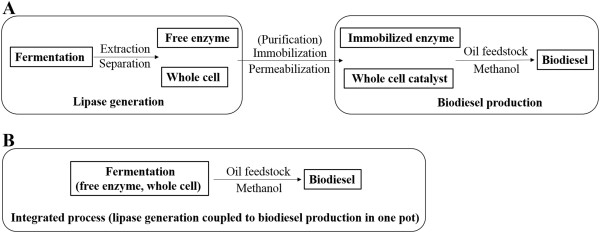
Lipase-catalyzed biotransformation of acylglycerides or fatty acids into biodiesel via immobilized enzymes or whole cell catalysts has been considered as one of the most promising methods to produce renewable and environmentally friendly alternative liquid fuels, thus being extensively studied so far. In all previously pursued approaches, however, lipase enzymes are prepared in an independent process separated from enzymatic biodiesel production, which would unavoidably increase the cost and energy consumption during industrial manufacture of this cost-sensitive energy product. Therefore, there is an urgent need to develop novel cost-effective biocatalysts and biocatalytic processes with genuine industrial feasibility.
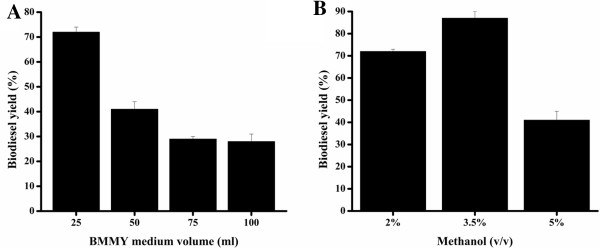
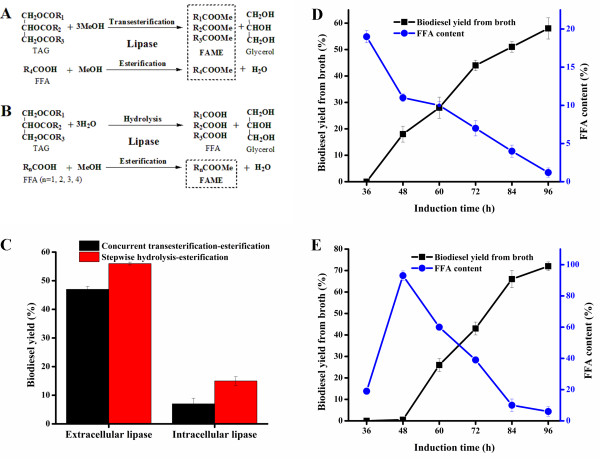
Inspired by the consolidated bioprocessing of lignocellulose to generate bioethanol, an integrated process with coupled lipase production and in situ biodiesel synthesis in a recombinant P. pastoris yeast was developed in this study. The novel and efficient dual biocatalytic system based on Thermomyces lanuginosus lipase took advantage of both cell free enzymes and whole cell catalysts. The extracellular and intracellular lipases of growing yeast cells were simultaneously utilized to produce biodiesel from waste cooking oils in situ and in one pot. This integrated system effectively achieved 58% and 72% biodiesel yield via concurrent esterified-transesterified methanolysis and stepwise hydrolysis-esterification at 3:1 molar ratio between methanol and waste cooking oils, respectively. Further increasing the molar ratio of methanol to waste cooking oils to 6:1 led to an 87% biodiesel yield using the stepwise strategy. Both water tolerance and methanol tolerance of this novel system were found to be significantly improved compared to previous non-integrated biodiesel production processes using separately prepared immobilized enzymes or whole cell catalysts.
We have proposed a new concept of integrated biodiesel production. This integrated system couples lipase production to lipase-catalyzed biodiesel synthesis in one pot. The proof-of-concept was established through construction of a recombinant P. pastoris yeast strain that was able to grow, overexpress T. lanuginosus lipase, and efficiently catalyze biodiesel production from fed waste cooking oils and methanol simultaneously. This simplified single-step process represents a significant advance toward achieving economical production of biodiesel at industrial scale via a 'green' biocatalytic route.
通过固定化酶或全细胞催化剂将酰基甘油或脂肪酸转化为生物柴油的脂肪酶催化生物转化,已被认为是生产可再生和环境友好型替代液体燃料最有前途的方法之一,因此迄今为止受到了广泛的研究。然而,在所有以前的研究中,脂肪酶都是在与酶法生物柴油生产分离的独立过程中制备的,这不可避免地会增加这种对成本敏感的能源产品在工业生产中的成本和能耗。因此,迫切需要开发具有真正工业可行性的新型经济有效的生物催化剂和生物催化工艺。
受木质纤维素的综合生物加工生产生物乙醇的启发,本研究开发了一种在重组毕赤酵母中同时进行脂肪酶生产和原位生物柴油合成的集成工艺。新型高效双生物催化体系以Thermomyces lanuginosus 脂肪酶为基础,利用无细胞酶和全细胞催化剂。生长酵母细胞的细胞外和细胞内脂肪酶同时用于原位一锅法从废食用油中生产生物柴油。该集成系统有效地实现了 58%和 72%的生物柴油产率,分别在甲醇与废食用油摩尔比为 3:1 和 1 时通过酯化-酯交换甲醇解和分步水解-酯化同时进行。进一步将甲醇与废食用油的摩尔比增加到 6:1 时,采用分步策略可获得 87%的生物柴油产率。与使用分别制备的固定化酶或全细胞催化剂的先前非集成生物柴油生产工艺相比,该新型体系的水耐受性和甲醇耐受性均得到显著提高。
我们提出了一种新的集成生物柴油生产概念。该集成系统将脂肪酶生产与脂肪酶催化的生物柴油合成在一个锅中偶联。通过构建能够生长、过表达 T. lanuginosus 脂肪酶并同时从进料废食用油和甲醇中高效催化生物柴油生产的重组毕赤酵母菌株,建立了概念验证。这种简化的单步工艺代表了通过“绿色”生物催化途径在工业规模上实现经济高效生产生物柴油的重大进展。