Bergouignan Audrey, Kealey Elizabeth H, Schmidt Stacy L, Jackman Matthew R, Bessesen Daniel H
Anschutz Health & Wellness Center at the University of Colorado, Anschutz Medical Campus, Aurora, Colorado, United States of America.
Division of Endocrinology, Metabolism, and Diabetes, University of Colorado, School of Medicine, Aurora, Colorado, United States of America.
PLoS One. 2014 Apr 8;9(4):e94181. doi: 10.1371/journal.pone.0094181. eCollection 2014.
It has been hypothesized that obese and reduced-obese individuals have decreased oxidative capacity, which contributes to weight gain and regain. Recent data have challenged this concept.
To determine (1) whether total and dietary fat oxidation are decreased in obese and reduced-obese adults compared to lean but increase in response to an acute exercise bout and (2) whether regular physical activity attenuates these metabolic alterations.
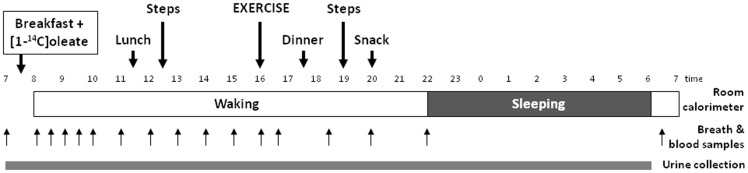
We measured 24-hr total (whole-room calorimetry) and dietary fat (14C-oleate) oxidation in Sedentary Lean (BMI = 21.5±1.6; n = 10), Sedentary Obese (BMI = 33.6±2.5; n = 9), Sedentary Reduced-Obese (RED-SED; BMI = 26.9±3.7; n = 7) and in Physically Active Reduced-Obese (RED-EX; BMI = 27.3±2.8; n = 12) men and women with or without an acute exercise bout where energy expended during exercise was not replaced.
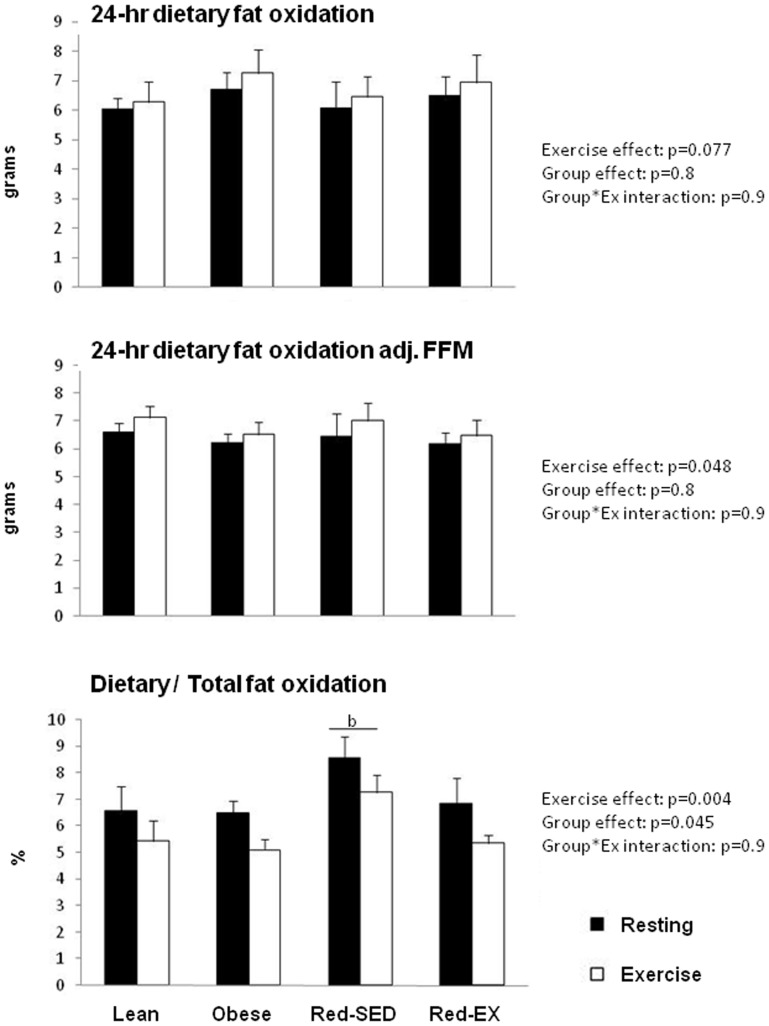
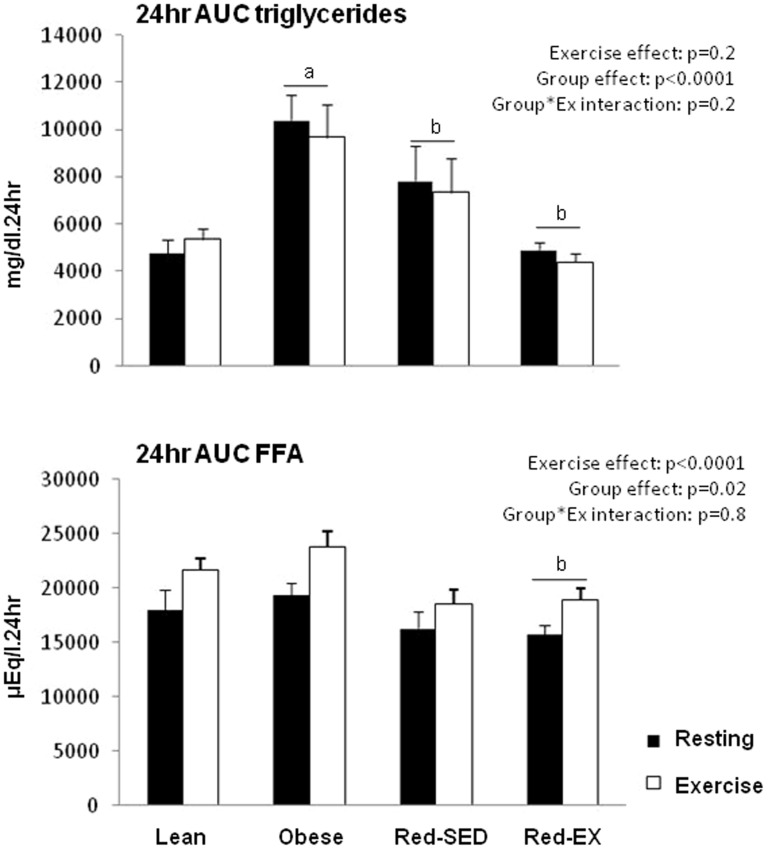
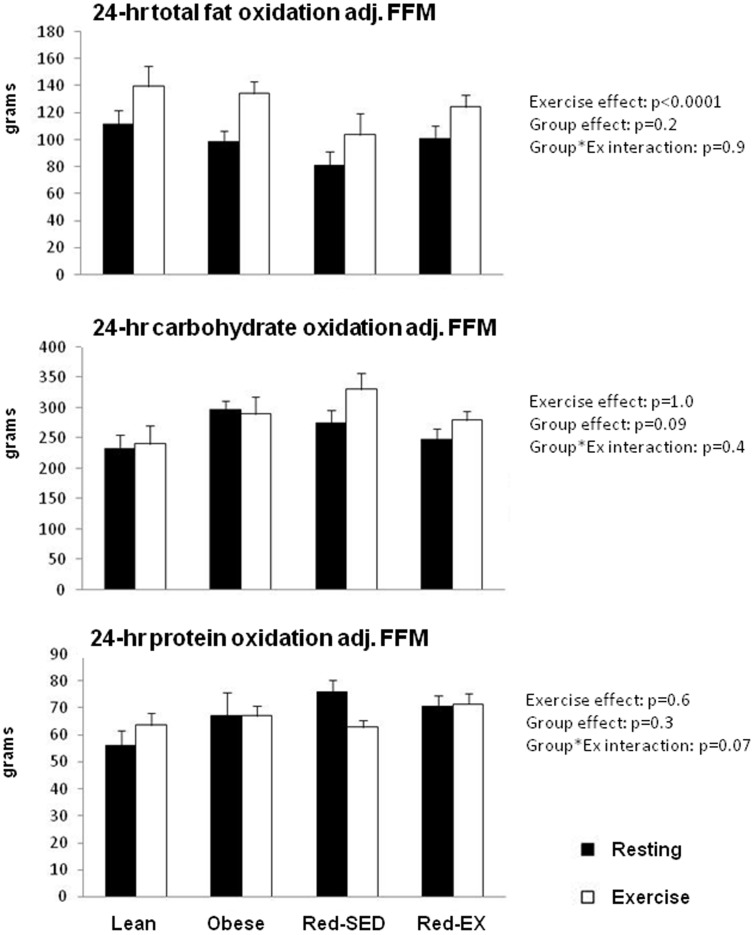
Although Red-SED and Red-EX had a similar level of fatness, aerobic capacity and metabolic profiles were better in Red-EX only compared to Obese subjects. No significant between-group differences were seen in 24-hr respiratory quotient (RQ, Lean: 0.831±0.044, Obese: 0.852±0.023, Red-SED: 0.864±0.037, Red-EX: 0.842±0.039), total and dietary fat oxidation. A single bout of exercise increased total (+27.8%, p<0.0001) and dietary (+6.6%, p = 0.048) fat oxidation across groups. Although exercise did not impact RQ during the day, it decreased RQ during sleep (p = 0.01) in all groups. Red-EX oxidized more fat overnight than Red-SED subjects under both resting (p = 0.036) and negative energy balance (p = 0.003) conditions, even after adjustment for fat-free mass.
Obese and reduced-obese individuals oxidize as much fat as lean both under eucaloric and negative energy balance conditions, which does not support the hypothesis of reduced oxidative capacity in these groups. Reduced-obese individuals who exercise regularly have markers of metabolic health similar to those seen in lean adults. Both the acute and chronic effects of exercise were primarily observed at night suggesting an important role of sleep in the regulation of lipid metabolism.
有假说认为肥胖及减重后的肥胖个体氧化能力下降,这会导致体重增加及体重反弹。近期数据对这一概念提出了挑战。
确定(1)与瘦人相比,肥胖及减重后的肥胖成年人的总脂肪氧化和膳食脂肪氧化是否降低,以及对急性运动的反应是否增加;(2)规律的体育活动是否会减弱这些代谢改变。
我们测量了久坐的瘦人(BMI = 21.5±1.6;n = 10)、久坐的肥胖者(BMI = 33.6±2.5;n = 9)、久坐的减重后的肥胖者(RED-SED;BMI = 26.9±3.7;n = 7)以及有规律运动的减重后的肥胖者(RED-EX;BMI = 27.3±2.8;n = 12)的男性和女性在有或没有急性运动 bout(运动期间消耗的能量未得到补充)情况下的 24 小时总脂肪氧化(全室量热法)和膳食脂肪氧化(14C-油酸)。
尽管 RED-SED 和 RED-EX 的肥胖程度相似,但仅与肥胖受试者相比,RED-EX 的有氧能力和代谢特征更好。在 24 小时呼吸商(RQ,瘦人:0.831±0.044,肥胖者:0.852±0.023,RED-SED:0.864±0.037,RED-EX:0.842±0.039)、总脂肪氧化和膳食脂肪氧化方面,未观察到显著的组间差异。单次运动 bout 使各组的总脂肪氧化(增加 27.8%,p<0.0001)和膳食脂肪氧化(增加 6.6%,p = 0.048)增加。尽管运动在白天不影响 RQ,但在所有组中,运动使睡眠期间的 RQ 降低(p = 0.01)。即使在调整了去脂体重后,在静息(p = 0.036)和负能量平衡(p = 0.003)条件下,RED-EX 夜间氧化的脂肪都比 RED-SED 受试者多。
肥胖及减重后的肥胖个体在等热量和负能量平衡条件下氧化的脂肪与瘦人一样多,这并不支持这些组氧化能力降低的假说。有规律运动的减重后的肥胖个体具有与瘦成年人相似的代谢健康标志物。运动的急性和慢性影响主要在夜间观察到,表明睡眠在脂质代谢调节中起重要作用。