CSIRO Plant Industry Canberra, ACT, Australia.
The Sainsbury Laboratory, Norwich Research Park Norwich, UK.
Front Plant Sci. 2014 Mar 24;5:98. doi: 10.3389/fpls.2014.00098. eCollection 2014.
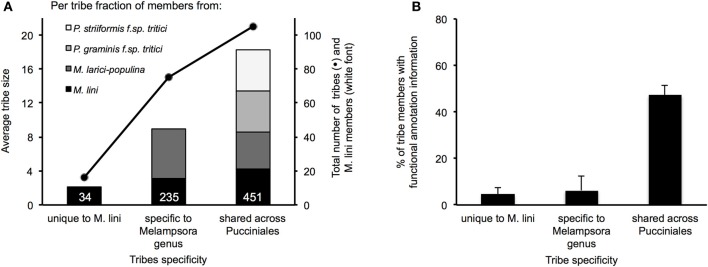
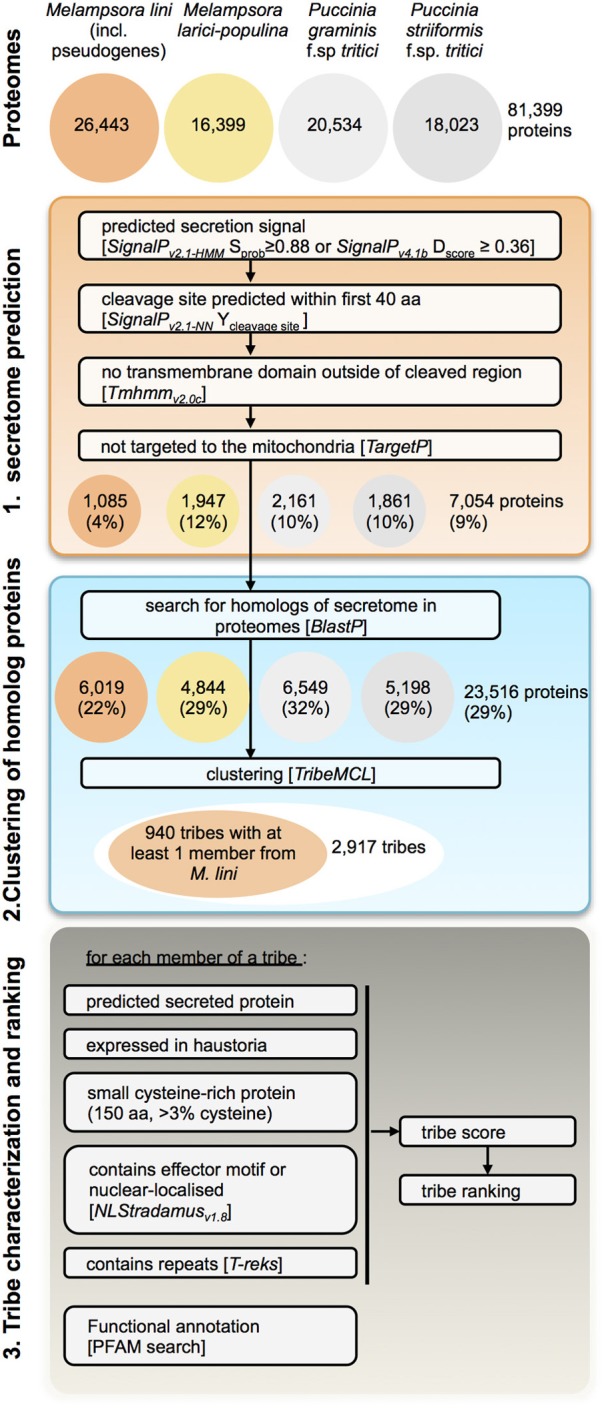
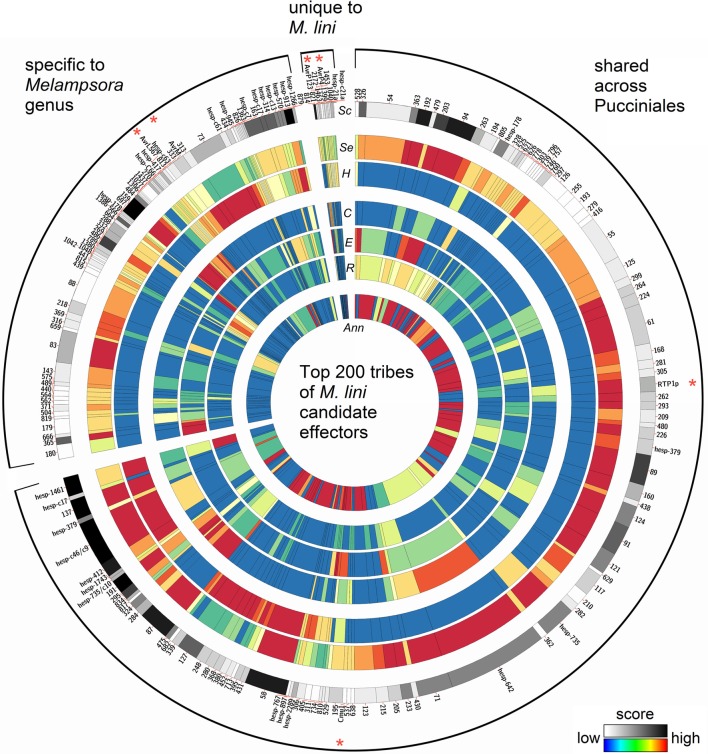
Rust fungi cause serious yield reductions on crops, including wheat, barley, soybean, coffee, and represent real threats to global food security. Of these fungi, the flax rust pathogen Melampsora lini has been developed most extensively over the past 80 years as a model to understand the molecular mechanisms that underpin pathogenesis. During infection, M. lini secretes virulence effectors to promote disease. The number of these effectors, their function and their degree of conservation across rust fungal species is unknown. To assess this, we sequenced and assembled de novo the genome of M. lini isolate CH5 into 21,130 scaffolds spanning 189 Mbp (scaffold N50 of 31 kbp). Global analysis of the DNA sequence revealed that repetitive elements, primarily retrotransposons, make up at least 45% of the genome. Using ab initio predictions, transcriptome data and homology searches, we identified 16,271 putative protein-coding genes. An analysis pipeline was then implemented to predict the effector complement of M. lini and compare it to that of the poplar rust, wheat stem rust and wheat stripe rust pathogens to identify conserved and species-specific effector candidates. Previous knowledge of four cloned M. lini avirulence effector proteins and two basidiomycete effectors was used to optimize parameters of the effector prediction pipeline. Markov clustering based on sequence similarity was performed to group effector candidates from all four rust pathogens. Clusters containing at least one member from M. lini were further analyzed and prioritized based on features including expression in isolated haustoria and infected leaf tissue and conservation across rust species. Herein, we describe 200 of 940 clusters that ranked highest on our priority list, representing 725 flax rust candidate effectors. Our findings on this important model rust species provide insight into how effectors of rust fungi are conserved across species and how they may act to promote infection on their hosts.
锈菌会导致包括小麦、大麦、大豆、咖啡在内的作物严重减产,对全球粮食安全构成了真正的威胁。在这些真菌中,亚麻锈菌病原体麦类亚麻锈菌在过去 80 年中被广泛开发,作为一种理解致病分子机制的模式生物。在感染过程中,M. lini 分泌毒性效应子来促进疾病。这些效应子的数量、功能及其在锈菌物种中的保守程度尚不清楚。为了评估这一点,我们对 M. lini 分离株 CH5 的基因组进行了从头测序和组装,共获得 21130 个支架,跨度为 189 Mbp(支架 N50 为 31 kbp)。对 DNA 序列的全局分析表明,重复元件,主要是逆转录转座子,至少占基因组的 45%。使用从头预测、转录组数据和同源搜索,我们鉴定了 16271 个推定的蛋白质编码基因。然后实施了一个分析管道来预测 M. lini 的效应子组成,并将其与杨树锈菌、小麦秆锈菌和小麦条锈菌的效应子组成进行比较,以鉴定保守和物种特异性的效应子候选物。先前克隆的四个 M. lini 无毒效应蛋白和两个担子菌效应子的知识被用于优化效应子预测管道的参数。基于序列相似性的 Markov 聚类被用于对来自所有四个锈菌病原体的效应子候选物进行分组。包含至少一个 M. lini 成员的簇进一步根据在分离的吸器和感染叶片组织中的表达以及在锈菌物种中的保守性等特征进行分析和优先排序。在此,我们描述了在我们的优先级列表上排名最高的 940 个簇中的 200 个,代表了 725 个亚麻锈菌候选效应子。我们对这个重要的模式锈菌物种的研究结果提供了关于锈菌效应子在物种间如何保守以及它们如何促进感染宿主的见解。