Pfortmueller Carmen A, Kunz Mirco, Lindner Gregor, Zisakis Athanasios, Puig Stefan, Exadaktylos Aristomenis K
Department of General Internal Medicine, University Hospital and University of Bern, 3010 Bern, Switzerland ; Department of Emergency Medicine, University Hospital and University of Bern, 3010 Bern, Switzerland.
Division of Anesthesiology, Cantonal Hospital of Winterthur, 8400 Winterthur, Switzerland.
ScientificWorldJournal. 2014 Mar 2;2014:256519. doi: 10.1155/2014/256519. eCollection 2014.
Throughout the world, falls are a major public health problem and a socioeconomic burden. Nevertheless there is little knowledge about how the injury types may be related to the aetiology and setting of the fall, especially in the elderly. We have therefore analysed all patients presenting with a fall to our Emergency Department (ED) over the past five years.
Our retrospective data analysis comprised adult patients admitted to our Emergency Department between January 1, 2006, and December 31, 2010, in relation to a fall.
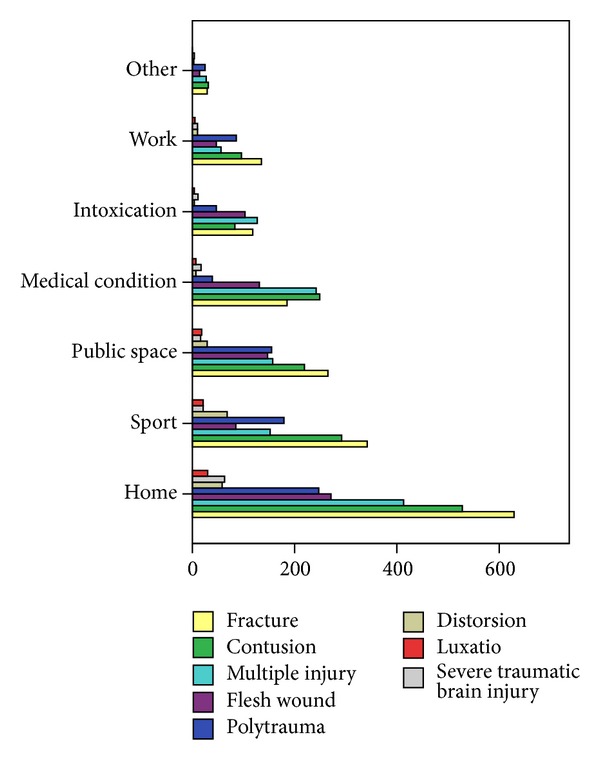
Of a total of 6357 patients 78% (n = 4957) patients were younger than 75 years. The main setting for falls was patients home (n = 2239, 35.3%). In contrast to the younger patients, the older population was predominantly female (56.3% versus 38.6%; P < 0.0001). Older patients were more likely to fall at home and suffer from medical conditions (all P < 0.0001). Injuries to the head (P < 0.0001) and to the lower extremity (P < 0.019) occurred predominantly in the older population. Age was the sole predictor for recurrent falls (OR 1.2, P < 0.0001).
Falls at home are the main class of falls for all age groups, particularly in the elderly. Fall prevention strategies must therefore target activities of daily living. Even though falls related to sports mostly take place in the younger cohort, a significant percentage of elderly patients present with falls related to sporting activity. Falls due to medical conditions were most likely to result in mild traumatic brain injury.
在全球范围内,跌倒都是一个重大的公共卫生问题和社会经济负担。然而,对于损伤类型如何与跌倒的病因及环境相关,人们了解甚少,尤其是在老年人中。因此,我们分析了过去五年间因跌倒前来我院急诊科就诊的所有患者。
我们的回顾性数据分析涵盖了2006年1月1日至2010年12月31日期间因跌倒入住我院急诊科的成年患者。
在总共6357例患者中,78%(n = 4957)的患者年龄小于75岁。跌倒的主要环境是患者家中(n = 2239,35.3%)。与年轻患者相比,老年人群中女性占比更高(56.3%对38.6%;P < 0.0001)。老年患者更有可能在家中跌倒且患有疾病(所有P < 0.0001)。头部损伤(P < 0.0001)和下肢损伤(P < 0.019)主要发生在老年人群中。年龄是反复跌倒的唯一预测因素(比值比1.2,P < 0.0001)。
在家中跌倒是所有年龄组跌倒的主要类型,尤其是在老年人中。因此,预防跌倒策略必须针对日常生活活动。尽管与运动相关的跌倒大多发生在年轻人群中,但仍有相当比例的老年患者因体育活动而跌倒。因疾病导致的跌倒最有可能导致轻度创伤性脑损伤。