Department of Food and Environmental Sciences, University of Helsinki Helsinki, Finland.
Department of Food and Environmental Sciences, University of Helsinki Helsinki, Finland ; Department of Plant Biology and Forest Genetics, Swedish University of Agricultural Sciences Uppsala, Sweden.
Front Plant Sci. 2014 Mar 26;5:110. doi: 10.3389/fpls.2014.00110. eCollection 2014.
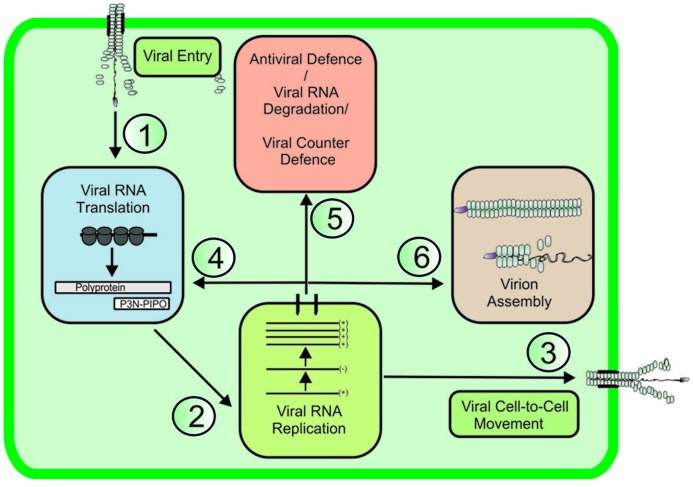
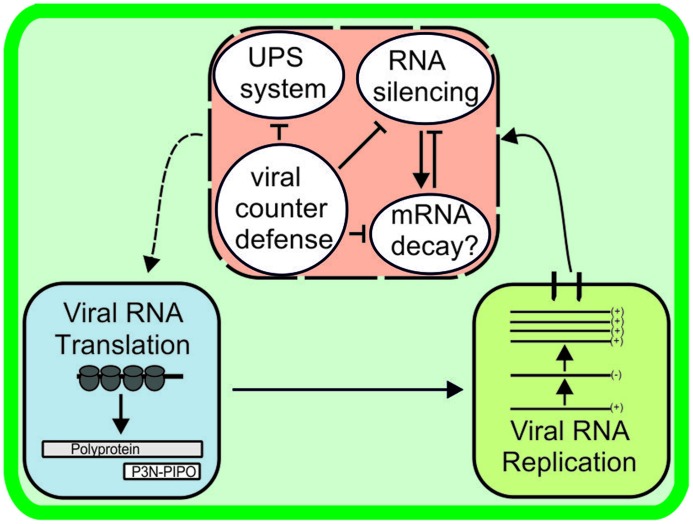
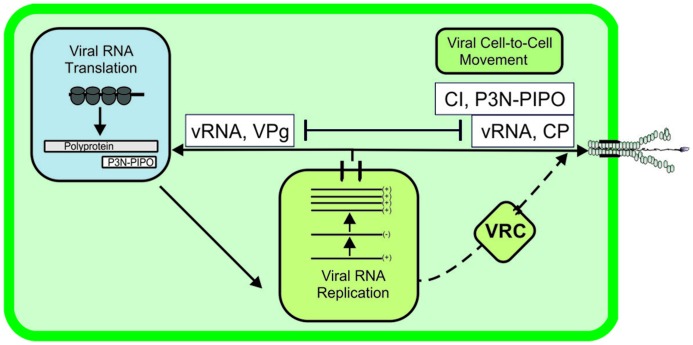
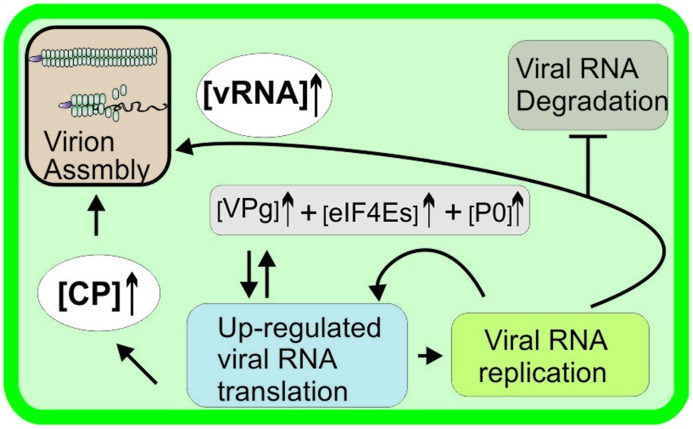
Establishment of an infection cycle requires mechanisms to allocate the genomes of (+)-stranded RNA viruses in a balanced ratio to translation, replication, encapsidation, and movement, as well as mechanisms to prevent translocation of viral RNA (vRNA) to cellular RNA degradation pathways. The ratio of vRNA allocated to various functions is likely balanced by the availability of regulatory proteins or competition of the interaction sites within regulatory ribonucleoprotein complexes. Due to the transient nature of viral processes and the interdependency between vRNA pathways, it is technically demanding to work out the exact molecular mechanisms underlying vRNA regulation. A substantial number of viral and host proteins have been identified that facilitate the steps that lead to the assembly of a functional potyviral RNA replication complex and their fusion with chloroplasts. Simultaneously with on-going viral replication, part of the replicated potyviral RNA enters movement pathways. Although not much is known about the processes of potyviral RNA release from viral replication complexes, the molecular interactions involved in these processes determine the fate of the replicated vRNA. Some viral and host cell proteins have been described that direct replicated potyviral RNA to translation to enable potyviral gene expression and productive infection. The antiviral defense of the cell causes vRNA degradation by RNA silencing. We hypothesize that also plant pathways involved in mRNA decay may have a role in the coordination of potyviral RNA expression. In this review, we discuss the roles of different potyviral and host proteins in the coordination of various potyviral RNA functions.
建立感染周期需要分配机制,以平衡(+)链 RNA 病毒的基因组,使其分配到翻译、复制、包装和运动等功能中,并需要防止病毒 RNA(vRNA)易位到细胞 RNA 降解途径的机制。vRNA 分配到各种功能的比例可能通过调节蛋白的可用性或调节核糖核蛋白复合物内相互作用位点的竞争来平衡。由于病毒过程的短暂性质和 vRNA 途径之间的相互依存关系,因此,要弄清 vRNA 调节的精确分子机制在技术上具有挑战性。已经鉴定出大量的病毒和宿主蛋白,这些蛋白促进了导致功能性马铃薯 Y 病毒 RNA 复制复合物组装及其与叶绿体融合的步骤。在病毒复制进行的同时,部分复制的马铃薯 Y 病毒 RNA 进入运动途径。尽管人们对马铃薯 Y 病毒 RNA 从病毒复制复合物中释放的过程了解甚少,但涉及这些过程的分子相互作用决定了复制 vRNA 的命运。已经描述了一些病毒和宿主细胞蛋白,它们将复制的马铃薯 Y 病毒 RNA 定向到翻译,以实现马铃薯 Y 病毒基因表达和有效感染。细胞的抗病毒防御会通过 RNA 沉默导致 vRNA 降解。我们假设,细胞中参与 mRNA 降解的途径也可能在协调马铃薯 Y 病毒 RNA 表达中发挥作用。在这篇综述中,我们讨论了不同的马铃薯 Y 病毒和宿主蛋白在协调各种马铃薯 Y 病毒 RNA 功能中的作用。