Laboratory of General and Agricultural Microbiology, Department of Crop Science, Agricultural University of Athens Athens, Greece.
Front Plant Sci. 2014 Mar 27;5:114. doi: 10.3389/fpls.2014.00114. eCollection 2014.
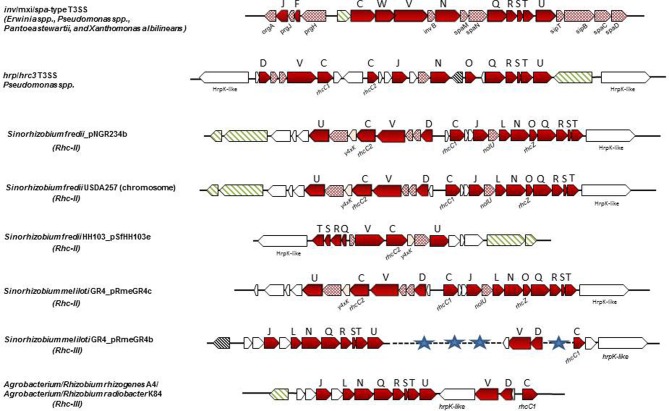
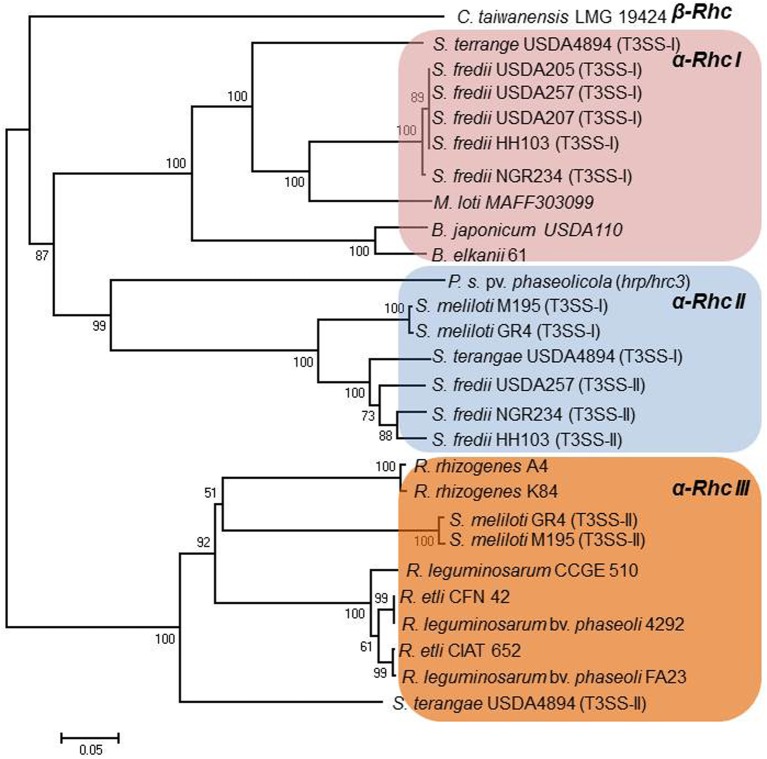
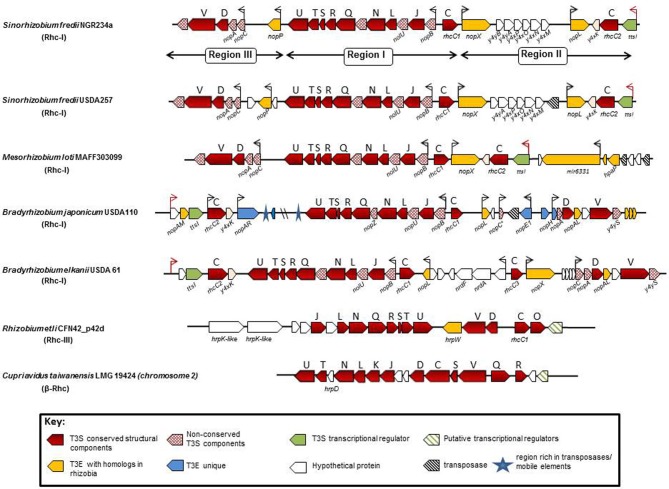
Plant pathogenic bacteria and rhizobia infect higher plants albeit the interactions with their hosts are principally distinct and lead to completely different phenotypic outcomes, either pathogenic or mutualistic, respectively. Bacterial protein delivery to plant host plays an essential role in determining the phenotypic outcome of plant-bacteria interactions. The involvement of type III secretion systems (T3SSs) in mediating animal- and plant-pathogen interactions was discovered in the mid-80's and is now recognized as a multiprotein nanomachine dedicated to trans-kingdom movement of effector proteins. The discovery of T3SS in bacteria with symbiotic lifestyles broadened its role beyond virulence. In most T3SS-positive bacterial pathogens, virulence is largely dependent on functional T3SSs, while in rhizobia the system is dispensable for nodulation and can affect positively or negatively the mutualistic associations with their hosts. This review focuses on recent comparative genome analyses in plant pathogens and rhizobia that uncovered similarities and variations among T3SSs in their genetic organization, regulatory networks and type III secreted proteins and discusses the evolutionary adaptations of T3SSs and type III secreted proteins that might account for the distinguishable phenotypes and host range characteristics of plant pathogens and symbionts.
植物病原细菌和根瘤菌感染高等植物,尽管它们与宿主的相互作用主要是不同的,并分别导致完全不同的表型结果,分别是致病性的或互利共生的。细菌蛋白向植物宿主的输送在决定植物-细菌相互作用的表型结果方面起着至关重要的作用。III 型分泌系统(T3SS)在介导动物和植物病原体相互作用的参与在 80 年代中期被发现,现在被认为是一种专门用于效应蛋白跨王国运动的多蛋白纳米机器。共生生活方式的细菌中 T3SS 的发现拓宽了其作用范围,超出了毒力。在大多数 T3SS 阳性病原菌中,毒力在很大程度上依赖于功能性 T3SS,而在根瘤菌中,该系统对于结瘤是可有可无的,并且可以积极或消极地影响其与宿主的互利共生关系。本综述重点介绍了植物病原体和根瘤菌的最新比较基因组分析,这些分析揭示了它们在遗传组织、调控网络和 III 型分泌蛋白方面的 T3SS 之间的相似性和差异,并讨论了 T3SS 和 III 型分泌蛋白的进化适应,这可能解释了植物病原体和共生体的可区分表型和宿主范围特征。