Li Xianjun, Yang Jian, Gao Jie, Luo Xue, Zhou Zhenyu, Hu Yajie, Wu Ed X, Wan Mingxi
Radiology Department of the First Affiliated Hospital, Xi'an Jiaotong University, Xi'an, Shaanxi, People's Republic of China; Department of Biomedical Engineering, the Key Laboratory of Biomedical Information Engineering of the Ministry of Education, School of Life Science and Technology, Xi'an Jiaotong University, Xi'an, Shaanxi, People's Republic of China.
Radiology Department of the First Affiliated Hospital, Xi'an Jiaotong University, Xi'an, Shaanxi, People's Republic of China.
PLoS One. 2014 Apr 11;9(4):e94592. doi: 10.1371/journal.pone.0094592. eCollection 2014.
The aim of this study was to develop a robust post-processing workflow for motion-corrupted datasets in diffusion kurtosis imaging (DKI).
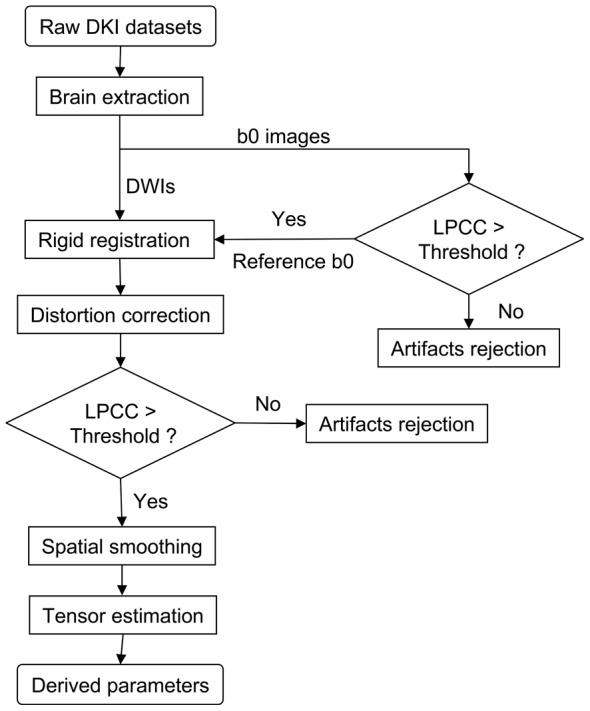
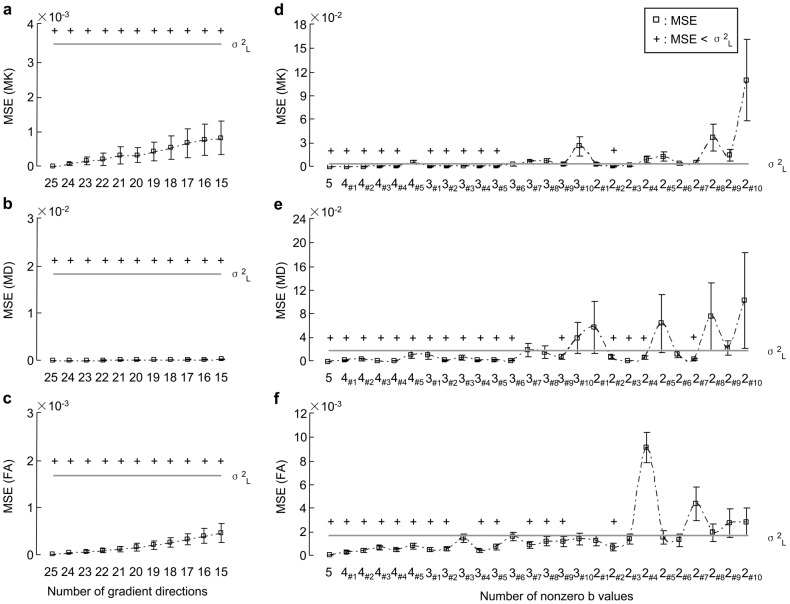
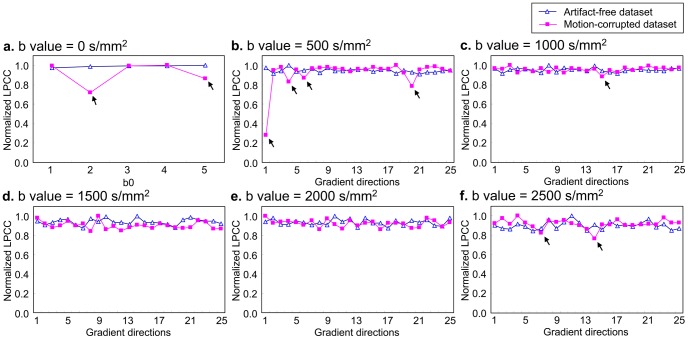
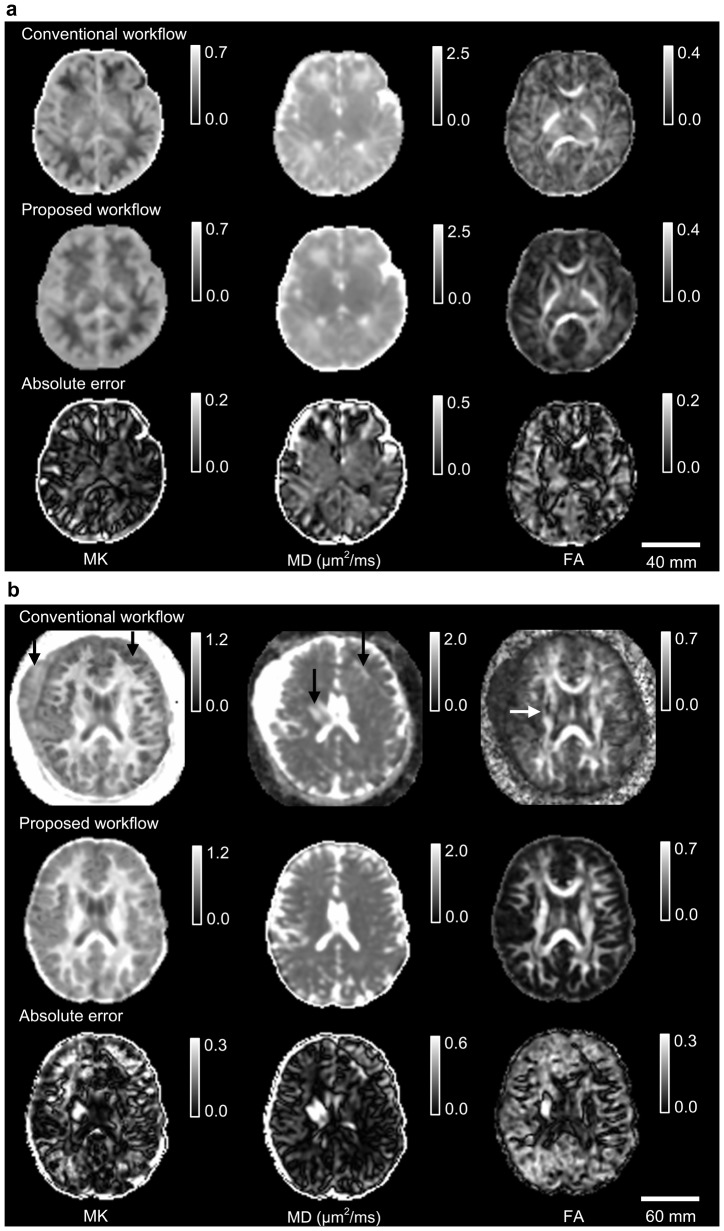
The proposed workflow consisted of brain extraction, rigid registration, distortion correction, artifacts rejection, spatial smoothing and tensor estimation. Rigid registration was utilized to correct misalignments. Motion artifacts were rejected by using local Pearson correlation coefficient (LPCC). The performance of LPCC in characterizing relative differences between artifacts and artifact-free images was compared with that of the conventional correlation coefficient in 10 randomly selected DKI datasets. The influence of rejected artifacts with information of gradient directions and b values for the parameter estimation was investigated by using mean square error (MSE). The variance of noise was used as the criterion for MSEs. The clinical practicality of the proposed workflow was evaluated by the image quality and measurements in regions of interest on 36 DKI datasets, including 18 artifact-free (18 pediatric subjects) and 18 motion-corrupted datasets (15 pediatric subjects and 3 essential tremor patients).
The relative difference between artifacts and artifact-free images calculated by LPCC was larger than that of the conventional correlation coefficient (p<0.05). It indicated that LPCC was more sensitive in detecting motion artifacts. MSEs of all derived parameters from the reserved data after the artifacts rejection were smaller than the variance of the noise. It suggested that influence of rejected artifacts was less than influence of noise on the precision of derived parameters. The proposed workflow improved the image quality and reduced the measurement biases significantly on motion-corrupted datasets (p<0.05).
The proposed post-processing workflow was reliable to improve the image quality and the measurement precision of the derived parameters on motion-corrupted DKI datasets. The workflow provided an effective post-processing method for clinical applications of DKI in subjects with involuntary movements.
本研究的目的是为扩散峰度成像(DKI)中运动受损的数据集开发一种强大的后处理工作流程。
所提出的工作流程包括脑提取、刚性配准、失真校正、伪影去除、空间平滑和张量估计。利用刚性配准来校正错位。通过使用局部皮尔逊相关系数(LPCC)去除运动伪影。在10个随机选择的DKI数据集中,将LPCC在表征伪影与无伪影图像之间相对差异方面的性能与传统相关系数的性能进行了比较。通过使用均方误差(MSE)研究了去除具有梯度方向和b值信息的伪影对参数估计的影响。将噪声方差用作MSE的标准。通过对36个DKI数据集(包括18个无伪影数据集(18名儿科受试者)和18个运动受损数据集(15名儿科受试者和3名特发性震颤患者))的图像质量和感兴趣区域的测量来评估所提出工作流程的临床实用性。
LPCC计算的伪影与无伪影图像之间的相对差异大于传统相关系数的相对差异(p<0.05)。这表明LPCC在检测运动伪影方面更敏感。去除伪影后保留数据的所有导出参数的MSE均小于噪声方差。这表明去除的伪影对导出参数精度的影响小于噪声的影响。所提出的工作流程显著提高了运动受损数据集的图像质量并减少了测量偏差(p<0.05)。
所提出的后处理工作流程对于提高运动受损DKI数据集的图像质量和导出参数的测量精度是可靠的。该工作流程为DKI在非自愿运动受试者中的临床应用提供了一种有效的后处理方法。