Paula Adelzon A, Schechter Mauro, Tuboi Suely H, Faulhaber José Claudio, Luz Paula M, Veloso Valdiléa G, Moreira Ronaldo I, Grinsztejn Beatriz, Harrison Lee H, Pacheco Antonio G
Programa de Computação Científica, Fundação Oswaldo Cruz, Rio de Janeiro, Brasil.
Projeto Praça Onze, Hospital Escola São Francisco de Assis, Universidade Federal do Rio de Janeiro, Rio de Janeiro, Brasil.
PLoS One. 2014 Apr 11;9(4):e94636. doi: 10.1371/journal.pone.0094636. eCollection 2014.
After antiretroviral therapy (ART) became available, there was a decline in the number of deaths in persons infected with HIV. Thereafter, there was a decrease in the proportion of deaths attributed to opportunistic infections and an increase in the proportion of deaths attributed to chronic comorbidities. Herein we extend previous observations from a nationwide survey on temporal trends in causes of death in HIV-infected patients in Brazil.
We describe temporal trends in causes of death among adults who had HIV/AIDS listed in the death certificate to those who did not. All death certificates issued in Brazil from 1999 to 2011 and listed in the national mortality database were included. Generalized linear mixed-effects logistic models were used to study temporal trends in proportions.
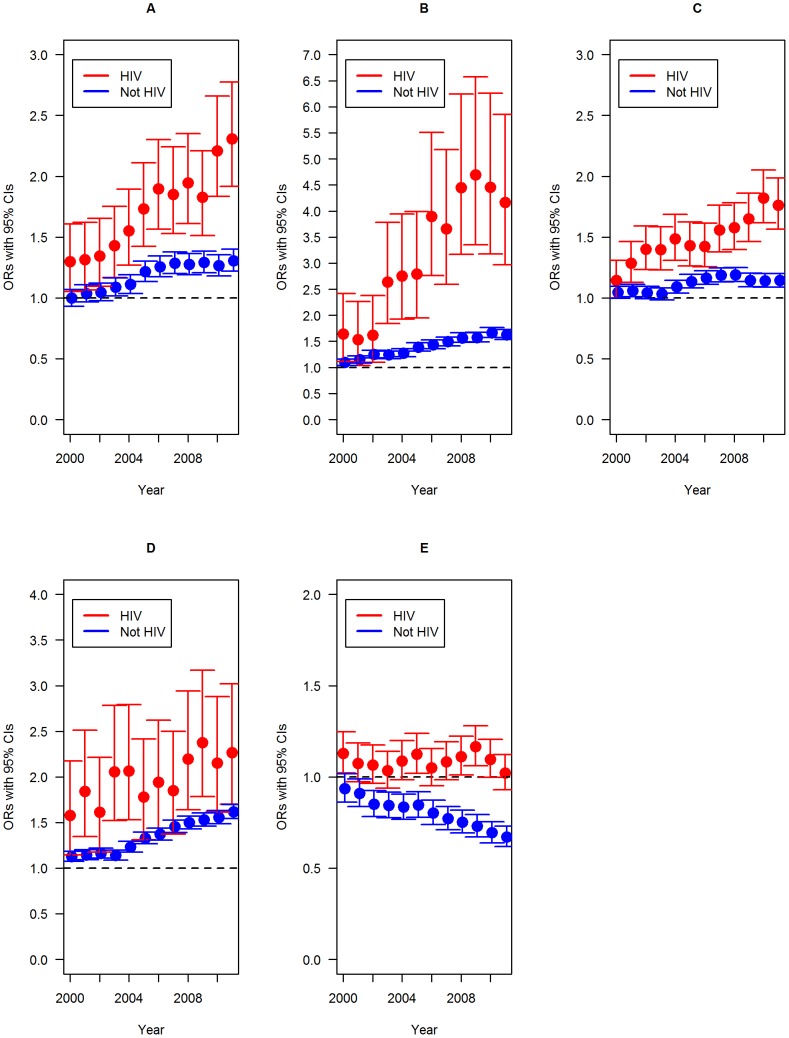
In the HIV-infected population, there was an annual adjusted average increase of 6.0%, 12.0%, 4.0% and 4.1% for cancer, external causes, cardiovascular diseases (CVD) and diabetes mellitus (DM), respectively, compared to 3.0%, 4.0%, 1.0% and 3.9%, in the non-HIV group. For tuberculosis (TB), there was an adjusted average increase of 0.3%/year and a decrease of 3.0%/year in the HIV and the non-HIV groups, respectively. Compared to 1999, the odds ratio (OR) for cancer, external causes, CVD, DM, or TB in the HIV group were, respectively, 2.31, 4.17, 1.76, 2.27 and 1.02, while for the non-HIV group, the corresponding OR were 1.31, 1.63, 1.14, 1.62 and 0.67. Interactions between year as a continuous or categorical variable and HIV were significant (p<0.001) for all conditions, except for DM when year was considered as a continuous variable (p = 0.76).
Non HIV-related co-morbidities continue to increase more rapidly as causes of death among HIV-infected individuals than in those without HIV infection, highlighting the need for targeting prevention measures and surveillance for chronic diseases among those patients.
抗逆转录病毒疗法(ART)问世后,感染艾滋病毒者的死亡人数有所下降。此后,因机会性感染导致的死亡比例下降,而因慢性合并症导致的死亡比例上升。在此,我们扩展了之前一项关于巴西艾滋病毒感染患者死亡原因时间趋势的全国性调查的观察结果。
我们描述了死亡证明上列出患有艾滋病毒/艾滋病的成年人与未列出者之间的死亡原因时间趋势。纳入了1999年至2011年在巴西签发并列入国家死亡率数据库的所有死亡证明。使用广义线性混合效应逻辑模型研究比例的时间趋势。
在艾滋病毒感染人群中,癌症、外部原因、心血管疾病(CVD)和糖尿病(DM)的年调整平均增长率分别为6.0%、12.0%、4.0%和4.1%,而在非艾滋病毒组中分别为3.0%、4.0%、1.0%和3.9%。对于结核病(TB),艾滋病毒组和非艾滋病毒组的调整平均增长率分别为每年0.3%和每年下降3.0%。与1999年相比,艾滋病毒组中癌症、外部原因、CVD、DM或TB的优势比(OR)分别为2.31、4.17、1.76、2.27和1.02,而非艾滋病毒组相应的OR分别为1.31、1.63、1.14、1.62和0.67。除了将年份视为连续变量时糖尿病的情况(p = 0.76)外,年份作为连续或分类变量与艾滋病毒之间的相互作用在所有情况下均具有显著性(p<0.001)。
与艾滋病毒无关的合并症作为艾滋病毒感染者死亡原因的增长速度继续比未感染艾滋病毒者更快,这突出表明需要针对这些患者采取慢性病预防措施和监测。