Department of Urology, National Police Hospital, Seoul, Korea.
Int Neurourol J. 2014 Mar;18(1):37-41. doi: 10.5213/inj.2014.18.1.37. Epub 2014 Mar 31.
To evaluate the correlation between the Visual Prostate Symptom Score (VPSS) and International Prostate Symptom Score (IPSS).
We enrolled 240 new male patients who had visited National Police Hospital more than twice during a 6-month period starting from July 2013. At initial visit, the Korean version of the IPSS and VPSS, uroflowmetry, and transrectal ultrasonography were used to evaluate urinary symptoms. After medication, IPSS and VPSS questionnaires were issued again. The Spearman correlation test and the Mantel-Haenszel test were used to evaluate the relationship between the IPSS and VPSS.
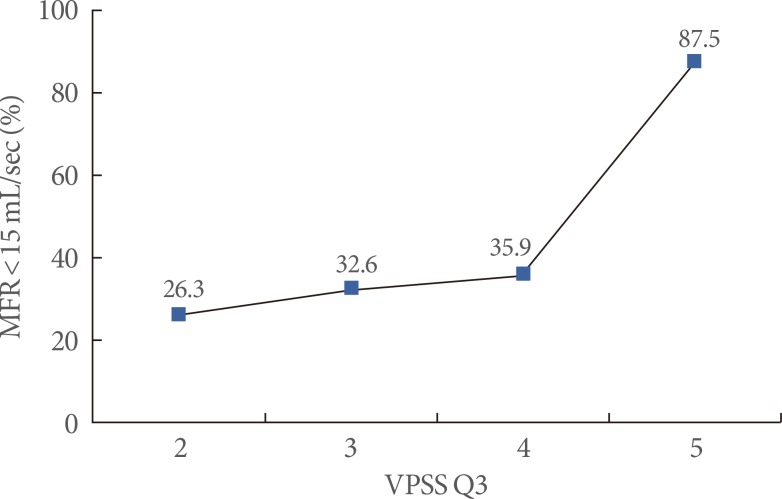
The median age, total prostate volume, total IPSS, and total VPSS were 59.0 years, 28.0 mL, 12, and 9, respectively. Total VPSS, VPSS obstructive symptoms, VPSS irritative symptoms, and VPSS quality of life (QoL) significantly correlated with the total IPSS, IPSS obstructive symptoms, IPSS irritative symptoms, and IPSS QoL, respectively (correlation coefficient, P-value: 0.632, <0.001; 0.431, <0.001; 0.696, <0.001; and 0.799, <0.001; respectively). The change in the total IPSS after treatment also significantly correlated with the change in total VPSS after treatment (correlation coefficient, P-value: 0.364, <0.001). There were significant correlations between maximal flow rate and IPSS/VPSS obstructive symptoms (correlation coefficient, P-value: -0.190, 0.004; -0.269, <0.001, respectively). Additionally, there was a significant increase in the ratio of the maximal flow rate <15 mL/sec to VPSS obstructive symptoms as the severity of the VPSS obstructive symptoms increased (P trend <0.001).
VPSS might be useful in evaluating lower urinary tract symptoms at the initial visit and assessing these symptoms at longitudinal follow-up examinations.
评估视觉前列腺症状评分(VPSS)与国际前列腺症状评分(IPSS)之间的相关性。
我们招募了 240 名新的男性患者,他们在 2013 年 7 月开始的 6 个月期间内,至少两次到国立警察医院就诊。在初次就诊时,使用韩文版 IPSS 和 VPSS、尿流率测定和经直肠超声检查来评估尿路症状。用药后,再次发放 IPSS 和 VPSS 问卷。使用 Spearman 相关检验和 Mantel-Haenszel 检验来评估 IPSS 和 VPSS 之间的关系。
中位年龄、总前列腺体积、总 IPSS 和总 VPSS 分别为 59.0 岁、28.0mL、12 和 9。总 VPSS、VPSS 梗阻症状、VPSS 刺激症状和 VPSS 生活质量(QoL)与总 IPSS、IPSS 梗阻症状、IPSS 刺激症状和 IPSS QoL 分别显著相关(相关系数,P 值:0.632,<0.001;0.431,<0.001;0.696,<0.001;0.799,<0.001)。治疗后总 IPSS 的变化也与治疗后总 VPSS 的变化显著相关(相关系数,P 值:0.364,<0.001)。最大尿流率与 IPSS/VPSS 梗阻症状之间存在显著相关性(相关系数,P 值:-0.190,0.004;-0.269,<0.001)。此外,随着 VPSS 梗阻症状的严重程度增加,最大尿流率<15mL/sec 与 VPSS 梗阻症状的比值显著增加(趋势 P <0.001)。
VPSS 可能有助于在初始就诊时评估下尿路症状,并在纵向随访检查中评估这些症状。