Faculty of Veterinary Medicine, Parasitology and Parasitic Diseases Department, University of Agricultural Science and Veterinary Medicine Cluj Napoca, 3-5 Calea Mănăştur, 400372 Cluj-Napoca, Romania.
Acta Vet Scand. 2014 Apr 15;56(1):22. doi: 10.1186/1751-0147-56-22.
Intensive poultry production systems depend on chemoprophylaxis with anticoccidial drugs to combat infection. A floor-pen study was conducted to evaluate the anticoccidial effect of Artemisia annua and Foeniculum vulgare on Eimeria tenella infection. Five experimental groups were established: negative control (untreated, unchallenged); positive control (untreated, challenged); a group medicated with 125 ppm lasalocid and challenged; a group medicated with A. annua leaf powder at 1.5% in feed and challenged; and a group treated with the mixed oils of A. annua and Foeniculum vulgare in equal parts, 7.5% in water and challenged. The effects of A. annua and oil extract of A. annua + F. vulgare on E. tenella infection were assessed by clinical signs, mortality, fecal oocyst output, faeces, lesion score, weight gain, and feed conversion.
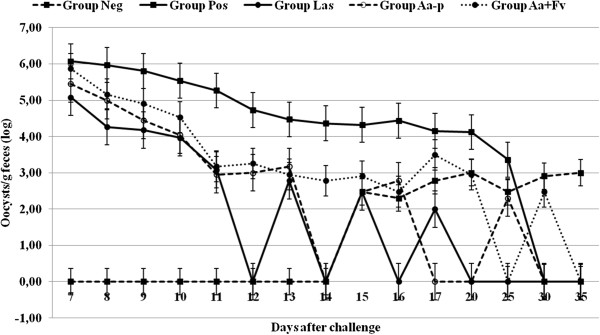
Clinical signs were noticed only in three chickens from the lasalocid group, six from the A. annua group, and nine from the A. annua + F. vulgare group, but were present in 19 infected chickens from the positive control group. Bloody diarrhea was registered in only two chickens from A. annua group, but in 17 chickens from the positive control group. Mortality also occurred in the positive control group (7/20). Chickens treated with A. annua had a significant reduction in faecal oocysts (95.6%; P = 0.027) and in lesion score (56.3%; P = 0.005) when compared to the positive control. At the end of experiment, chickens treated with A. annua leaf powder had the highest body weight gain (68.2 g/day), after the negative control group, and the best feed conversion (1.85) among all experimental groups.
Our results suggest that A. annua leaf powder (Aa-p), at 1.5% of the daily diet post-infection, can be a valuable alternative for synthetic coccidiostats, such as lasalocid.
集约化家禽生产系统依赖于抗球虫药物的化学预防来对抗感染。进行了一项地面围栏研究,以评估青蒿和茴香对柔嫩艾美耳球虫感染的抗球虫效果。建立了五个实验组:阴性对照(未处理、未挑战);阳性对照(未处理、挑战);用 125ppm 拉沙里菌素处理并挑战的组;用 1.5%饲料中添加青蒿叶粉并挑战的组;以及用青蒿和茴香等份混合油处理,7.5%水并挑战的组。通过临床症状、死亡率、粪便卵囊排出量、粪便、病变评分、体重增加和饲料转化率评估青蒿和青蒿+茴香油提取物对柔嫩艾美耳球虫感染的影响。
仅在拉沙里菌素组的三只鸡、青蒿组的六只鸡和青蒿+茴香组的九只鸡中观察到临床症状,但在阳性对照组的 19 只感染鸡中均存在。仅在青蒿组的两只鸡中出现血性腹泻,但在阳性对照组的 17 只鸡中出现。阳性对照组也发生了死亡(7/20)。与阳性对照组相比,用青蒿治疗的鸡粪便卵囊减少(95.6%;P=0.027)和病变评分(56.3%;P=0.005)显著降低。实验结束时,用青蒿叶粉处理的鸡体重增加最高(68.2g/天),仅次于阴性对照组,在所有实验组中饲料转化率最佳(1.85)。
我们的结果表明,青蒿叶粉(Aa-p)在感染后每日饮食的 1.5%,可以作为合成抗球虫药(如拉沙里菌素)的有价值替代品。