Mick Virginie, Le Carrou Gilles, Corde Yannick, Game Yvette, Jay Maryne, Garin-Bastuji Bruno
Paris-Est University/Anses, EU/OIE/FAO & National Reference Laboratory for Brucellosis, Animal Health Laboratory, Maisons-Alfort, France.
Departmental Veterinary Laboratory of Savoie (LDAV 73), Chambery, France.
PLoS One. 2014 Apr 14;9(4):e94168. doi: 10.1371/journal.pone.0094168. eCollection 2014.
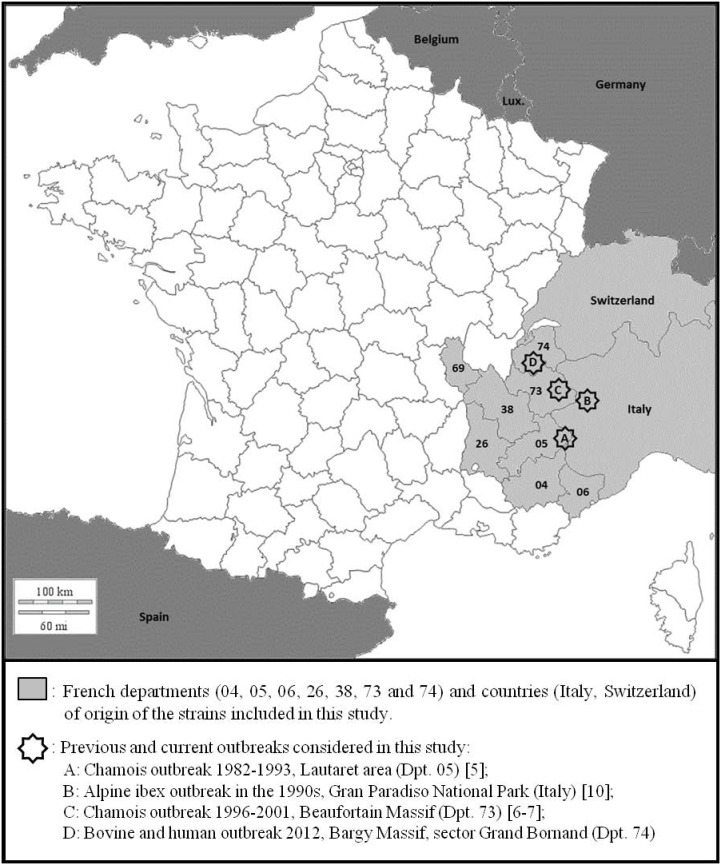
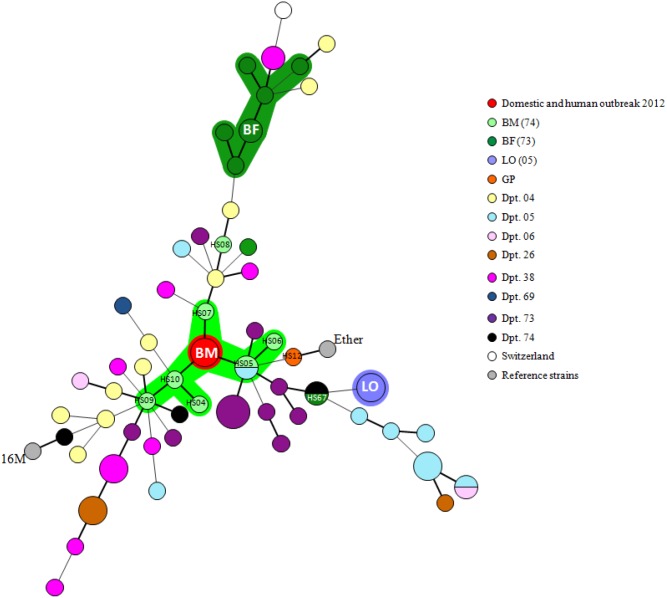
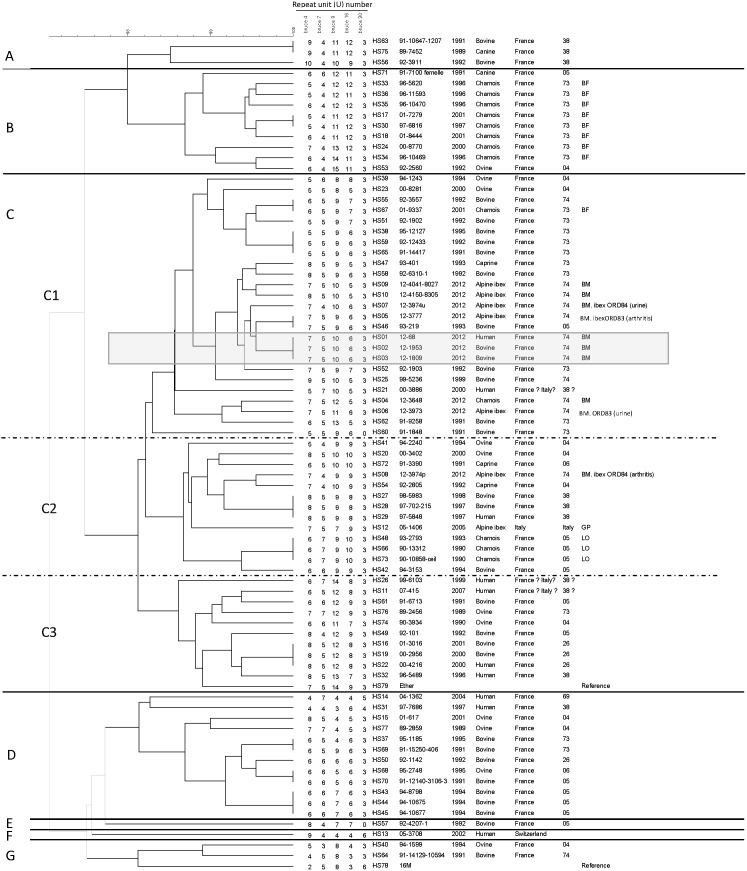
Bovine brucellosis is a major zoonosis, mainly caused by Brucella abortus, more rarely by Brucella melitensis. France has been bovine brucellosis officially-free since 2005 with no cases reported in domestic/wild ruminants since 2003. In 2012, bovine and autochthonous human cases due to B. melitensis biovar 3 (Bmel3) occurred in the French Alps. Epidemiological investigations implemented in wild and domestic ruminants evidenced a high seroprevalence (>45%) in Alpine ibex (Capra ibex); no cases were disclosed in other domestic or wild ruminants, except for one isolated case in a chamois (Rupicapra rupicapra). These results raised the question of a possible persistence/emergence of Brucella in wildlife. The purpose of this study was to assess genetic relationships among the Bmel3 strains historically isolated in humans, domestic and wild ruminants in Southeastern France, over two decades, by the MLVA-panel2B assay, and to propose a possible explanation for the origin of the recent bovine and human infections. Indeed, this genotyping strategy proved to be efficient for this microepidemiological investigation using an interpretation cut-off established for a fine-scale setting. The isolates, from the 2012 domestic/human outbreak harbored an identical genotype, confirming a recent and direct contamination from cattle to human. Interestingly, they clustered not only with isolates from wildlife in 2012, but also with local historical domestic isolates, in particular with the 1999 last bovine case in the same massif. Altogether, our results suggest that the recent bovine outbreak could have originated from the Alpine ibex population. This is the first report of a B. melitensis spillover from wildlife to domestic ruminants and the sustainability of the infection in Alpine ibex. However, this wild population, reintroduced in the 1970s in an almost closed massif, might be considered as a semi-domestic free-ranging herd. Anthropogenic factors could therefore account with the high observed intra-species prevalence.
牛布鲁氏菌病是一种主要的人畜共患病,主要由流产布鲁氏菌引起,较少由羊种布鲁氏菌引起。自2005年以来,法国已实现牛布鲁氏菌病官方无疫,自2003年以来,在国内/野生反刍动物中未报告病例。2012年,法国阿尔卑斯山发生了由羊种布鲁氏菌生物变种3(Bmel3)引起的牛和本地人类病例。在野生和家养反刍动物中进行的流行病学调查显示,阿尔卑斯野生山羊(Capra ibex)的血清阳性率很高(>45%);在其他家养或野生反刍动物中未发现病例,只有一只岩羚羊(Rupicapra rupicapra)有一例孤立病例。这些结果引发了布鲁氏菌在野生动物中可能持续存在/出现的问题。本研究的目的是通过MLVA-panel2B检测评估过去二十多年来在法国东南部人类、家养和野生反刍动物中历史分离的Bmel3菌株之间的遗传关系,并对近期牛和人类感染的起源提出可能的解释。事实上,这种基因分型策略被证明对于使用为精细规模设定的解释阈值的这种微观流行病学调查是有效的。2012年国内/人类疫情中的分离株具有相同的基因型,证实了近期牛对人的直接污染。有趣的是,它们不仅与2012年野生动物的分离株聚类,还与当地历史家养分离株聚类,特别是与同一地块1999年最后一例牛病例的分离株聚类。总之,我们的结果表明,近期的牛疫情可能起源于阿尔卑斯野生山羊种群。这是羊种布鲁氏菌从野生动物溢出到家养反刍动物以及在阿尔卑斯野生山羊中感染可持续性的首次报告。然而,这个在20世纪70年代重新引入几乎封闭地块的野生种群可能被视为半家养的自由放养畜群。因此,人为因素可能是观察到的高种内流行率的原因。