Wen Duancheng, Saiz Nestor, Rosenwaks Zev, Hadjantonakis Anna-Katerina, Rafii Shahin
Ansary Stem Cell Institute and Department of Genetic Medicine, Weill Cornell Medical College, New York, New York, United States of America; Ronald O. Perelman and Claudia Cohen Center for Reproductive Medicine, Weill Cornell Medical College, New York, New York, United States of America.
Developmental Biology Program, Sloan Kettering Institute, New York, New York, United States of America.
PLoS One. 2014 Apr 14;9(4):e94730. doi: 10.1371/journal.pone.0094730. eCollection 2014.
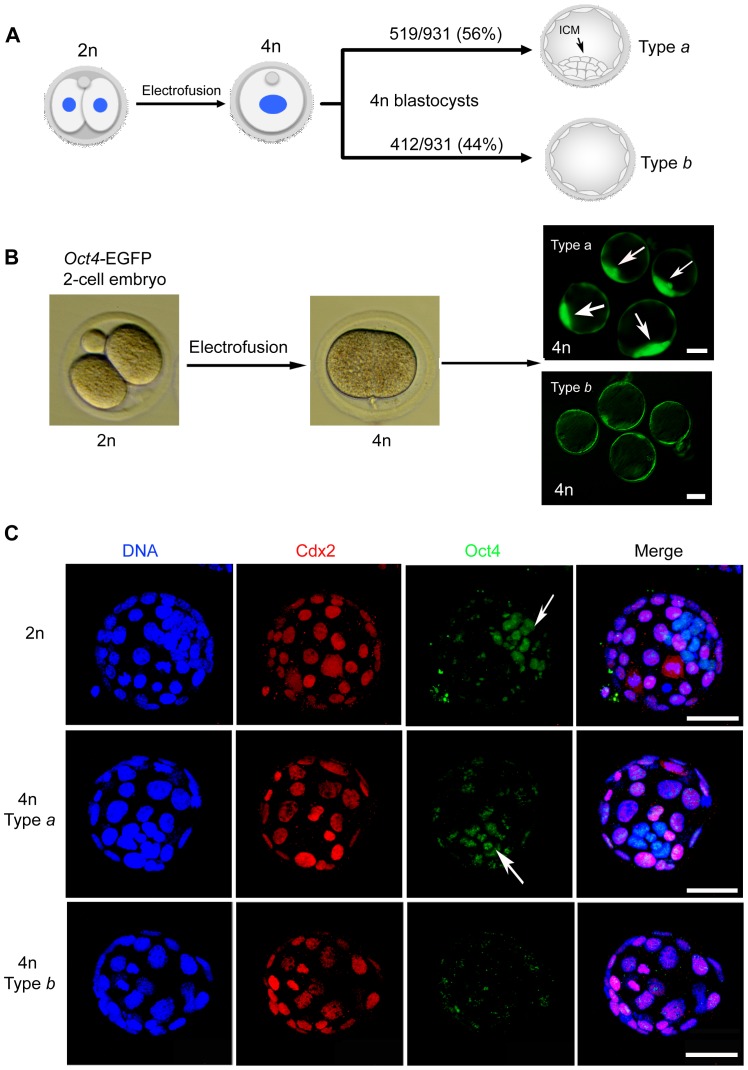
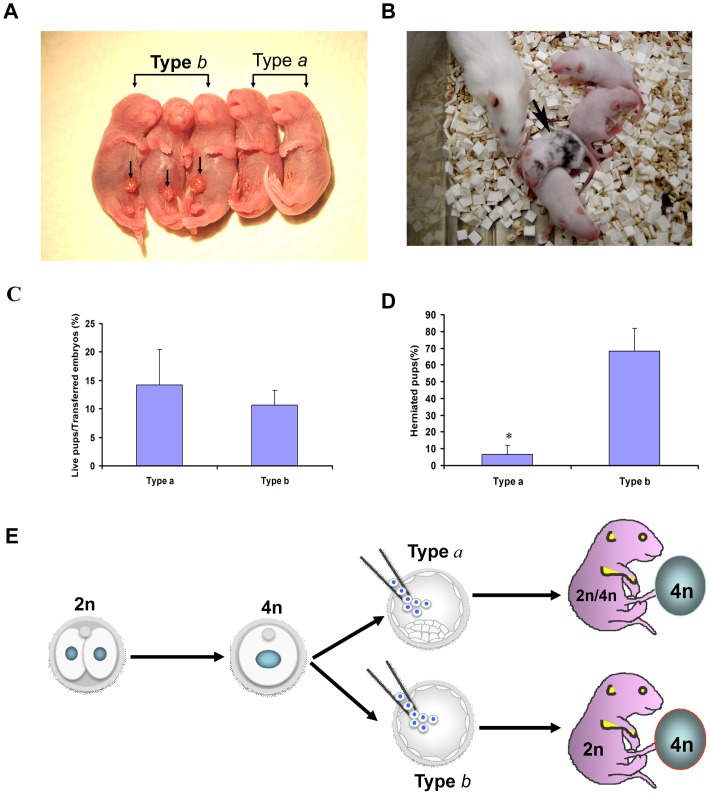
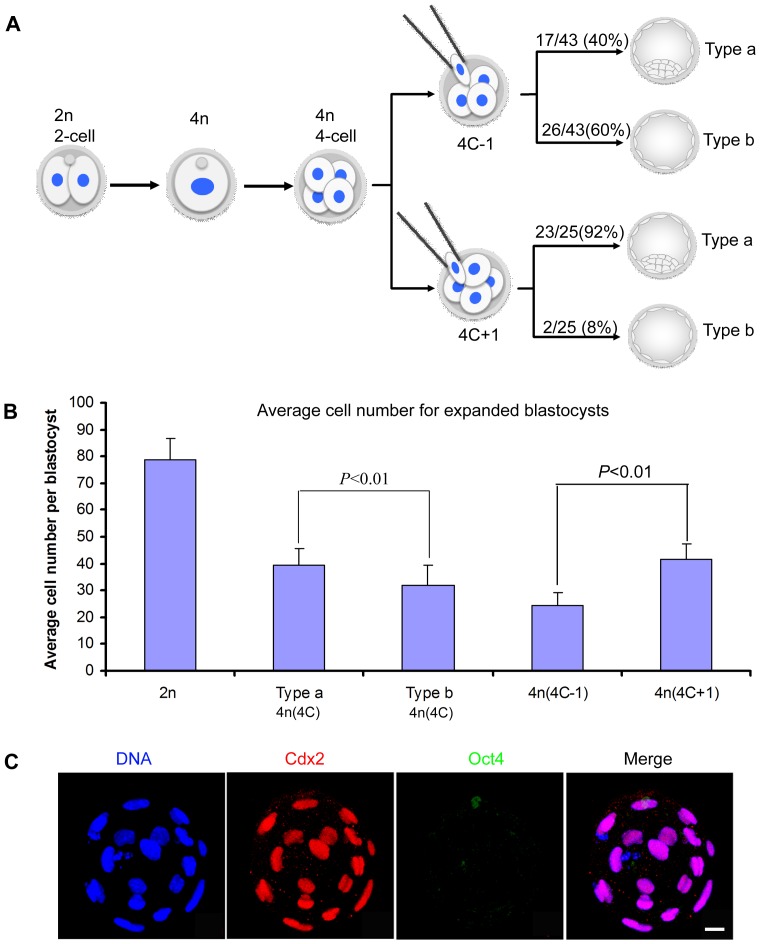
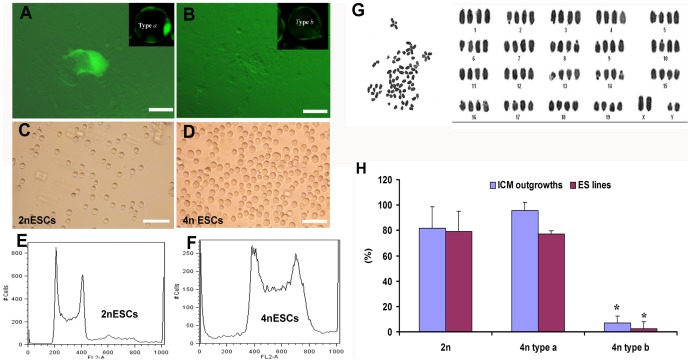
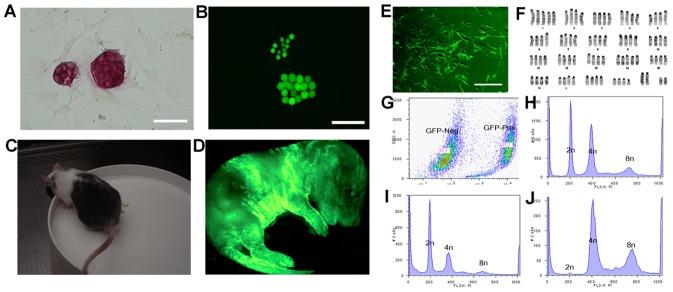
Tetraploid complementation is often used to produce mice from embryonic stem cells (ESCs) by injection of diploid (2n) ESCs into tetraploid (4n) blastocysts (ESC-derived mice). This method has also been adapted to mouse cloning and the derivation of mice from induced pluripotent stem (iPS) cells. However, the underlying mechanism(s) of the tetraploid complementation remains largely unclear. Whether this approach can give rise to completely ES cell-derived mice is an open question, and has not yet been unambiguously proven. Here, we show that mouse tetraploid blastocysts can be classified into two groups, according to the presence or absence of an inner cell mass (ICM). We designate these as type a (presence of ICM at blastocyst stage) or type b (absence of ICM). ESC lines were readily derived from type a blastocysts, suggesting that these embryos retain a pluripotent epiblast compartment; whereas the type b blastocysts possessed very low potential to give rise to ESC lines, suggesting that they had lost the pluripotent epiblast. When the type a blastocysts were used for tetraploid complementation, some of the resulting mice were found to be 2n/4n chimeric; whereas when type b blastocysts were used as hosts, the resulting mice are all completely ES cell-derived, with the newborn pups displaying a high frequency of abdominal hernias. Our results demonstrate that completely ES cell-derived mice can be produced using ICM-deficient 4n blastocysts, and provide evidence that the exclusion of tetraploid cells from the fetus in 2n/4n chimeras can largely be attributed to the formation of ICM-deficient blastocysts.
四倍体互补技术常用于通过将二倍体(2n)胚胎干细胞(ESC)注射到四倍体(4n)囊胚中来培育小鼠(ESC衍生小鼠)。该方法也已应用于小鼠克隆以及从诱导多能干细胞(iPS)中培育小鼠。然而,四倍体互补的潜在机制在很大程度上仍不清楚。这种方法是否能产生完全由ES细胞衍生的小鼠仍是一个悬而未决的问题,尚未得到明确证实。在此,我们表明,根据内细胞团(ICM)的有无,小鼠四倍体囊胚可分为两组。我们将其指定为a型(囊胚期存在ICM)或b型(不存在ICM)。ESC系很容易从a型囊胚中获得,这表明这些胚胎保留了一个多能性上胚层区室;而b型囊胚产生ESC系的潜力非常低,这表明它们已经失去了多能性上胚层。当a型囊胚用于四倍体互补时,发现一些所产生的小鼠是2n/4n嵌合体;而当b型囊胚用作宿主时,所产生的小鼠全部完全由ES细胞衍生,新生幼崽出现腹疝的频率很高。我们的结果表明,使用缺乏ICM的4n囊胚可以产生完全由ES细胞衍生的小鼠,并提供证据表明,在2n/4n嵌合体中,四倍体细胞从胎儿中排除很大程度上可归因于缺乏ICM的囊胚的形成。