Košťál Milan, Bláha Milan, Rencová Eva, Lánská Miriam, Rozsíval Pavel, Kratochvilová Vera, Langrová Hana
IVth Department of Internal Medicine-Hematology, Faculty Hospital, Faculty of Medicine in Hradec Králové-Charles University in Prague, Sokolska Street 581, 500 05 Hradec Králové, Czech Republic.
Department of Ophthalmology, Faculty Hospital, Faculty of Medicine in Hradec Králové-Charles University in Prague, Sokolska Street 581, 500 05 Hradec Králové, Czech Republic.
Biomed Res Int. 2014;2014:858219. doi: 10.1155/2014/858219. Epub 2014 Mar 6.
Rheohemapheresis (RHF) is a method that can stop the activity of the dry form of age-related macular degeneration (AMD). The pathophysiologic mechanisms are not well understood, and the effects of the RHF procedures extend beyond the time of the individual procedures.
We present the data for 46 patients with AMD treated with a series of 8 rheohemapheretic procedures. Blood count parameters were measured before the first and the last procedures. The clinical effect was judged by changes in the drusenoid pigment epithelium detachment (DPED) area before and after the rheopheretic sessions.
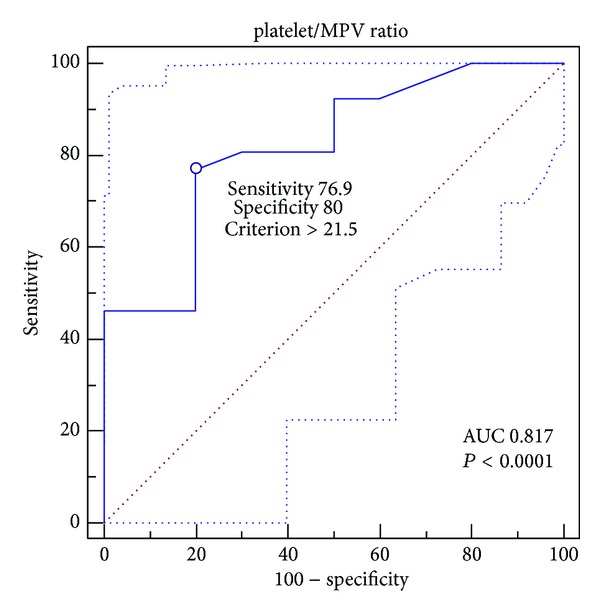
Rheopheresis caused a decrease in hemoglobin (P<0.001), a decrease in leukocytes (P<0.034), and an increase in platelets (P<0.005). We found a negative correlation between the amount of platelets and their volume (P<0.001, Pearson correlation coefficient: -0.509). We identified the platelet/MPV ratio as a good predictor of the clinical outcome. Patients with a platelet/MPV ratio greater than 21.5 (before the last rheopheresis) had a significantly better outcome (P=0.003, sensitivity of 76.9% and specificity of 80%).
Several basic blood count parameters after RHF can be concluded to significantly change, with some of those changes correlating with the clinical results (reduction of the DPED area).
血液成分单采置换术(RHF)是一种能够阻止干性年龄相关性黄斑变性(AMD)进展的方法。其病理生理机制尚不完全清楚,且血液成分单采置换术的效果在单次治疗后仍会持续。
我们呈现了46例接受了一系列8次血液成分单采置换术治疗的AMD患者的数据。在首次和末次治疗前测量血常规参数。通过血液成分单采置换术前、后类玻璃膜疣色素上皮脱离(DPED)面积的变化来判断临床疗效。
血液成分单采置换术导致血红蛋白降低(P<0.001)、白细胞减少(P<0.034)以及血小板增加(P<0.005)。我们发现血小板数量与其体积之间呈负相关(P<0.001,Pearson相关系数:-0.509)。我们确定血小板/平均血小板体积(MPV)比值是临床结局的良好预测指标。血小板/MPV比值大于21.5(末次血液成分单采置换术前)的患者结局明显更好(P=0.003,敏感性为76.9%,特异性为80%)。
可以得出结论,血液成分单采置换术后多项基本血常规参数会发生显著变化,其中一些变化与临床结果(DPED面积减小)相关。