McCaffrey Nikki, Skuza Pawel, Breaden Katrina, Eckermann Simon, Hardy Janet, Oaten Sheila, Briffa Michael, Currow David
Flinders Centre for Clinical Change and Health Care Research, Flinders University, Daw Park, South Australia, Australia.
2eResearch@Flinders, Central Library, Flinders University, Bedford Park, South Australia, Australia.
PLoS One. 2014 Apr 15;9(4):e94316. doi: 10.1371/journal.pone.0094316. eCollection 2014.
The ability of patients to finalise their affairs at the end of life is an often neglected aspect of quality of life (QOL) measurement in palliative care effectiveness research despite compelling evidence of the high value patients place on this domain.
This paper describes the preliminary development and evaluation of a new, single-item, end-of-life patient-reported outcome measure (EOLPRO) designed to capture changes in the ability of patients to finalise their affairs at the end of life.
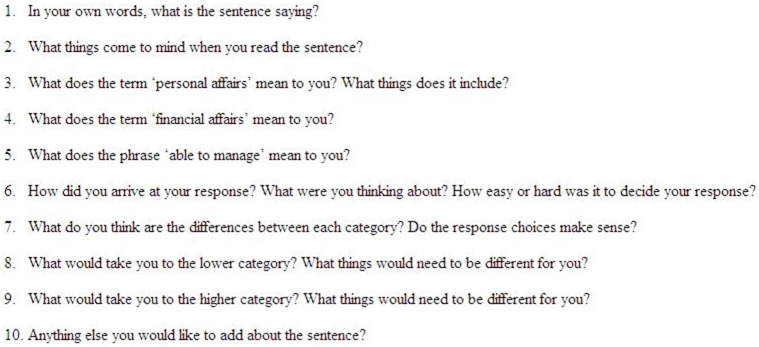
Cognitive interviews with purposively sampled Australian palliative care patients (N = 9) were analysed thematically to explore content validity. Simultaneously, secondary analysis of data from a randomised controlled trial comparing ketamine and placebo for the management of cancer pain (N = 185) evaluated: construct validity; test-retest reliability; and responsiveness.
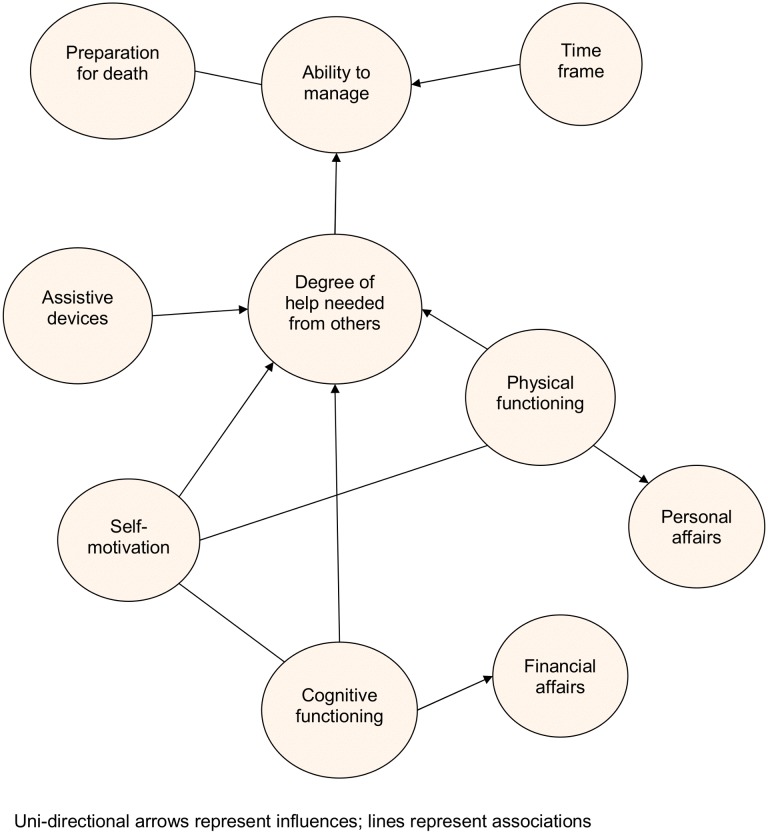
Preliminary findings suggest patients interpret the new measure consistently. The EOLPRO captures the ability to complete physical tasks and finalise practical matters although it is unclear whether emotional tasks or resolution of relationship issues are considered. Personal and financial affairs should be separated to allow for differences in ability for these two types of affairs. The significant correlation between performance status and EOLPRO scores (r = 0.41, p<0.01, n = 137) and expected relationships between EOLPRO and proximity to death and constipation demonstrated construct validity. Pre- and post-treatment EOLPRO scores moderately agreed (n = 14, κ = 0.52 [95% CI 0.19, 0.84]) supporting reliability. The measure's apparent lack of sensitivity to discriminate between treatment responders and non-responders may be confounded.
Based on the preliminary findings, the EOLPRO should be separated into 'personal' and 'financial' affairs with further testing suggested, particularly to verify coverage and responsiveness. Initial evaluation suggests that the single-item EOLPRO is a useful addition to QOL outcome measurement in palliative care effectiveness research because common palliative care specific QOL questionnaires do not include or explicitly capture this domain.
尽管有确凿证据表明患者非常重视临终时安排自身事务的能力,但在姑息治疗效果研究中,这一方面在生活质量(QOL)测量中常常被忽视。
本文描述了一种新的、单项的、患者报告的临终结局测量指标(EOLPRO)的初步开发和评估,该指标旨在捕捉患者在临终时安排自身事务能力的变化。
对有目的地抽取的澳大利亚姑息治疗患者(N = 9)进行认知访谈,并进行主题分析以探索内容效度。同时,对一项比较氯胺酮和安慰剂治疗癌症疼痛的随机对照试验的数据(N = 185)进行二次分析,评估:结构效度;重测信度;以及反应度。
初步研究结果表明患者对新指标的理解一致。EOLPRO能够体现完成身体任务和处理实际事务的能力,不过尚不清楚情感任务或关系问题的解决是否也被纳入考量。个人事务和财务事务应分开,以考虑这两类事务处理能力的差异。功能状态与EOLPRO评分之间存在显著相关性(r = 0.41,p < 0.01,n = 137),且EOLPRO与接近死亡和便秘之间的预期关系证明了结构效度。治疗前后EOLPRO评分有中度一致性(n = 14,κ = 0.52 [95% CI 0.19, 0.84]),支持信度。该指标在区分治疗反应者和无反应者方面明显缺乏敏感性,这可能存在混淆因素。
基于初步研究结果,EOLPRO应分为“个人”和“财务”事务,并建议进一步测试,特别是要验证涵盖范围和反应度。初步评估表明,单项EOLPRO是姑息治疗效果研究中生活质量结局测量的一个有用补充,因为常见的姑息治疗特定生活质量问卷未包括或明确涵盖这一领域。