• 文献检索
  • 文档翻译
  • 深度研究
  • 学术资讯
  • Suppr Zotero 插件Zotero 插件
  • 邀请有礼
  • 套餐&价格
  • 历史记录
应用&插件
Suppr Zotero 插件Zotero 插件浏览器插件Mac 客户端Windows 客户端微信小程序
定价
高级版会员购买积分包购买API积分包
服务
文献检索文档翻译深度研究API 文档MCP 服务
关于我们
关于 Suppr公司介绍联系我们用户协议隐私条款
关注我们

Suppr 超能文献

核心技术专利:CN118964589B侵权必究
粤ICP备2023148730 号-1Suppr @ 2026

文献检索

告别复杂PubMed语法,用中文像聊天一样搜索,搜遍4000万医学文献。AI智能推荐,让科研检索更轻松。

立即免费搜索

文件翻译

保留排版,准确专业,支持PDF/Word/PPT等文件格式,支持 12+语言互译。

免费翻译文档

深度研究

AI帮你快速写综述,25分钟生成高质量综述,智能提取关键信息,辅助科研写作。

立即免费体验

将通过智能手机获取的加速度模式中的跌倒检测为异常情况。

Detecting falls as novelties in acceleration patterns acquired with smartphones.

作者信息

Medrano Carlos, Igual Raul, Plaza Inmaculada, Castro Manuel

机构信息

Computer Vision Lab, Aragon Institute for Engineering Research, Zaragoza, Spain; EduQTech Group, Escuela Universitaria Politecnica, University of Zaragoza, Teruel, Spain.

EduQTech Group, Escuela Universitaria Politecnica, University of Zaragoza, Teruel, Spain.

出版信息

PLoS One. 2014 Apr 15;9(4):e94811. doi: 10.1371/journal.pone.0094811. eCollection 2014.

DOI:10.1371/journal.pone.0094811
PMID:24736626
原文链接:https://pmc.ncbi.nlm.nih.gov/articles/PMC3988107/
Abstract

Despite being a major public health problem, falls in the elderly cannot be detected efficiently yet. Many studies have used acceleration as the main input to discriminate between falls and activities of daily living (ADL). In recent years, there has been an increasing interest in using smartphones for fall detection. The most promising results have been obtained by supervised Machine Learning algorithms. However, a drawback of these approaches is that they rely on falls simulated by young or mature people, which might not represent every possible fall situation and might be different from older people's falls. Thus, we propose to tackle the problem of fall detection by applying a kind of novelty detection methods which rely only on true ADL. In this way, a fall is any abnormal movement with respect to ADL. A system based on these methods could easily adapt itself to new situations since new ADL could be recorded continuously and the system could be re-trained on the fly. The goal of this work is to explore the use of such novelty detectors by selecting one of them and by comparing it with a state-of-the-art traditional supervised method under different conditions. The data sets we have collected were recorded with smartphones. Ten volunteers simulated eight type of falls, whereas ADL were recorded while they carried the phone in their real life. Even though we have not collected data from the elderly, the data sets were suitable to check the adaptability of novelty detectors. They have been made publicly available to improve the reproducibility of our results. We have studied several novelty detection methods, selecting the nearest neighbour-based technique (NN) as the most suitable. Then, we have compared NN with the Support Vector Machine (SVM). In most situations a generic SVM outperformed an adapted NN.

摘要

尽管老年人跌倒已成为一个重大的公共卫生问题,但目前仍无法有效地检测到。许多研究将加速度作为主要输入,以区分跌倒和日常生活活动(ADL)。近年来,使用智能手机进行跌倒检测的兴趣日益浓厚。最有前景的结果是通过监督式机器学习算法获得的。然而,这些方法的一个缺点是它们依赖于年轻人或成年人模拟的跌倒,这可能无法代表每一种可能的跌倒情况,并且可能与老年人的跌倒情况不同。因此,我们建议应用一种仅依赖真实ADL的新颖性检测方法来解决跌倒检测问题。通过这种方式,相对于ADL而言,任何异常运动都可视为跌倒。基于这些方法的系统可以轻松地适应新情况,因为可以持续记录新的ADL,并且系统可以即时重新训练。这项工作的目标是通过选择其中一种新颖性检测器,并在不同条件下将其与一种先进的传统监督方法进行比较,来探索此类新颖性检测器的用途。我们收集的数据集是用智能手机记录的。十名志愿者模拟了八种跌倒类型,而ADL是在他们实际生活中携带手机时记录的。尽管我们没有收集老年人的数据,但这些数据集适合检验新颖性检测器的适应性。它们已公开提供,以提高我们结果的可重复性。我们研究了几种新颖性检测方法,选择基于最近邻的技术(NN)作为最合适的方法。然后,我们将NN与支持向量机(SVM)进行了比较。在大多数情况下,通用的SVM比经过调整的NN表现更好。
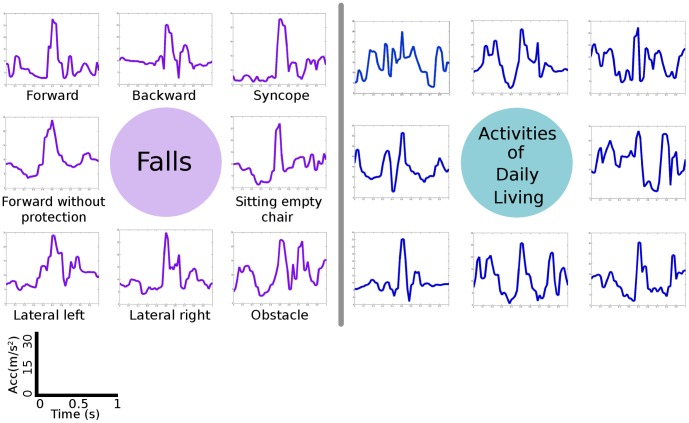
https://cdn.ncbi.nlm.nih.gov/pmc/blobs/6407/3988107/3903a65387f8/pone.0094811.g004.jpg
https://cdn.ncbi.nlm.nih.gov/pmc/blobs/6407/3988107/74656ed13d01/pone.0094811.g001.jpg
https://cdn.ncbi.nlm.nih.gov/pmc/blobs/6407/3988107/df3e85fdcc5c/pone.0094811.g002.jpg
https://cdn.ncbi.nlm.nih.gov/pmc/blobs/6407/3988107/72b0c1cbc569/pone.0094811.g003.jpg
https://cdn.ncbi.nlm.nih.gov/pmc/blobs/6407/3988107/3903a65387f8/pone.0094811.g004.jpg
https://cdn.ncbi.nlm.nih.gov/pmc/blobs/6407/3988107/74656ed13d01/pone.0094811.g001.jpg
https://cdn.ncbi.nlm.nih.gov/pmc/blobs/6407/3988107/df3e85fdcc5c/pone.0094811.g002.jpg
https://cdn.ncbi.nlm.nih.gov/pmc/blobs/6407/3988107/72b0c1cbc569/pone.0094811.g003.jpg
https://cdn.ncbi.nlm.nih.gov/pmc/blobs/6407/3988107/3903a65387f8/pone.0094811.g004.jpg

相似文献

1
Detecting falls as novelties in acceleration patterns acquired with smartphones.将通过智能手机获取的加速度模式中的跌倒检测为异常情况。
PLoS One. 2014 Apr 15;9(4):e94811. doi: 10.1371/journal.pone.0094811. eCollection 2014.
2
Combining novelty detectors to improve accelerometer-based fall detection.结合新颖性探测器提高基于加速度计的跌倒检测。
Med Biol Eng Comput. 2017 Oct;55(10):1849-1858. doi: 10.1007/s11517-017-1632-z. Epub 2017 Mar 1.
3
Evaluation of a threshold-based tri-axial accelerometer fall detection algorithm.基于阈值的三轴加速度计跌倒检测算法的评估
Gait Posture. 2007 Jul;26(2):194-9. doi: 10.1016/j.gaitpost.2006.09.012. Epub 2006 Nov 13.
4
A threshold-based fall-detection algorithm using a bi-axial gyroscope sensor.一种基于阈值的使用双轴陀螺仪传感器的跌倒检测算法。
Med Eng Phys. 2008 Jan;30(1):84-90. doi: 10.1016/j.medengphy.2006.12.001. Epub 2007 Jan 11.
5
Determination of simple thresholds for accelerometry-based parameters for fall detection.基于加速度计的跌倒检测参数简单阈值的确定。
Annu Int Conf IEEE Eng Med Biol Soc. 2007;2007:1367-70. doi: 10.1109/IEMBS.2007.4352552.
6
Fall-detection solution for mobile platforms using accelerometer and gyroscope data.使用加速度计和陀螺仪数据的移动平台跌倒检测解决方案。
Annu Int Conf IEEE Eng Med Biol Soc. 2015 Aug;2015:3727-30. doi: 10.1109/EMBC.2015.7319203.
7
Detecting falls with wearable sensors using machine learning techniques.运用机器学习技术,通过可穿戴传感器检测跌倒情况。
Sensors (Basel). 2014 Jun 18;14(6):10691-708. doi: 10.3390/s140610691.
8
Validation of accuracy of SVM-based fall detection system using real-world fall and non-fall datasets.使用真实世界的跌倒和非跌倒数据集验证基于支持向量机的跌倒检测系统的准确性。
PLoS One. 2017 Jul 5;12(7):e0180318. doi: 10.1371/journal.pone.0180318. eCollection 2017.
9
Highly Portable, Sensor-Based System for Human Fall Monitoring.高度便携的基于传感器的人体跌倒监测系统。
Sensors (Basel). 2017 Sep 13;17(9):2096. doi: 10.3390/s17092096.
10
Unsupervised machine-learning method for improving the performance of ambulatory fall-detection systems.无监督机器学习方法提高动态跌倒检测系统的性能。
Biomed Eng Online. 2012 Feb 16;11:9. doi: 10.1186/1475-925X-11-9.

引用本文的文献

1
A Decade of Progress in Wearable Sensors for Fall Detection (2015-2024): A Network-Based Visualization Review.用于跌倒检测的可穿戴传感器十年进展(2015 - 2024):基于网络的可视化综述
Sensors (Basel). 2025 Mar 31;25(7):2205. doi: 10.3390/s25072205.
2
A benchmark for domain adaptation and generalization in smartphone-based human activity recognition.基于智能手机的人类活动识别中的领域自适应和泛化基准。
Sci Data. 2024 Nov 2;11(1):1192. doi: 10.1038/s41597-024-03951-4.
3
Wrist-Based Fall Detection: Towards Generalization across Datasets.

本文引用的文献

1
Development of a standard fall data format for signals from body-worn sensors : the FARSEEING consensus.开发用于可穿戴式传感器信号的标准跌倒数据格式:远见共识
Z Gerontol Geriatr. 2013 Dec;46(8):720-6. doi: 10.1007/s00391-013-0554-0.
2
Challenges, issues and trends in fall detection systems.跌倒检测系统中的挑战、问题和趋势。
Biomed Eng Online. 2013 Jul 6;12:66. doi: 10.1186/1475-925X-12-66.
3
Smartphone-based solutions for fall detection and prevention: the FARSEEING approach.基于智能手机的跌倒检测与预防解决方案:远见方法。
基于手腕的跌倒检测:迈向跨数据集的泛化。
Sensors (Basel). 2024 Mar 5;24(5):1679. doi: 10.3390/s24051679.
4
Ambient assisted living for frail people through human activity recognition: state-of-the-art, challenges and future directions.通过人类活动识别实现的针对体弱人群的环境辅助生活:现状、挑战与未来方向。
Front Neurosci. 2023 Oct 2;17:1256682. doi: 10.3389/fnins.2023.1256682. eCollection 2023.
5
An Enhanced Ensemble Deep Neural Network Approach for Elderly Fall Detection System Based on Wearable Sensors.基于可穿戴传感器的老年人跌倒检测系统的增强型集成深度神经网络方法。
Sensors (Basel). 2023 May 15;23(10):4774. doi: 10.3390/s23104774.
6
The use of deep learning for smartphone-based human activity recognition.基于深度学习的智能手机人类活动识别。
Front Public Health. 2023 Feb 28;11:1086671. doi: 10.3389/fpubh.2023.1086671. eCollection 2023.
7
Online Fall Detection Using Wrist Devices.在线使用腕部设备进行跌倒检测。
Sensors (Basel). 2023 Jan 19;23(3):1146. doi: 10.3390/s23031146.
8
Deep Neural Network for the Detections of Fall and Physical Activities Using Foot Pressures and Inertial Sensing.基于足底压力和惯性传感的深度神经网络进行跌倒和身体活动检测
Sensors (Basel). 2023 Jan 2;23(1):495. doi: 10.3390/s23010495.
9
Stochastic Recognition of Human Physical Activities via Augmented Feature Descriptors and Random Forest Model.基于增强特征描述符和随机森林模型的人体活动随机识别。
Sensors (Basel). 2022 Sep 2;22(17):6632. doi: 10.3390/s22176632.
10
Explaining One-Dimensional Convolutional Models in Human Activity Recognition and Biometric Identification Tasks.在人类活动识别和生物识别任务中解释一维卷积模型。
Sensors (Basel). 2022 Jul 28;22(15):5644. doi: 10.3390/s22155644.
Z Gerontol Geriatr. 2012 Dec;45(8):722-7. doi: 10.1007/s00391-012-0404-5.
4
Evaluation of accelerometer-based fall detection algorithms on real-world falls.基于加速度计的摔倒检测算法在真实摔倒中的评估。
PLoS One. 2012;7(5):e37062. doi: 10.1371/journal.pone.0037062. Epub 2012 May 16.
5
Fall classification by machine learning using mobile phones.基于机器学习的手机摔倒分类。
PLoS One. 2012;7(5):e36556. doi: 10.1371/journal.pone.0036556. Epub 2012 May 7.
6
Unsupervised machine-learning method for improving the performance of ambulatory fall-detection systems.无监督机器学习方法提高动态跌倒检测系统的性能。
Biomed Eng Online. 2012 Feb 16;11:9. doi: 10.1186/1475-925X-11-9.
7
Comparison of real-life accidental falls in older people with experimental falls in middle-aged test subjects.老年人实际跌倒与中年测试对象实验性跌倒的比较。
Gait Posture. 2012 Mar;35(3):500-5. doi: 10.1016/j.gaitpost.2011.11.016. Epub 2011 Dec 12.
8
Detection of falls using accelerometers and mobile phone technology.利用加速度计和移动电话技术检测跌倒。
Age Ageing. 2011 Nov;40(6):690-6. doi: 10.1093/ageing/afr050. Epub 2011 May 19.
9
Comparison of acceleration signals of simulated and real-world backward falls.模拟和真实世界向后摔倒的加速度信号比较。
Med Eng Phys. 2011 Apr;33(3):368-73. doi: 10.1016/j.medengphy.2010.11.003. Epub 2010 Nov 30.
10
Assessment of waist-worn tri-axial accelerometer based fall-detection algorithms using continuous unsupervised activities.使用连续无监督活动评估基于腰部佩戴式三轴加速度计的跌倒检测算法。
Annu Int Conf IEEE Eng Med Biol Soc. 2010;2010:2782-5. doi: 10.1109/IEMBS.2010.5626364.