Lanciotti M, Masieri L, Raspollini M R, Minervini A, Mari A, Comito G, Giannoni E, Carini M, Chiarugi P, Serni S
Department of Urology, University of Florence, Careggi Hospital, Viale San Luca, 50134 Florence, Italy.
Department of Pathology, University of Florence, Careggi Hospital, Florence, Italy.
Biomed Res Int. 2014;2014:486798. doi: 10.1155/2014/486798. Epub 2014 Mar 11.
The aim of our work was to investigate the causal connection between M1 and M2 macrophage phenotypes occurrence and prostate cancer, their correlation with tumor extension (ECE), and biochemical recurrence (BR).
Clinical and pathological data were prospectively gathered from 93 patients treated with radical prostatectomy. Correlations of commonly used variables were evaluated with uni- and multivariate analysis. The relationship between M1 and M2 occurrence and BR was also assessed with Kaplan-Meier survival analysis.
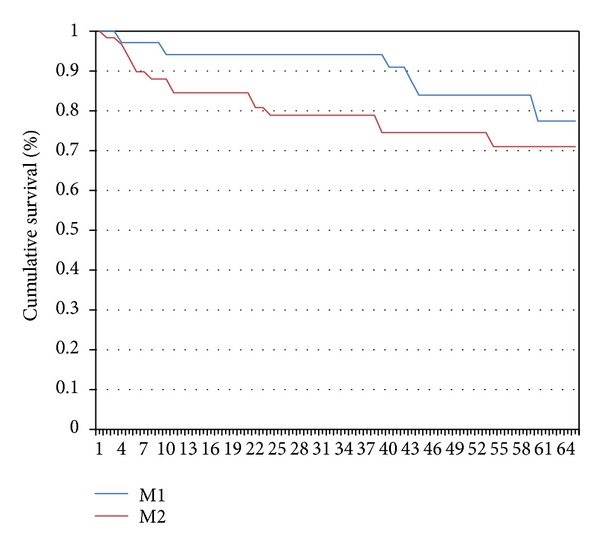
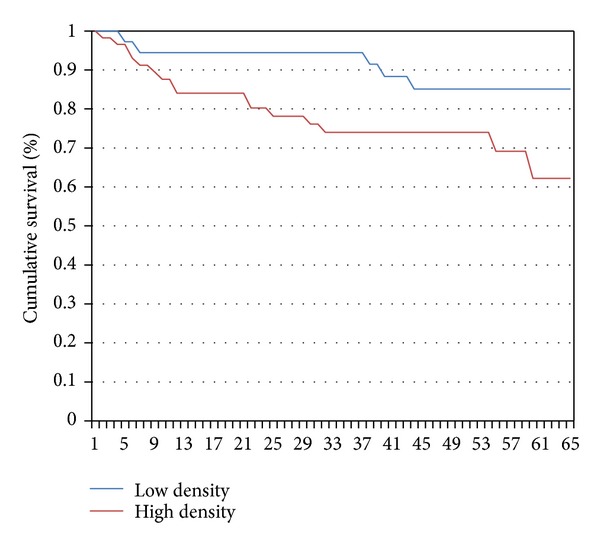
Above all in 63.4% there was a M2 prevalence. M1 occurred more frequently in OC disease, while M2 was more represented in ECE. At univariate analysis biopsy and pathologic GS and M2 were statistically correlated with ECE. Only pathologic GS and M2 confirmed to be correlated with ECE. According to macrophage density BCR free survival curves presented a statistically significant difference. When we stratified our population for M1 and M2,we did not find any statistical difference among curves. At univariate analysis GS, pTNM, and positive margins resulted to be significant predictors of BCR, while M1 and M2 did not achieve the statistical significance. At multivariate analysis, only GS and pathologic stage were independent predictors of BR.
In our study patients with higher density of M count were associated with poor prognosis; M2 phenotype was significantly associated with ECE.
我们研究的目的是探讨M1和M2巨噬细胞表型的出现与前列腺癌之间的因果关系,以及它们与肿瘤外侵(ECE)和生化复发(BR)的相关性。
前瞻性收集了93例行根治性前列腺切除术患者的临床和病理数据。通过单因素和多因素分析评估常用变量的相关性。还采用Kaplan-Meier生存分析评估M1和M2的出现与BR之间的关系。
首先,63.4%的患者存在M2优势。M1在器官局限性疾病中更常见,而M2在肿瘤外侵中更常见。单因素分析显示,活检、病理Gleason评分(GS)和M2与肿瘤外侵在统计学上相关。只有病理GS和M2被证实与肿瘤外侵相关。根据巨噬细胞密度,无生化复发(BCR)的生存曲线存在统计学显著差异。当我们按M1和M2对人群进行分层时,曲线之间未发现任何统计学差异。单因素分析显示,GS、pTNM和手术切缘阳性是BCR的显著预测因素,而M1和M2未达到统计学显著性。多因素分析显示,只有GS和病理分期是BR的独立预测因素。
在我们的研究中,巨噬细胞计数较高的患者预后较差;M2表型与肿瘤外侵显著相关。