Jay Kenneth, Sundstrup Emil, Andersen Lars L
National Research Centre for the Working Environment, Lersø Parkalle 105, 2100 Copenhagen Ø, Denmark ; Electronics and Computer Science, Faculty of Physical and Applied Sciences, University of Southampton, Southampton SO17 1BJ, UK ; Institute of Sports Science and Clinical Biomechanics, University of Southern Denmark, Campusvej 55, 5230 Odense, Denmark.
National Research Centre for the Working Environment, Lersø Parkalle 105, 2100 Copenhagen Ø, Denmark ; Institute of Sports Science and Clinical Biomechanics, University of Southern Denmark, Campusvej 55, 5230 Odense, Denmark.
Biomed Res Int. 2014;2014:961748. doi: 10.1155/2014/961748. Epub 2014 Mar 13.
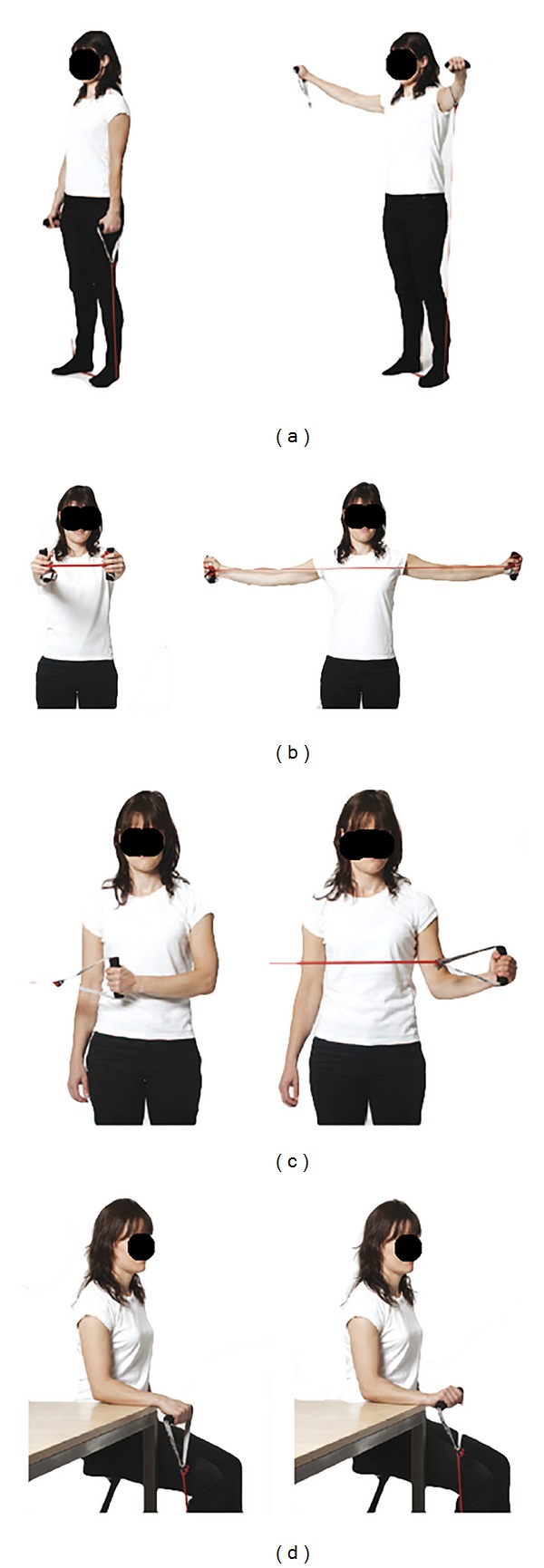
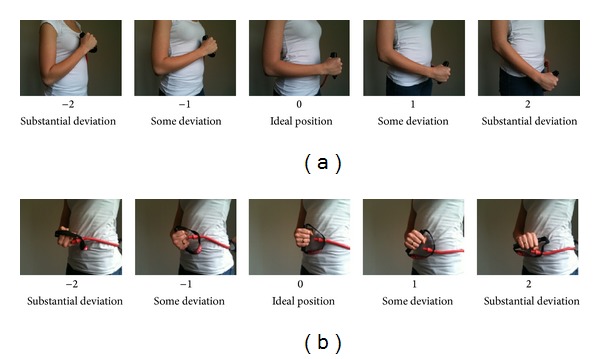
The main objective was to investigate the intra- and intertester reliability of a simple screening tool assessing errors in exercise execution by visual observation. 38 participants with no previous resistance exercise experience practiced for two weeks four typical upper limb exercises using elastic tubing. At 2-week follow-up, the participants were invited for a test-retest assessment on errors in technical execution. The assessment was based on ordinal deviation of joint position from neutral of the shoulder, elbow, and wrist in a single plane by visual observation. Moderate intratester reliability weighted kappa (wΚ) score ranging from 0.50 (0.21-0.71) to 0.57 (0.24-0.82) for observer 1 and a fair to moderate intratester reliability wΚ score ranging from 0.27 (0.09-0.43) to 0.52 (0.15-0.86) for observer 2 across the four exercises was observed. For intertester reliability moderate to substantial mean wΚ scores were found between the two observers, slightly improving from round one to round two ranging from 0.40 (0.20-0.59) to 0.68 (0.45-0.91) in round one to 0.52 (0.20-0.80) to 0.69 (0.39-0.86) in round two. The exercise error assessment demonstrated fair to substantial intratester and intertester reliability, which is congruent with previously published studies. Hence the simplicity of defining a neutral joint position for each of the involved joints in the exercise and categorizing the deviation in "some deviation" and "substantial deviation" to either side in a single plane is a viable and inexpensive solution when assessing for errors during exercise.
主要目的是研究一种通过视觉观察评估运动执行错误的简单筛查工具在测试者内部和测试者之间的可靠性。38名此前没有抗阻运动经验的参与者使用弹力带进行了为期两周的四项典型上肢运动练习。在2周的随访中,邀请参与者对技术执行错误进行重测评估。该评估基于通过视觉观察单个平面中肩部、肘部和腕部相对于中立位的关节位置的序数偏差。观察者1在四项运动中的测试者内部可靠性加权kappa(wΚ)得分中等,范围为0.50(0.21 - 0.71)至0.57(0.24 - 0.82),观察者2的测试者内部可靠性wΚ得分从一般到中等,范围为0.27(0.09 - 0.43)至0.52(0.15 - 0.86)。对于测试者之间的可靠性,在两名观察者之间发现了中等至较高的平均wΚ得分,从第一轮到第二轮略有提高,第一轮为0.40(0.20 - 0.59)至0.68(0.45 - 0.91),第二轮为0.52(0.20 - 0.80)至0.69(0.39 - 0.86)。运动错误评估显示出测试者内部和测试者之间具有一般至较高的可靠性,这与先前发表的研究一致。因此,在运动过程中评估错误时,为运动中每个相关关节定义中立关节位置并将单个平面中向两侧的偏差分类为“一些偏差”和“明显偏差”这种简单方法是一种可行且成本低廉的解决方案。