Jay Kenneth, Schraefel M C, Brandt Mikkel, Andersen Lars L
National Research Centre for the Working Environment, Lersø Parkalle 105, 2100 Copenhagen Ø, Denmark ; Electronics and Computer Science, Faculty of Physical and Applied Sciences, University of Southampton, Southampton SO17 1BJ, UK ; Institute of Sports Science and Clinical Biomechanics, University of Southern Denmark, Campusvej 55, 5230 Odense, Denmark.
Electronics and Computer Science, Faculty of Physical and Applied Sciences, University of Southampton, Southampton SO17 1BJ, UK.
Biomed Res Int. 2014;2014:790937. doi: 10.1155/2014/790937. Epub 2014 Mar 10.
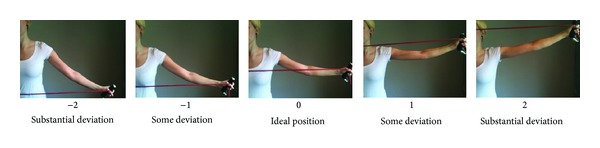
Workplace interventions have shown beneficial results of resistance training for chronic pain in the neck, shoulder, and arm. However, studies have relied on experienced exercise instructors, which may not be an available resource at most workplaces. The objective of this study is to evaluate the technical performance level of upper limb rehabilitation exercises following video-based versus personalized exercise instruction. We recruited 38 laboratory technicians and office workers with neck/shoulder pain for a two-week exercise training period receiving either (1) personal and video or (2) video only instruction in four typical neck/shoulder/arm rehabilitation exercises using elastic tubing. At a 2-week follow-up, the participants' technical execution was assessed by two blinded physical therapists using a reliable error assessment tool. The error assessment was based on ordinal deviation of joint position from the ideal position of the shoulder, elbow, and wrist in a single plane by visual observation. Of the four exercises only unilateral shoulder external rotation had a higher normalized error score in the V group of 22.19 (9.30) to 12.64 (6.94) in the P group (P=0.002). For the remaining three exercises the normalized error score did not differ. In conclusion, when instructing simple exercises to reduce musculoskeletal pain the use of video material is a cost-effective solution that can be implemented easily in corporations with challenging work schedules not allowing for a fixed time of day to go see a personal trainer.
工作场所干预措施已显示出针对颈部、肩部和手臂慢性疼痛进行阻力训练的有益效果。然而,以往研究依赖经验丰富的运动教练,而这在大多数工作场所可能并非可获取的资源。本研究的目的是评估基于视频指导与个性化运动指导后上肢康复锻炼的技术执行水平。我们招募了38名患有颈部/肩部疼痛的实验室技术员和办公室职员,进行为期两周的运动训练,他们接受以下两种指导之一:(1)个人指导和视频指导,或(2)仅视频指导,内容为使用弹力管进行四种典型的颈部/肩部/手臂康复锻炼。在为期2周的随访中,由两名不知情的物理治疗师使用可靠的误差评估工具对参与者的技术执行情况进行评估。误差评估基于通过视觉观察单个平面中关节位置相对于肩部、肘部和腕部理想位置的序数偏差。在这四项锻炼中,只有单侧肩部外旋在视频指导组(V组)的标准化误差得分较高,为22.19(9.30),而在个人指导组(P组)为12.64(6.94)(P = 0.002)。对于其余三项锻炼,标准化误差得分没有差异。总之,在指导简单锻炼以减轻肌肉骨骼疼痛时,使用视频材料是一种经济高效的解决方案,对于工作时间表紧张、无法安排固定时间去见私人教练的公司而言,易于实施。