Dipartimento di Matematica e Applicazioni, Università degli Studi di Napoli "Federico II," Napoli, Italy.
Dipartimento di Ingegneria Elettrica e Tecnologie dell'Informazione, Università degli Studi di Napoli "Federico II," Napoli, Italy.
Front Psychol. 2014 Apr 1;5:273. doi: 10.3389/fpsyg.2014.00273. eCollection 2014.
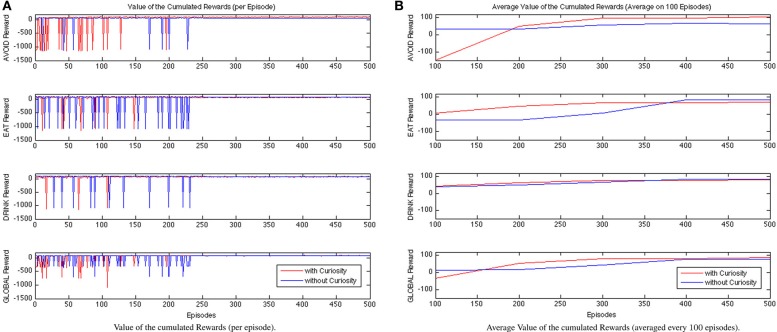
The concepts of attention and intrinsic motivations are of great interest within adaptive robotic systems, and can be exploited in order to guide, activate, and coordinate multiple concurrent behaviors. Attention allocation strategies represent key capabilities of human beings, which are strictly connected with action selection and execution mechanisms, while intrinsic motivations directly affect the allocation of attentional resources. In this paper we propose a model of Reinforcement Learning (RL), where both these capabilities are involved. RL is deployed to learn how to allocate attentional resources in a behavior-based robotic system, while action selection is obtained as a side effect of the resulting motivated attentional behaviors. Moreover, the influence of intrinsic motivations in attention orientation is obtained by introducing rewards associated with curiosity drives. In this way, the learning process is affected not only by goal-specific rewards, but also by intrinsic motivations.
注意和内在动机的概念在自适应机器人系统中非常重要,可以用来指导、激活和协调多个并发行为。注意力分配策略是人类的关键能力,与动作选择和执行机制密切相关,而内在动机直接影响注意力资源的分配。在本文中,我们提出了一种强化学习(RL)模型,其中涉及到这两种能力。RL 被用来学习如何在基于行为的机器人系统中分配注意力资源,而动作选择则是由此产生的有动机的注意力行为的副作用。此外,通过引入与好奇心驱动相关的奖励,获得了内在动机对注意力方向的影响。这样,学习过程不仅受到特定于目标的奖励的影响,还受到内在动机的影响。