Fletcher Jared R, Pfister Ted R, Macintosh Brian R
Human Performance Laboratory, Faculty of Kinesiology, University of Calgary, Calgary, Alberta, Canada.
Physiol Rep. 2013 Dec 6;1(7):e00178. doi: 10.1002/phy2.178. eCollection 2013 Dec 1.
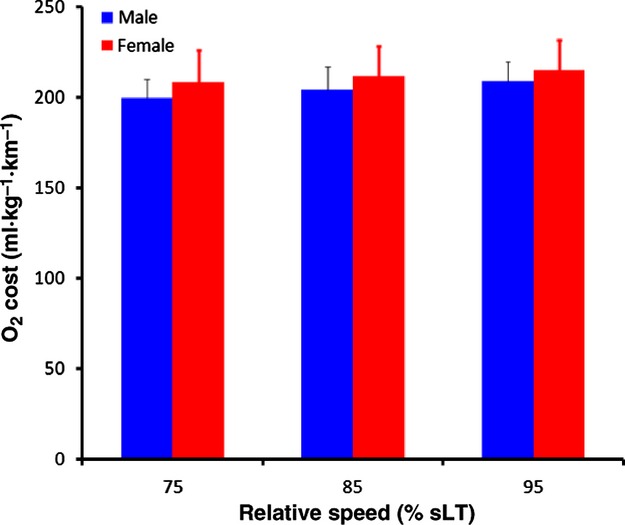
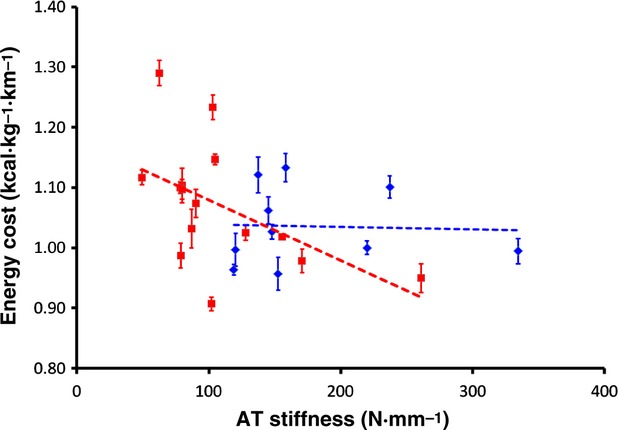
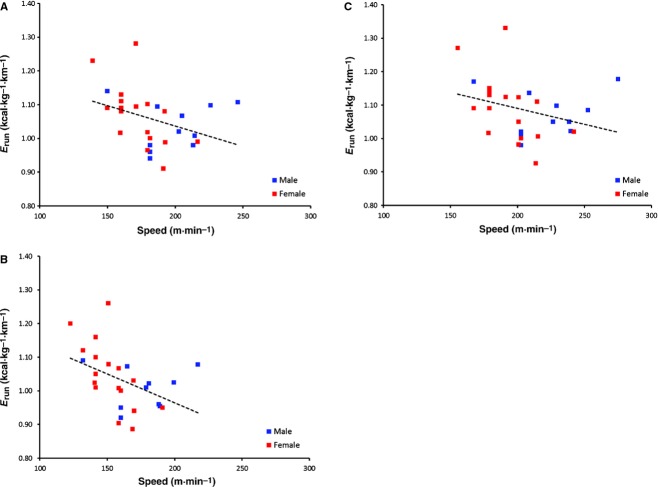
The energy cost of running (E run), a key determinant of distance running performance, is influenced by several factors. Although it is important to express E run as energy cost, no study has used this approach to compare similarly trained men and women. Furthermore, the relationship between Achilles tendon (AT) stiffness and E run has not been compared between men and women. Therefore, our purpose was to determine if sex-specific differences in E run and/or AT stiffness existed. E run (kcal kg(-1) km(-1)) was determined by indirect calorimetry at 75%, 85%, and 95% of the speed at lactate threshold (sLT) on 11 man (mean ± SEM, 35 ± 1 years, 177 ± 1 cm, 78 ± 1 kg, [Formula: see text]1 = 56 ± 1 mL kg(-1) min(-1)) and 18 woman (33 ± 1 years, 165 ± 1 cm, 58 ± 1 kg, [Formula: see text]2 = 50 ± 0.3 mL kg(-1) min(-1)) runners. AT stiffness was measured using ultrasound with dynamometry. Man E run was 1.01 ± 0.06, 1.04 ± 0.07, and 1.07 ± 0.07 kcal kg(-1) km(-1). Woman E run was 1.05 ± 0.10, 1.07 ± 0.09, and 1.09 ± 0.10 kcal kg(-1) km(-1). There was no significant sex effect for E run or RER, but both increased with speed (P < 0.01) expressed relative to sLT. High-range AT stiffness was 191 ± 5.1 N mm(-1) for men and 125 ± 5.5 N mm(-1), for women (P < 0.001). The relationship between low-range AT stiffness and E run was significant at all measured speeds for women (r (2) = 0.198, P < 0.05), but not for the men. These results indicate that when E run is measured at the same relative intensity, there are no sex-specific differences in E run or substrate use. Furthermore, differences in E run cannot be explained solely by differences in AT stiffness.
跑步能耗(E_run)是长跑成绩的关键决定因素,受多种因素影响。尽管将E_run表示为能量消耗很重要,但尚无研究采用这种方法对训练水平相似的男性和女性进行比较。此外,男女之间跟腱(AT)刚度与E_run的关系也未作比较。因此,我们的目的是确定E_run和/或AT刚度是否存在性别差异。通过间接测热法在乳酸阈速度(sLT)的75%、85%和95%时测定11名男性(平均±标准误,35±1岁,177±1厘米,78±1千克,[公式:见原文]1 = 56±1毫升·千克⁻¹·分钟⁻¹)和18名女性(33±1岁,165±1厘米,58±1千克,[公式:见原文]2 = 50±0.3毫升·千克⁻¹·分钟⁻¹)跑步者的E_run(千卡·千克⁻¹·千米⁻¹)。使用超声动力测定法测量AT刚度。男性的E_run分别为1.01±0.06、1.04±0.07和1.07±0.07千卡·千克⁻¹·千米⁻¹。女性的E_run分别为1.05±0.10、1.07±0.09和1.09±0.10千卡·千克⁻¹·千米⁻¹。E_run或呼吸交换率(RER)不存在显著的性别效应,但相对于sLT表示时,二者均随速度增加(P < 0.01)。男性的高范围AT刚度为191±5.1牛·毫米⁻¹,女性为125±5.5牛·毫米⁻¹(P < 0.001)。在所有测量速度下,女性低范围AT刚度与E_run之间的关系显著(r² = 0.198,P < 0.05),而男性则不然。这些结果表明,当以相同相对强度测量E_run时,E_run或底物利用不存在性别差异。此外,E_run的差异不能仅由AT刚度的差异来解释。