Molloy Gerard J, Messerli-Bürgy Nadine, Hutton Gemma, Wikman Anna, Perkins-Porras Linda, Steptoe Andrew
School of Psychology, National University of Ireland Galway, Ireland.
Department of Clinical Psychology and Psychotherapy, University of Bern, Switzerland.
J Psychosom Res. 2014 May;76(5):430-2. doi: 10.1016/j.jpsychores.2014.02.007. Epub 2014 Feb 26.
Non-adherence to medication is common among coronary heart disease patients. Non-adherence to medication may be either intentional or unintentional. In this analysis we provide estimates of intentional and unintentional non-adherence in the year following an acute coronary syndrome (ACS).
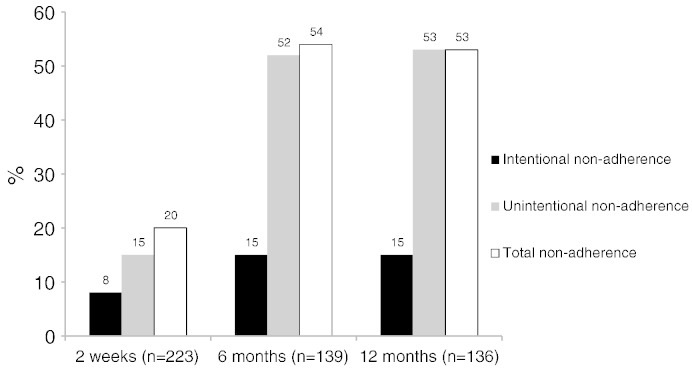
In this descriptive prospective observational study of patients with confirmed ACS medication adherence measures were derived from responses to the Medication Adherence Report Scale at approximately 2 weeks (n=223), 6 months (n=139) and 12 months (n=136) following discharge from acute treatment for ACS.
Total medication non-adherence was 20%, 54% and 53% at each of these time points respectively. The corresponding figures for intentional non-adherence were 8%, 15% and 15% and 15%, 52% and 53% for unintentional non-adherence. There were significant increases in the levels of medication non-adherence between the immediate discharge period (2 weeks) and 6 months that appeared to stabilize between 6 and 12 months after acute treatment for ACS.
Unintentional non-adherence to medications may be the primary form of non-adherence in the year following ACS. Interventions delivered early in the post-discharge period may prevent the relatively high levels of non-adherence that appear to become established by 6 months following an ACS.
冠心病患者中不遵医嘱服药的情况很常见。不遵医嘱服药可能是有意的,也可能是无意的。在本分析中,我们提供了急性冠状动脉综合征(ACS)后一年中有意和无意不遵医嘱服药情况的估计值。
在这项针对确诊ACS患者的描述性前瞻性观察研究中,服药依从性测量数据来自于急性治疗ACS出院后约2周(n = 223)、6个月(n = 139)和12个月(n = 136)时对药物依从性报告量表的回答。
在这些时间点,总的服药不依从率分别为20%、54%和53%。有意不依从的相应数字分别为8%、15%和15%,无意不依从的数字分别为15%、52%和53%。在急性治疗ACS出院后的即刻(2周)至6个月期间,服药不依从水平显著上升,在ACS急性治疗后6至12个月之间似乎趋于稳定。
在ACS后的一年中,无意不遵医嘱服药可能是不依从的主要形式。出院后早期进行干预可能会预防ACS后6个月时似乎已确立的较高水平的不依从情况。