Kocak-Uzel Esengul, Gunn G Brandon, Colen Rivka R, Kantor Micheal E, Mohamed Abdallah S R, Schoultz-Henley Sara, Mavroidis Paniyotis, Frank Steven J, Garden Adam S, Beadle Beth M, Morrison William H, Phan Jack, Rosenthal David I, Fuller Clifton D
Department of Radiation Oncology, The University of Texas MD Anderson Cancer Center, Houston, USA; Department of Radiation Oncology, Sisli Etfal Teaching and Research Hospital, Istanbul, Turkey.
Department of Radiation Oncology, The University of Texas MD Anderson Cancer Center, Houston, USA.
Radiother Oncol. 2014 May;111(2):281-8. doi: 10.1016/j.radonc.2014.02.019. Epub 2014 Apr 17.
To investigate potential dose-response relationship between radiation-associated nausea and vomiting (RANV) reported during radiotherapy and candidate nausea/vomiting-associated regions of interest (CNV-ROIs) in head and neck (HNC) squamous cell carcinomas.
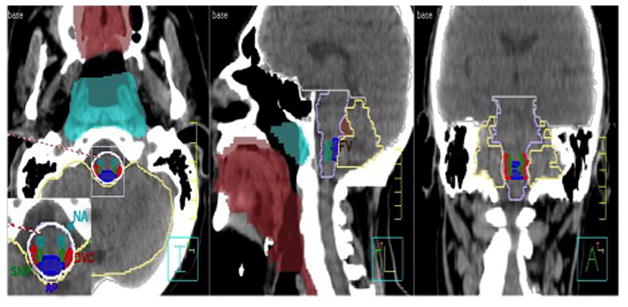
A total of 130 patients treated with IMRT with squamous cell carcinomas of head and neck were evaluated. For each patient, CNV-ROIs were segmented manually on planning CT images. Clinical on-treatment RANV data were reconstructed by a review of the records for all patients. Dosimetric data parameters were recorded from dose-volume histograms. Nausea and vomiting reports were concatenated as a single binary "Any N/V" variable, and as a "CTC-V2+" variable.
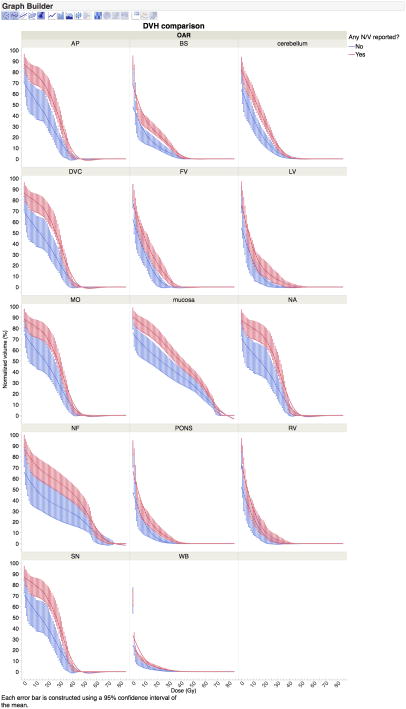
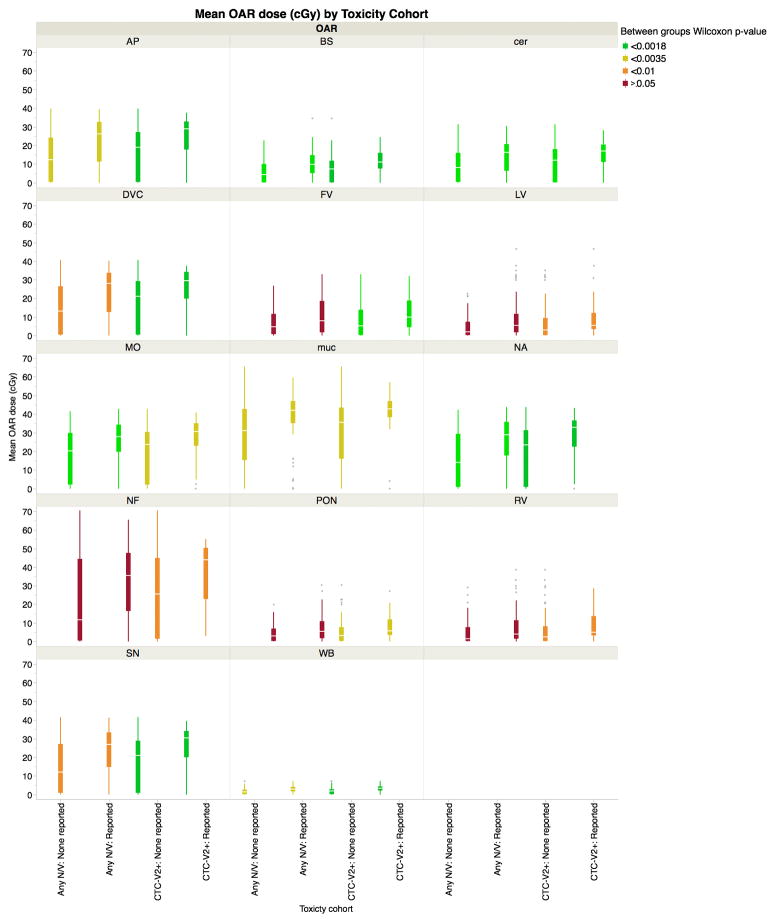
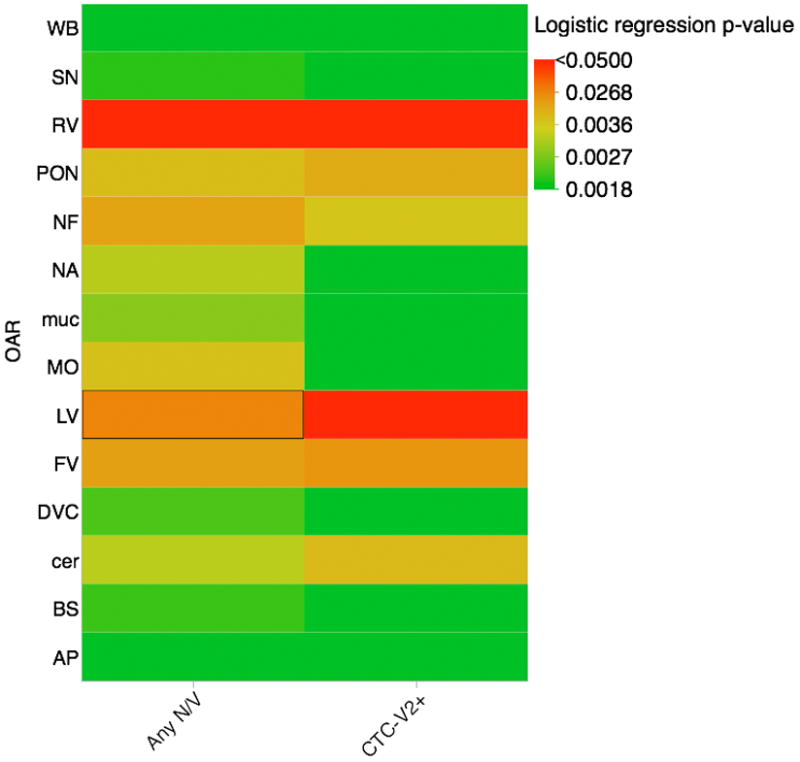
The mean dose to CNV-ROIs was higher for patients experiencing RANV events. For patients receiving IMRT alone, a dose-response effect was observed with varying degrees of magnitude, at a statistically significant level for the area postrema, brainstem, dorsal vagal complex, medulla oblongata, solitary nucleus, oropharyngeal mucosa and whole brain CNV-ROIs.
RANV is a common therapy-related morbidity facing patients receiving HNC radiotherapy, and, for those receiving radiotherapy-alone, is associated with modifiable dose to specific CNS structures.
探讨头颈部鳞状细胞癌(HNC)放疗期间报告的放射性恶心和呕吐(RANV)与候选恶心/呕吐相关感兴趣区域(CNV-ROIs)之间潜在的剂量反应关系。
对130例接受调强放射治疗(IMRT)的头颈部鳞状细胞癌患者进行评估。对每位患者,在计划CT图像上手动分割CNV-ROIs。通过查阅所有患者的记录重建临床治疗期间的RANV数据。从剂量体积直方图记录剂量学数据参数。恶心和呕吐报告合并为一个单一的二元“任何恶心/呕吐”变量,以及一个“常见毒性标准-第2版及以上(CTC-V2+)”变量。
发生RANV事件的患者,其CNV-ROIs的平均剂量更高。对于仅接受IMRT的患者,在最后区、脑干、迷走神经背核、延髓、孤束核、口咽黏膜和全脑CNV-ROIs观察到不同程度的剂量反应效应,且具有统计学意义。
RANV是接受HNC放疗患者面临的一种常见的治疗相关并发症,对于仅接受放疗的患者,它与特定中枢神经系统结构的可调整剂量相关。