Tsitrou Effrosyni, Kelogrigoris Stavros, Koulaouzidou Elisabeth, Antoniades-Halvatjoglou Maria, Koliniotou-Koumpia Eugenia, van Noort Richard
The Academic Unit of Restorative Dentistry is a Department in the Dental School in Sheffield, School of Clinical Dentistry, University of Sheffield, Claremont Crescent, S10 2TA, Sheffield, UK.
Department of Operative Dentistry, School of Clinical Dentistry, Aristotle University of Thessaloniki, Thessaloniki, Greece.
Toxicol Int. 2014 Jan;21(1):89-95. doi: 10.4103/0971-6580.128811.
The purpose of this study was to examine the effect of different extraction media, including culture media, as well as storage times on the elution of monomers from modern dental composites.
FOUR CONTEMPORARY COMPOSITE MATERIALS WERE TESTED: (a) Clearfil Majesty Esthetic (Kuraray), (b) Esthet X (DENTSPLY), (c) Filtek Silorane (3M ESPE), and (d) Admira (Voco). Forty-eight specimens were made. The specimens were stored in 1 ml of (a) artificial saliva, (b) Dulbecco's Modified Eagle Medium (DMEM), (c) DMEM plus 10% fetal bovine serum (FBS), and (d) ethanol 75%. The specimens were analyzed after 24 hours and after 1 week of storage. HPLC Liquid Chromatography was performed to analyze the extracted solutions. The statistical package SPSS 18 was used for the statistical analysis of the results.
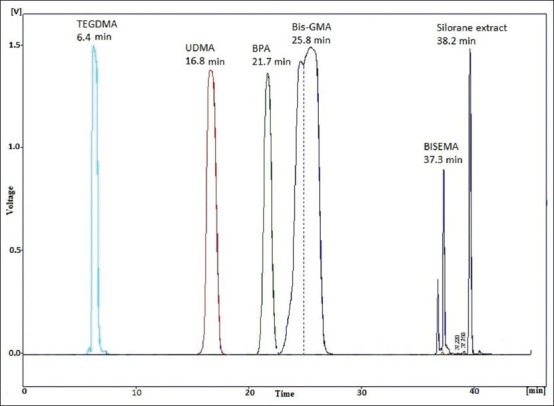
All the materials tested released monomers that were consistent with the base composition of their resin matrix. Bisphenol-A (BPA) was detected in Clearfil Esthetic and EsthetX when ethanol 75% was used for storage. TEGDMA was released at a faster rate compared to the other monomers with most of the monomer eluted in the first 24 hours. The effect of storage solution and storage time on the elution of the same monomers varied between materials.
There was a significant effect of time, storage solution, and material on the elution of the detectable unbound monomers. Unbound monomers were detected in culture media, which may lead to false-negative results in cytotoxicity tests of resin composite materials. BPA was detected in two of the tested materials.
本研究的目的是研究不同提取介质(包括培养基)以及储存时间对现代牙科复合材料中单体洗脱的影响。
测试了四种当代复合材料:(a)Clearfil Majesty Esthetic(可乐丽),(b)Esthet X(登士柏),(c)Filtek Silorane(3M ESPE),以及(d)Admira(VOCO)。制作了48个样本。样本分别储存在1毫升(a)人工唾液、(b)杜氏改良 Eagle 培养基(DMEM)、(c)添加10%胎牛血清(FBS)的DMEM和(d)75%乙醇中。储存24小时和1周后对样本进行分析。采用高效液相色谱法分析提取的溶液。结果的统计分析使用统计软件包SPSS 18。
所有测试材料均释放出与其树脂基质基本组成一致的单体。当使用75%乙醇储存时,在Clearfil Esthetic和EsthetX中检测到双酚A(BPA)。与其他单体相比,TEGDMA的释放速度更快,大部分单体在最初24小时内被洗脱。储存溶液和储存时间对相同单体洗脱的影响因材料而异。
时间、储存溶液和材料对可检测到的未结合单体的洗脱有显著影响。在培养基中检测到未结合单体,这可能导致树脂复合材料细胞毒性测试出现假阴性结果。在两种测试材料中检测到了BPA。