Wan Qiaofeng, Wang Hao, Han Xuebo, Lin Yuan, Yang Yanhui, Gu Ligang, Zhao Jiaqing, Wang Li, Huang Ling, Li Yanbin, Yang Yurong
Department of Pathogenic Biology and Immunology, Basic Medical Science College, Ningxia Medical University, Yinchuan, Ningxia 750004, P.R. China.
Key Laboratory of Antivirus of the Ministry of Education, Beijing University of Chinese Medicine, Beijing 100029, P.R. China.
Biomed Rep. 2014 May;2(3):437-441. doi: 10.3892/br.2014.253. Epub 2014 Mar 14.
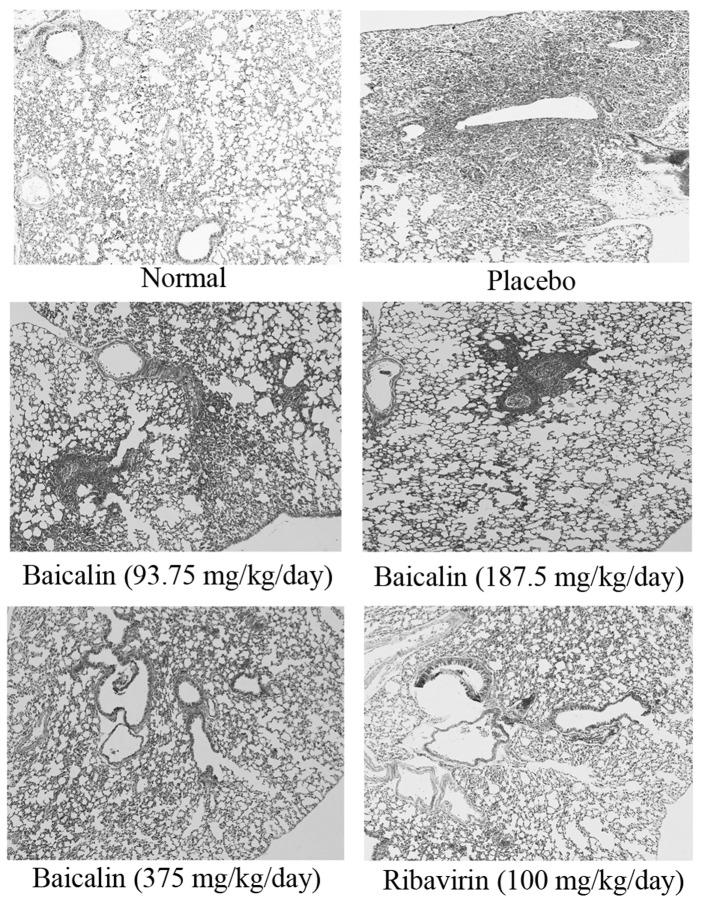
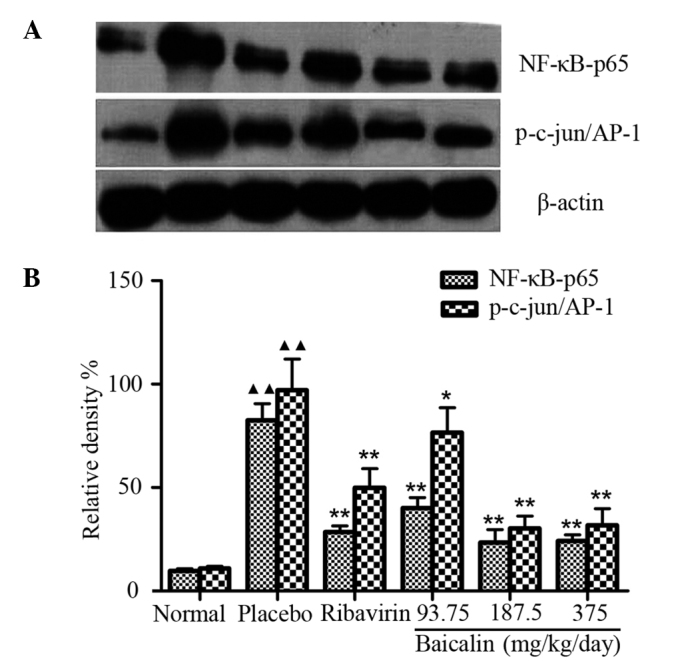
The present study aimed to investigate the protective effects and underlying mechanisms of baicalin on imprinting control region mice infected with influenza A/FM/1/47 (H1N1) virus. Oral administration of baicalin into mice infected with H1N1 prevented death, increased the mean time to death and inhibited lung index and lung consolidation. Subsequently, fluorescence quantitative polymerase chain reaction was used to assess the mRNA expression of toll-like receptor 7 (TLR7) and myeloid differentiation primary response gene 88 (MYD88), and western blot analysis was used to determine the expression of phosphorylated nuclear factor κB (NF-κB)-P65 and c-jun/activator protein 1 (AP-1). An enzyme-linked immunosorbent assay was applied to test for the inflammatory cytokines, tumor necrosis factor (TNF)-α and interleukin (IL)-1β and IL-6, in the lung tissue. The findings indicated that baicalin downregulated the mRNA expression of TLR7 and MYD88, significantly downregulated the protein expression of NF-κB-P65 and AP-1 and also inhibited the secretion of TNF-α, IL-1β and IL-6. In conclusion, baicalin effectively reduced the pathological damage and inflammation of the lungs by downregulating the TLR7/MYD88-mediated signaling pathway.
本研究旨在探讨黄芩苷对感染甲型流感病毒A/FM/1/47(H1N1)的印记控制区小鼠的保护作用及潜在机制。对感染H1N1的小鼠口服黄芩苷可预防死亡、延长平均死亡时间,并抑制肺指数和肺实变。随后,采用荧光定量聚合酶链反应评估Toll样受体7(TLR7)和髓样分化初级反应基因88(MYD88)的mRNA表达,并用蛋白质印迹分析确定磷酸化核因子κB(NF-κB)-P65和c-jun/激活蛋白1(AP-1)的表达。应用酶联免疫吸附测定法检测肺组织中的炎性细胞因子、肿瘤坏死因子(TNF)-α、白细胞介素(IL)-1β和IL-6。结果表明,黄芩苷下调了TLR7和MYD88的mRNA表达,显著下调了NF-κB-P65和AP-1的蛋白表达,还抑制了TNF-α、IL-1β和IL-6的分泌。总之,黄芩苷通过下调TLR7/MYD88介导的信号通路有效减轻了肺部的病理损伤和炎症。