Etienne Rampal S, Morlon Hélène, Lambert Amaury
Community and Conservation Ecology Group, Centre for Ecological and Evolutionary Studies, University of Groningen, Box 11103, 9700 CC Groningen, The Netherlands.
Evolution. 2014 Aug;68(8):2430-40. doi: 10.1111/evo.12433. Epub 2014 Jun 3.
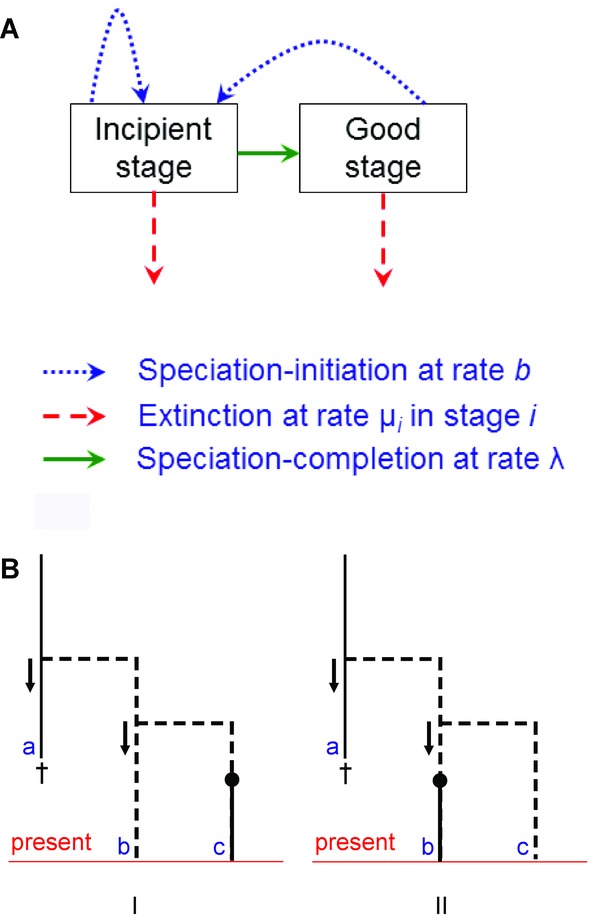
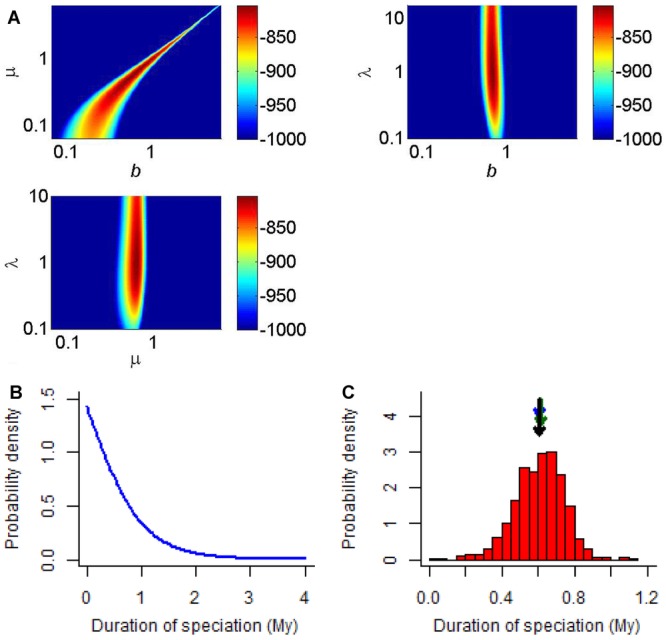
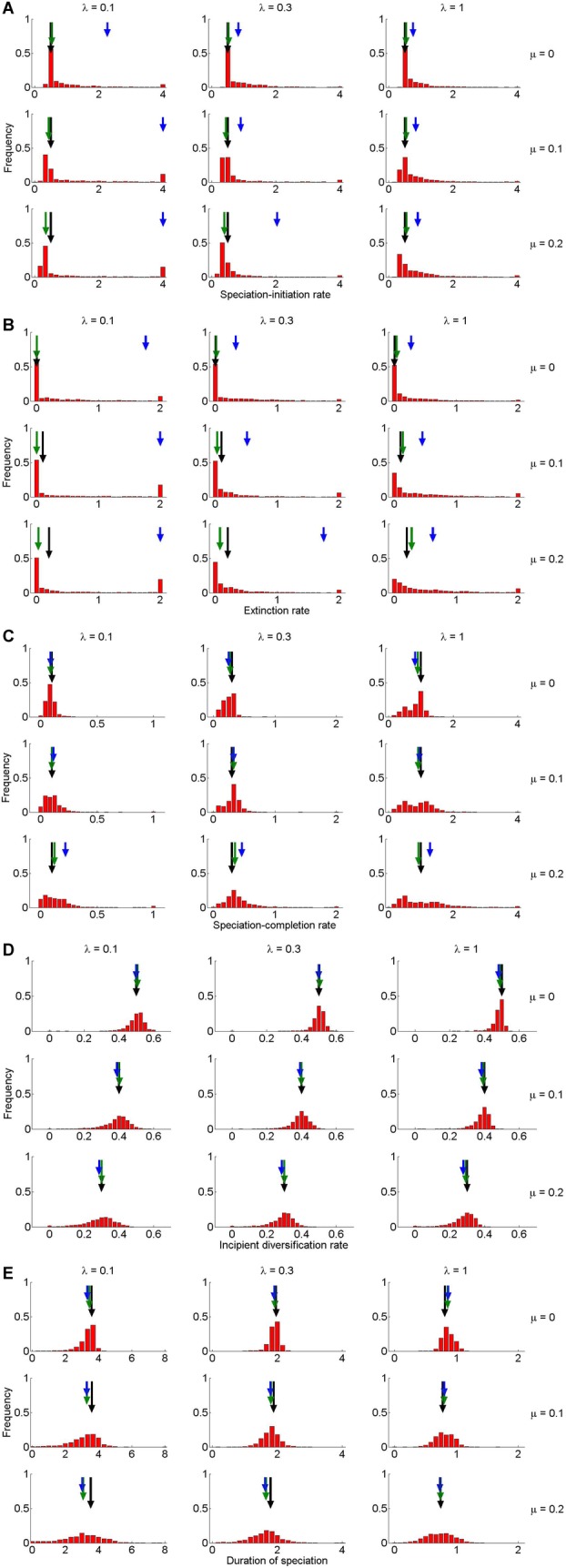
Speciation is not instantaneous but takes time. The protracted birth-death diversification model incorporates this fact and predicts the often observed slowdown of lineage accumulation toward the present. The mathematical complexity of the protracted speciation model has barred estimation of its parameters until recently a method to compute the likelihood of phylogenetic branching times under this model was outlined (Lambert et al. ). Here, we implement this method and study using simulated phylogenies of extant species how well we can estimate the model parameters (rate of initiation of speciation, rate of extinction of incipient and good species, and rate of completion of speciation) as well as the duration of speciation, which is a combination of the aforementioned parameters. We illustrate our approach by applying it to a primate phylogeny. The simulations show that phylogenies often do not contain enough information to provide unbiased estimates of the speciation-initiation rate and the extinction rate, but the duration of speciation can be estimated without much bias. The estimate of the duration of speciation for the primate clade is consistent with literature estimates. We conclude that phylogenies combined with the protracted speciation model provide a promising way to estimate the duration of speciation.
物种形成并非一蹴而就,而是需要时间。长期的出生-死亡多样化模型纳入了这一事实,并预测了通常观察到的谱系积累向现代的放缓。长期物种形成模型的数学复杂性阻碍了其参数的估计,直到最近概述了一种在此模型下计算系统发育分支时间可能性的方法(兰伯特等人)。在这里,我们实施这种方法,并使用现存物种的模拟系统发育来研究我们能多好地估计模型参数(物种形成起始率、初始物种和优良物种的灭绝率以及物种形成完成率)以及物种形成的持续时间,后者是上述参数的组合。我们通过将其应用于灵长类系统发育来阐述我们的方法。模拟表明,系统发育通常不包含足够的信息来提供物种形成起始率和灭绝率的无偏估计,但物种形成的持续时间可以在没有太大偏差的情况下进行估计。灵长类分支的物种形成持续时间估计与文献估计一致。我们得出结论,系统发育与长期物种形成模型相结合为估计物种形成的持续时间提供了一种有前景的方法。