Sahni Shivani, Mangano Kelsey M, Tucker Katherine L, Kiel Douglas P, Casey Virginia A, Hannan Marian T
Institute for Aging Research, Hebrew SeniorLife, Beth Israel Deaconess Medical Center, Harvard Medical School, Boston, MA, USA.
J Bone Miner Res. 2014 Aug;29(8):1756-62. doi: 10.1002/jbmr.2219.
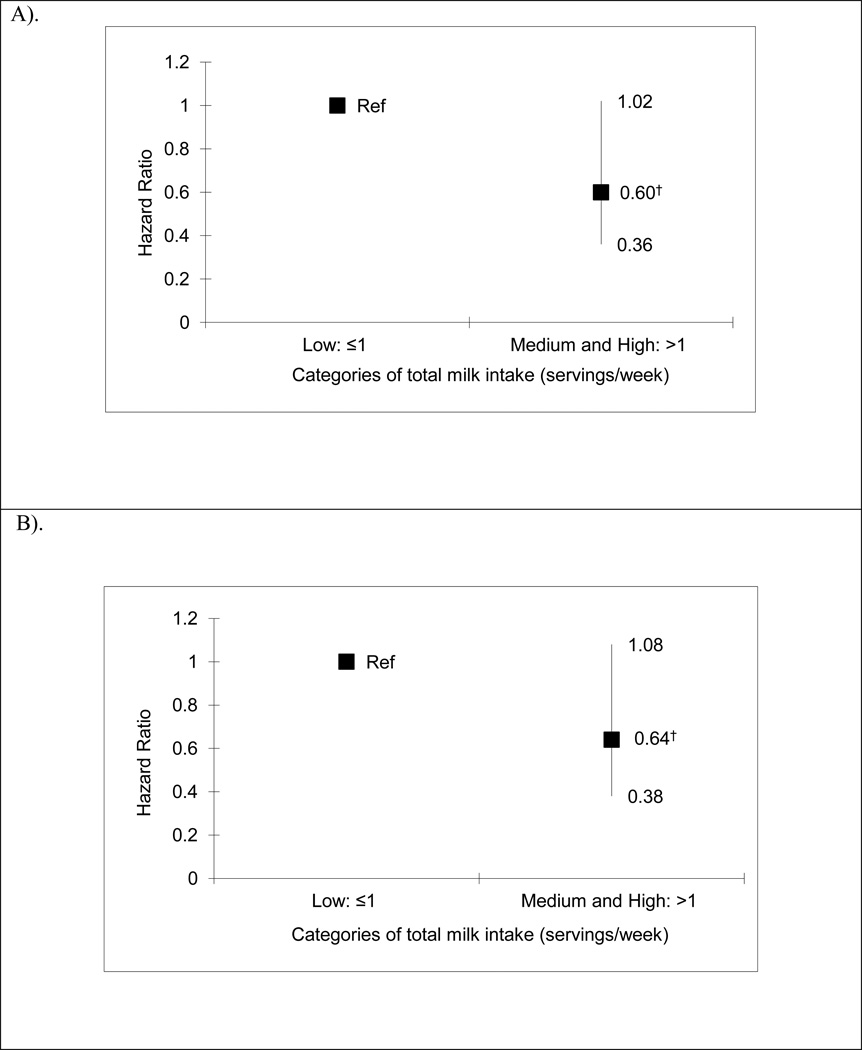
Dairy foods are rich in bone-beneficial nutrients, yet the role of dairy foods in hip fracture prevention remains controversial. Our objective was to evaluate the association of milk, yogurt, cheese, cream, and milk + yogurt intakes with incident hip fracture in the Framingham Original Cohort. A total of 830 men and women from the Framingham Original Cohort, a prospective cohort study, completed a food-frequency questionnaire (1988 to 1989) and were followed for hip fracture until 2008. In this population-based study, Cox-proportional hazards regression was used to estimate hazard ratios (HR) by categories of energy-adjusted dairy intake (servings/wk), adjusting for standard confounders and covariates. The exposure was energy-adjusted intakes of milk, yogurt, cheese, cream, and milk + yogurt (servings/wk). Risk of hip fracture over the follow-up was the primary outcome; the hypothesis being tested was formulated after data collection. The mean age at baseline was 77 years (SD 4.9, range 68 to 96). Ninety-seven hip fractures occurred over the mean follow-up time of 11.6 years (range 0.04 to 21.9 years). The mean ± SD (servings/wk) of dairy intakes at baseline were: milk = 6.0 ± 6.4; yogurt = 0.4 ± 1.3; cheese = 2.6 ± 3.1; and cream = 3.4 ± 5.5. Participants with medium (>1 and <7 servings/wk) or higher (≥7 servings/wk) milk intake tended to have lower hip fracture risk than those with low (≤1 serving/wk) intake (high versus low intake HR 0.58, 95% confidence interval [CI] 0.31-1.06, p = 0.078; medium versus low intake HR 0.61, 95% CI 0.36-1.08, p = 0.071; p trend = 0.178]. There appeared to be a threshold for milk, with 40% lower risk of hip fracture among those with medium/high milk intake compared with those with low intake (p = 0.061). A similar threshold was observed for milk + yogurt intake (p = 0.104). These associations were further attenuated after adjustment for femoral neck bone mineral density. No significant associations were seen for other dairy foods (p range = 0.117 to 0.746). These results suggest that greater intakes of milk and milk + yogurt may lower risk for hip fracture in older adults through mechanisms that are partially, but not entirely, attributable to effects on bone mineral density.
乳制品富含对骨骼有益的营养成分,但乳制品在预防髋部骨折方面的作用仍存在争议。我们的目的是评估在弗雷明汉姆原始队列中,牛奶、酸奶、奶酪、奶油以及牛奶加酸奶的摄入量与髋部骨折发生率之间的关联。来自弗雷明汉姆原始队列(一项前瞻性队列研究)的830名男性和女性完成了一份食物频率问卷(1988年至1989年),并随访至2008年以观察髋部骨折情况。在这项基于人群的研究中,采用Cox比例风险回归按能量调整后的乳制品摄入量类别(份/周)估计风险比(HR),并对标准混杂因素和协变量进行了调整。暴露因素为能量调整后的牛奶、酸奶、奶酪、奶油以及牛奶加酸奶的摄入量(份/周)。随访期间髋部骨折风险是主要结局;所检验的假设是在数据收集后制定的。基线时的平均年龄为77岁(标准差4.9,范围68至96岁)。在平均11.6年(范围0.04至21.9年)的随访期间发生了97例髋部骨折。基线时乳制品摄入量的均值±标准差(份/周)分别为:牛奶 = 6.0±6.4;酸奶 = 0.4±1.3;奶酪 = 2.6±3.1;奶油 = 3.4±5.5。牛奶摄入量中等(>1且<7份/周)或较高(≥7份/周)的参与者相比摄入量低(≤1份/周)的参与者,髋部骨折风险往往更低(高摄入量与低摄入量相比,HR为0.58,95%置信区间[CI]为0.31 - 1.06,p = 0.078;中等摄入量与低摄入量相比,HR为0.61,95%CI为0.36 - 1.08,p = 0.071;p趋势 = 0.178)。牛奶似乎存在一个阈值,中等/高牛奶摄入量者相比低摄入量者髋部骨折风险降低40%(p = 0.061)。牛奶加酸奶的摄入量也观察到类似阈值(p = 0.104)。在调整股骨颈骨矿物质密度后,这些关联进一步减弱。其他乳制品未观察到显著关联(p值范围为0.117至0.746)。这些结果表明,增加牛奶和牛奶加酸奶的摄入量可能通过部分但并非完全归因于对骨矿物质密度影响的机制降低老年人髋部骨折风险。