1 Department of Neurosciences, Centre Hospitalier de Luxembourg, Luxembourg-City, Luxembourg2 Centre for Systems Biomedicine, University of Luxembourg, Esch-Belval, Luxembourg3 Department of Neurological Sciences, Rush University Medical Centre, Chicago, USA
3 Department of Neurological Sciences, Rush University Medical Centre, Chicago, USA.
Brain. 2014 Jun;137(Pt 6):1838-49. doi: 10.1093/brain/awu094. Epub 2014 Apr 24.
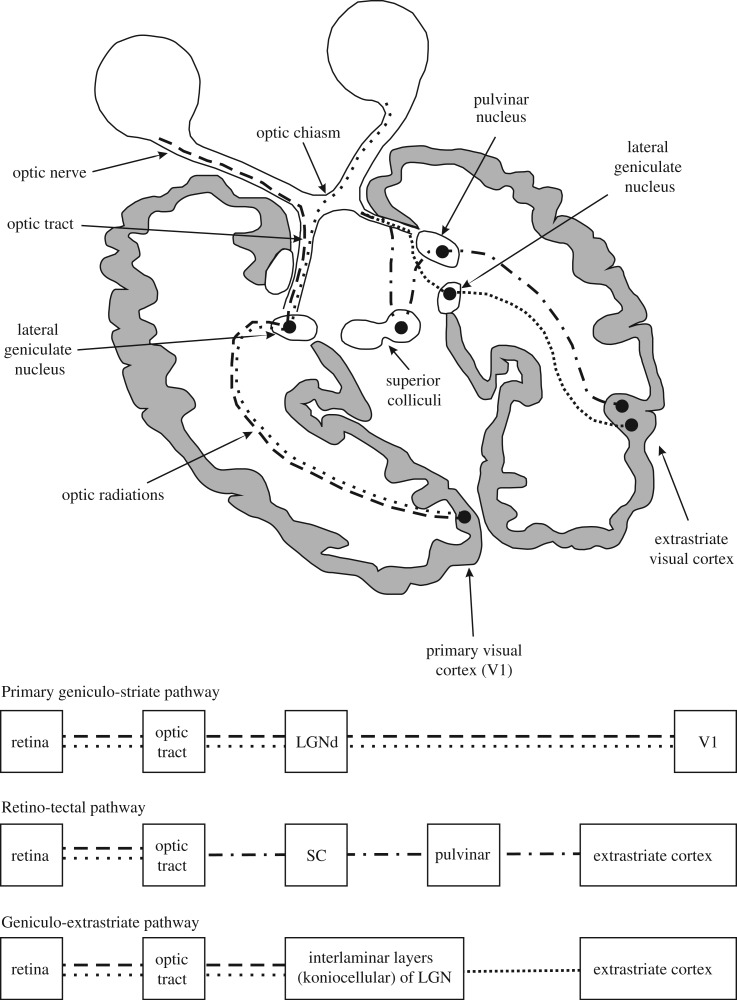
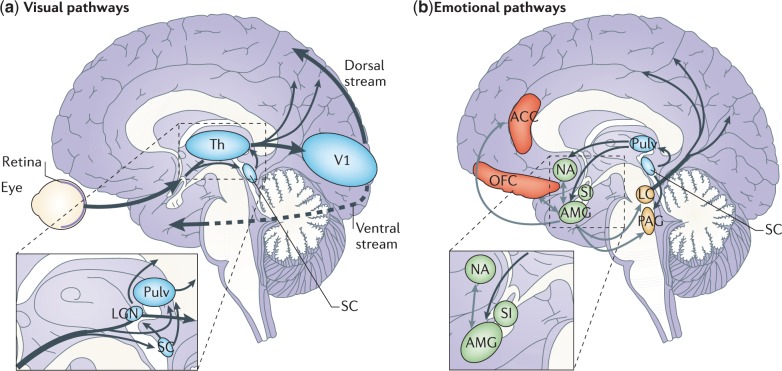
In Parkinson's disease, visual dysfunction is prominent. Visual hallucinations can be a major hallmark of late stage disease, but numerous visual deficits also occur in early stage Parkinson's disease. Specific retinopathy, deficits in the primary visual pathway and the secondary ventral and dorsal pathways, as well as dysfunction of the attention pathways have all been posited as causes of hallucinations in Parkinson's disease. We present data from patients with Parkinson's disease that contrast with a known neuro-ophthalmological syndrome, termed 'blindsight'. In this syndrome, there is an absence of conscious object identification, but preserved 'guess' of the location of a stimulus, preserved reflexive saccades and motion perception and preserved autonomical and expressive reactions to negative emotional facial expressions. We propose that patients with Parkinson's disease have the converse of blindsight, being 'blind to blindsight'. As such they preserve conscious vision, but show erroneous 'guess' localization of visual stimuli, poor saccades and motion perception, and poor emotional face perception with blunted autonomic reaction. Although a large data set on these deficits in Parkinson's disease has been accumulated, consolidation into one specific syndrome has not been proposed. Focusing on neuropathological and physiological data from two phylogenetically old and subconscious pathways, the retino-colliculo-thalamo-amygdala and the retino-geniculo-extrastriate pathways, we propose that aberrant function of these systems, including pathologically inhibited superior colliculus activity, deficient corollary discharges to the frontal eye fields, dysfunctional pulvinar, claustrum and amygdaloid subnuclei of the amygdala, the latter progressively burdened with Lewy bodies, underlie this syndrome. These network impairments are further corroborated by the concept of the 'silent amygdala'. Functionally being 'blind to blindsight' may facilitate the highly distinctive 'presence' or 'passage' hallucinations of Parkinson's disease and can help to explain handicaps in driving capacities and dysfunctional 'theory of mind'. We propose this synthesis to prompt refined neuropathological and neuroimaging studies on the pivotal nuclei in these pathways in order to better understand the networks underpinning this newly conceptualized syndrome in Parkinson's disease.
在帕金森病中,视觉功能障碍很突出。视觉幻觉可能是疾病晚期的一个主要标志,但在帕金森病的早期也存在许多视觉缺陷。特定的视网膜病变、初级视觉通路和次级腹侧和背侧通路的缺陷,以及注意力通路的功能障碍,都被认为是帕金森病幻觉的原因。我们提出了帕金森病患者的数据,与一种已知的神经眼科综合征形成对比,称为“盲视”。在这种综合征中,存在对物体的有意识识别缺失,但对刺激位置的“猜测”保留,反射性扫视和运动感知保留,以及对负性情绪面部表情的自主和表达反应保留。我们提出,帕金森病患者的情况与盲视相反,即“对盲视视而不见”。因此,他们保留有意识的视觉,但表现出错误的“猜测”视觉刺激的定位、较差的扫视和运动感知,以及对情绪面部感知的反应迟钝,自主反应减弱。尽管已经积累了大量关于帕金森病这些缺陷的数据,但尚未提出将其整合为一种特定的综合征。我们专注于两个在进化上古老的、潜意识的通路的神经病理学和生理学数据,即视网膜-脑丘-丘脑-杏仁核和视网膜-纹状体外侧通路,我们提出这些系统的异常功能,包括病理性抑制上丘的活动、对额眼区的伴随放电不足、丘脑枕和屏状核以及杏仁核的杏仁核亚核的功能障碍,以及后者逐渐被路易体负担,是这种综合征的基础。通过“沉默的杏仁核”这一概念,可以进一步证实这些网络损伤。功能上的“对盲视视而不见”可能促进帕金森病高度独特的“存在”或“经过”幻觉,并有助于解释驾驶能力障碍和“心理理论”障碍。我们提出这一综合观点,以促使对这些通路中关键核团进行更精细的神经病理学和神经影像学研究,以便更好地理解支持帕金森病这一新概念综合征的网络。