O'Neill Brenda, McDowell Kathryn, Bradley Judy, Blackwood Bronagh, Mullan Brian, Lavery Gavin, Agus Ashley, Murphy Sally, Gardner Evie, McAuley Daniel F
Centre for Health and Rehabilitation Technologies (CHaRT), Institute of Nursing and Health Research, School of Health Sciences, University of Ulster, Newtownabbey BT37 0QB, UK.
Trials. 2014 Apr 27;15:146. doi: 10.1186/1745-6215-15-146.
Following discharge home from the ICU, patients often suffer from reduced physical function, exercise capacity, health-related quality of life and social functioning. There is usually no support to address these longer term problems, and there has been limited research carried out into interventions which could improve patient outcomes. The aim of this study is to investigate the effectiveness and cost-effectiveness of a 6-week programme of exercise on physical function in patients discharged from hospital following critical illness compared to standard care.
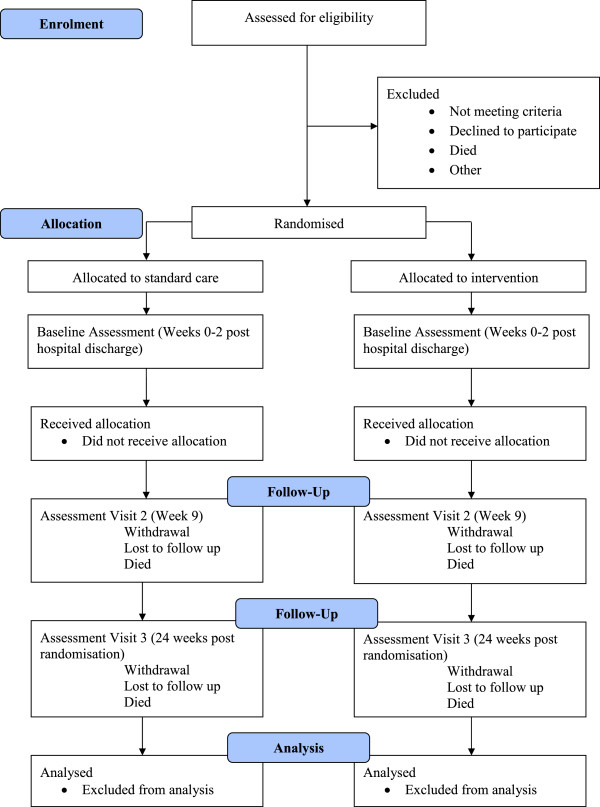
METHODS/DESIGN: The study design is a multicentre prospective phase II, allocation-concealed, assessor-blinded, randomised controlled clinical trial. Participants randomised to the intervention group will complete three exercise sessions per week (two sessions of supervised exercise and one unsupervised session) for 6 weeks. Supervised sessions will take place in a hospital gymnasium or, if this is not possible, in the participants home and the unsupervised session will take place at home. Blinded outcome assessment will be conducted at baseline after hospital discharge, following the exercise intervention, and at 6 months following baseline assessment (or equivalent time points for the standard care group). The primary outcome measure is physical function as measured by the physical functioning subscale of the Short-Form-36 health survey following the exercise programme. Secondary outcomes are health-related quality of life, exercise capacity, anxiety and depression, self efficacy to exercise and healthcare resource use. In addition, semi-structured interviews will be conducted to explore participants' perceptions of the exercise programme, and the feasibility (safety, practicality and acceptability) of providing the exercise programme will be assessed. A within-trial cost-utility analysis to assess the cost-effectiveness of the intervention compared to standard care will also be conducted.
If the exercise programme is found to be effective, this study will improve outcomes that are meaningful to patients and their families. It will inform the design of a future multicentre phase III clinical trial of exercise following recovery from critical illness. It will provide useful information which will help the development of services for patients after critical illness.
ClinicalTrials.gov NCT01463579.
从重症监护病房出院回家后,患者常常身体功能下降、运动能力降低、健康相关生活质量和社会功能受到影响。通常没有针对这些长期问题的支持措施,并且针对能够改善患者预后的干预措施的研究也很有限。本研究的目的是调查与标准护理相比,为期6周的运动计划对危重症出院患者身体功能的有效性和成本效益。
方法/设计:本研究设计为多中心前瞻性II期、分配隐藏、评估者盲法、随机对照临床试验。随机分配到干预组的参与者将每周进行三次运动训练(两次有监督的运动训练和一次无监督的训练),持续6周。有监督的训练将在医院体育馆进行,如果不可能,则在参与者家中进行,无监督的训练将在家中进行。在出院后的基线、运动干预后以及基线评估后6个月(或标准护理组的等效时间点)进行盲法结局评估。主要结局指标是运动计划后通过简短36项健康调查的身体功能分量表测量的身体功能。次要结局包括健康相关生活质量、运动能力、焦虑和抑郁、运动自我效能以及医疗资源使用。此外,将进行半结构化访谈以探讨参与者对运动计划的看法,并评估提供该运动计划的可行性(安全性、实用性和可接受性)。还将进行试验内成本效用分析,以评估与标准护理相比干预措施的成本效益。
如果运动计划被证明是有效的,本研究将改善对患者及其家人有意义的结局。它将为未来危重症康复后运动的多中心III期临床试验的设计提供信息。它将提供有用信息,有助于为危重症患者开发服务。
ClinicalTrials.gov NCT01463579。