MRC Cognition and Brain Sciences Unit, Cambridge, UK.
Institut für Psychologie, Universität Bern, Bern, Switzerland; Center for Cognition, Learning, and Memory, Universität Bern, Bern, Switzerland.
Trends Cogn Sci. 2014 Jul;18(7):376-84. doi: 10.1016/j.tics.2014.03.004. Epub 2014 Apr 24.
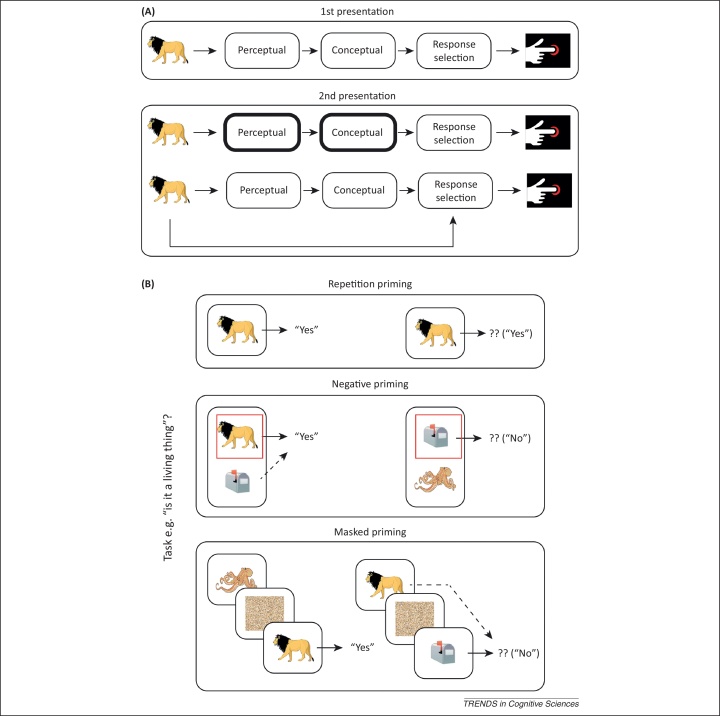
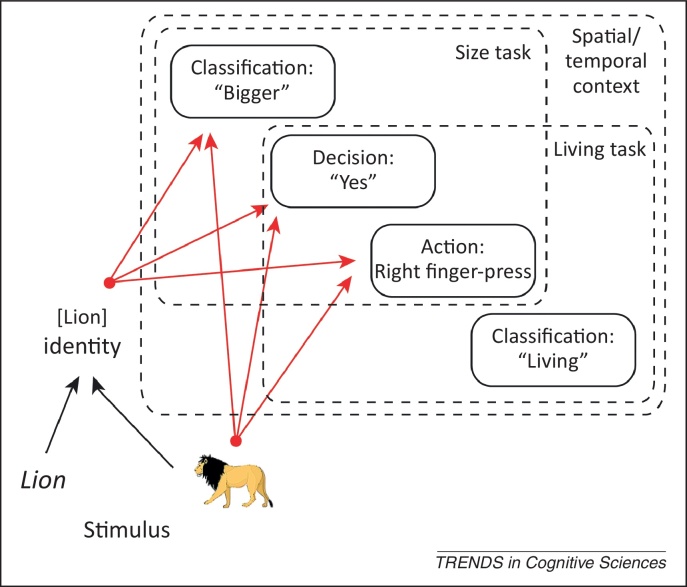
People can rapidly form arbitrary associations between stimuli and the responses they make in the presence of those stimuli. Such stimulus-response (S-R) bindings, when retrieved, affect the way that people respond to the same, or related, stimuli. Only recently, however, has the flexibility and ubiquity of these S-R bindings been appreciated, particularly in the context of priming paradigms. This is important for the many cognitive theories that appeal to evidence from priming. It is also important for the control of action generally. An S-R binding is more than a gradually learned association between a specific stimulus and a specific response; instead, it captures the full, context-dependent behavioral potential of a stimulus.
人们可以在刺激存在的情况下迅速将刺激和他们做出的反应任意地联系起来。这种刺激-反应 (S-R) 绑定在被检索时会影响人们对相同或相关刺激的反应方式。然而,直到最近,这些 S-R 绑定的灵活性和普遍性才得到重视,特别是在启动范式的背景下。这对于许多依赖于启动证据的认知理论很重要。它对一般的行动控制也很重要。S-R 绑定不仅仅是特定刺激和特定反应之间逐渐习得的关联,而是捕捉了刺激的完整、上下文相关的行为潜力。