Bittner Ava K, Gould Jeffrey M, Rosenfarb Andy, Rozanski Collin, Dagnelie Gislin
Johns Hopkins University, Wilmer Eye Institute, Baltimore, Maryland, USA.
Clin Exp Optom. 2014 May;97(3):240-7. doi: 10.1111/cxo.12117. Epub 2013 Oct 29.
Patients with retinitis pigmentosa are motivated to try complementary or integrative therapies to slow disease progression. Basic science, clinical research and retinitis pigmentosa patients' self-reports support the hypothesis that acupuncture may improve visual function.
A prospective, case series, pilot study enrolled 12 adult patients with RP treated at an academic medical centre with a standardised protocol that combined electroacupuncture to the forehead and below the eyes and acupuncture to the body, at 10 half-hour sessions over two weeks. Pre- and post-treatment tests included Early Treatment Diabetic Retinopathy Study visual acuity (VA), Pelli-Robson contrast sensitivity (CS), Goldmann visual fields, and dark-adapted full-field stimulus threshold (FST)(n = 9). Scotopic Sensitivity Tester-1 (SST-1) dark-adaptometry was performed on the last two subjects.
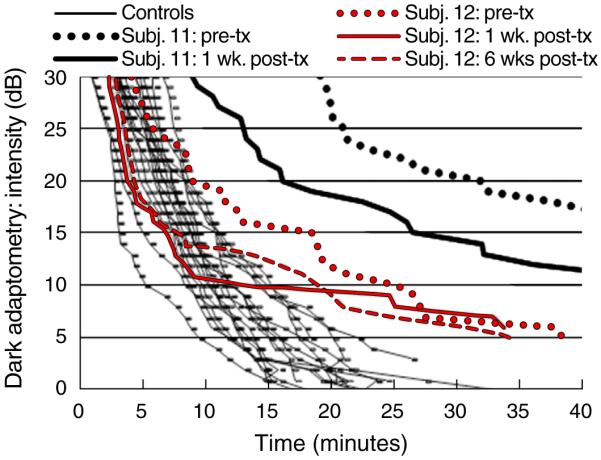
Six of 12 subjects had measurable, significant visual function improvements after treatment. Three of nine subjects tested with the FST had a significant 10.3 to 17.5 dB (that is, 13- to 53-fold) improvement in both eyes at one week after acupuncture, maintained for at least 10 to 12 months, which was well outside typical test-retest variability (95% CI: 3-3.5 dB) previously found in retinitis pigmentosa. SST-1 dark-adaptation was shortened in both subjects tested on average by 48.5 per cent at one week (range 36 to 62 per cent across 10 to 30 dB), which was outside typical coefficients of variation of less than 30 per cent previously determined in patients with retinitis pigmentosa and normals. Four of the five subjects with psychophysically measured scotopic sensitivity improvements reported subjective improvements in vision at night or in dark environments. One subject had 0.2 logMAR improvement in VA; another had 0.55 logCS improvement. Another subject developed more than 20 per cent improvement in the area of the Goldmann visual fields. The acupuncture protocol was completed and well tolerated by all, without adverse events or visual loss.
Acupuncture entails minimal risk, if administered by a well-trained acupuncturist and may have significant, measurable benefits on residual visual function in patients with retinitis pigmentosa, in particular scotopic sensitivity, which had not previously been studied. These preliminary findings support the need for future controlled studies of potential mechanisms.
视网膜色素变性患者有尝试补充或整合疗法以减缓疾病进展的意愿。基础科学、临床研究以及视网膜色素变性患者的自我报告均支持针刺可能改善视觉功能这一假说。
一项前瞻性病例系列试点研究纳入了12名在学术医疗中心接受治疗的成年视网膜色素变性患者,采用标准化方案,在两周内进行10次半小时的治疗,该方案包括对额头和眼睛下方进行电针治疗以及对身体进行针刺治疗。治疗前和治疗后的测试包括糖尿病视网膜病变早期治疗研究视力(VA)、佩利-罗布森对比敏感度(CS)、戈德曼视野检查以及暗适应全视野刺激阈值(FST)(n = 9)。对最后两名受试者进行了暗视敏感度测试仪-1(SST-1)暗适应测量。
12名受试者中有6名在治疗后视觉功能有可测量的显著改善。在接受FST测试的9名受试者中,有3名在针刺治疗后1周时双眼有显著改善,改善幅度为10.3至17.5分贝(即13至53倍),并持续至少10至12个月,这超出了先前在视网膜色素变性患者中发现的典型重测变异性(95%可信区间:3 - 3.5分贝)。在接受测试的两名受试者中,SST-1暗适应平均在1周时缩短了48.5%(在10至30分贝范围内为36%至62%),这超出了先前在视网膜色素变性患者和正常人中确定的典型变异系数(小于30%)。在通过心理物理学测量暗视敏感度有所改善的5名受试者中,有4名报告在夜间或黑暗环境中的视力有主观改善。一名受试者的视力提高了0.2 logMAR;另一名受试者的对比敏感度提高了0.55 logCS。另一名受试者的戈德曼视野面积改善超过20%。所有受试者均完成了针刺方案,且耐受性良好,未出现不良事件或视力丧失。
如果由训练有素的针灸师实施,针刺风险极小,并且可能对视网膜色素变性患者的残余视觉功能,特别是暗视敏感度产生显著的、可测量的益处,而暗视敏感度此前尚未得到研究。这些初步发现支持未来对潜在机制进行对照研究的必要性。