Fu Junsheng, Chen Huadong, Soroka Dominique N, Warin Renaud F, Sang Shengmin
Center for Excellence in Post-Harvest Technologies, North Carolina Agricultural and Technical State University, North Carolina Research Campus , 500 Laureate Way, Kannapolis, North Carolina 28081, United States.
J Agric Food Chem. 2014 May 21;62(20):4632-42. doi: 10.1021/jf501351r. Epub 2014 May 12.
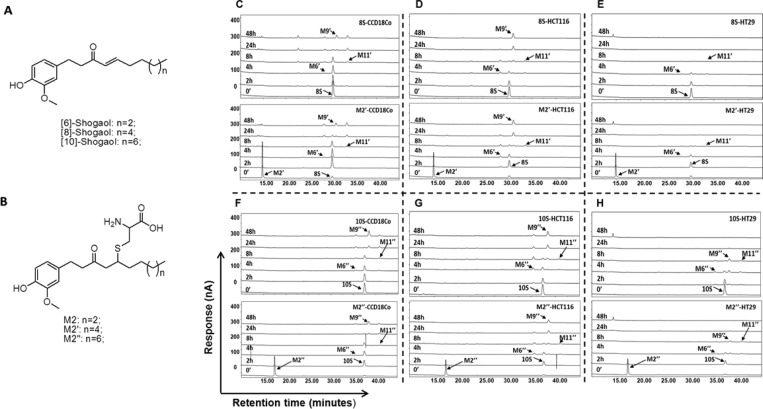
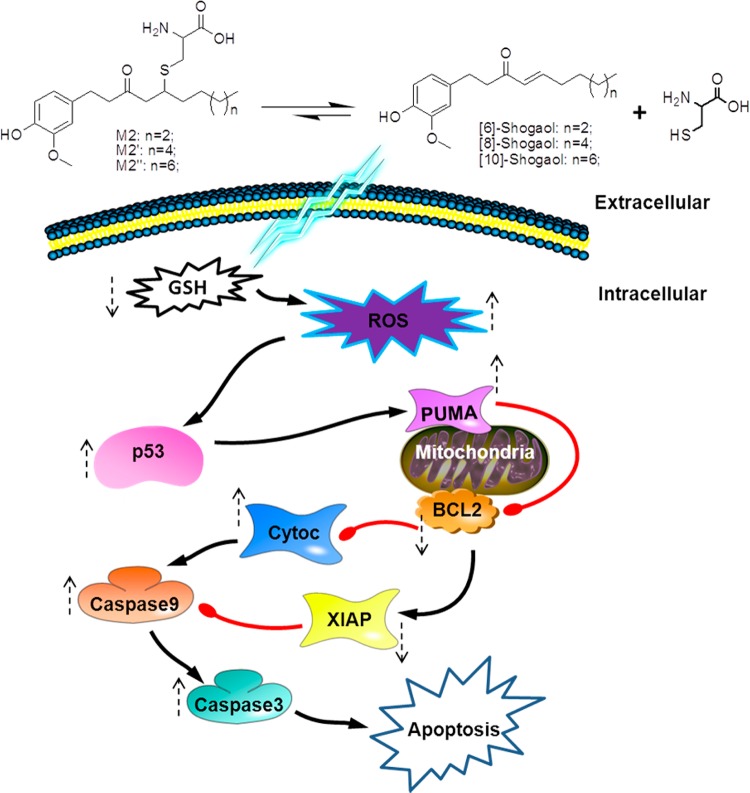
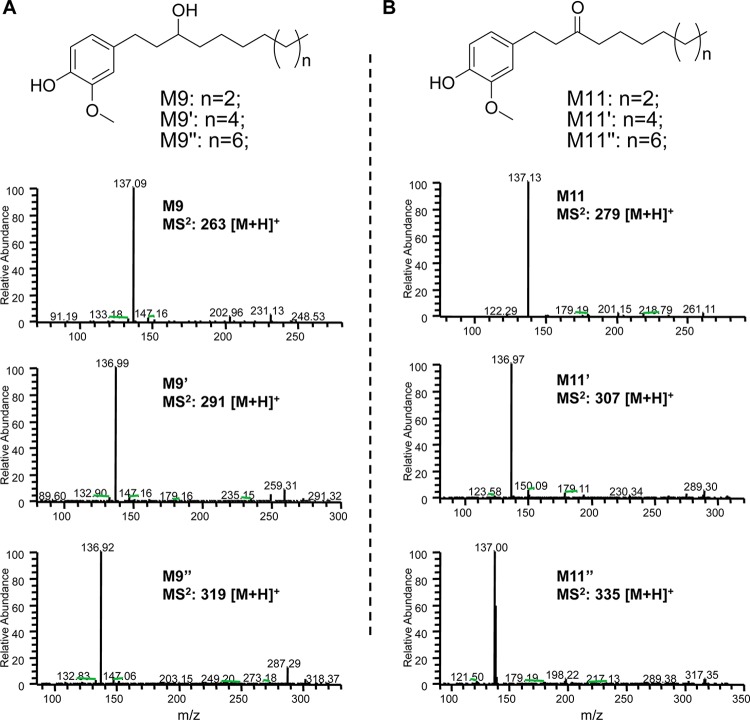
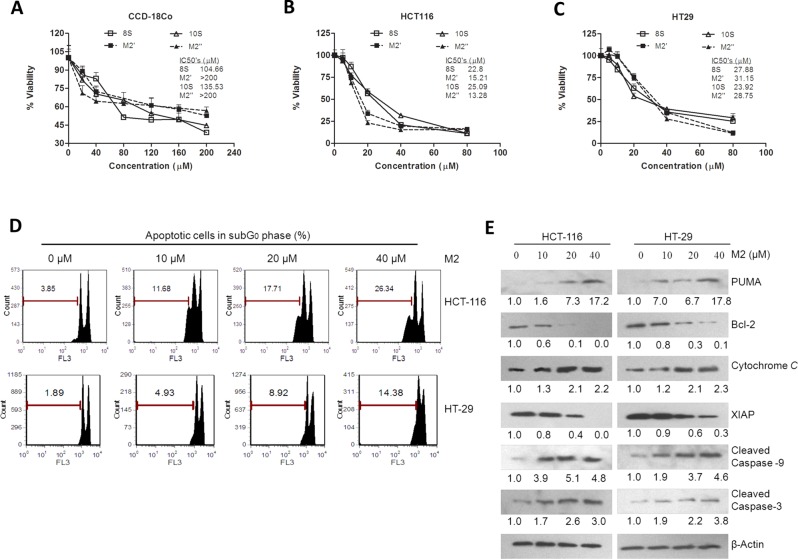
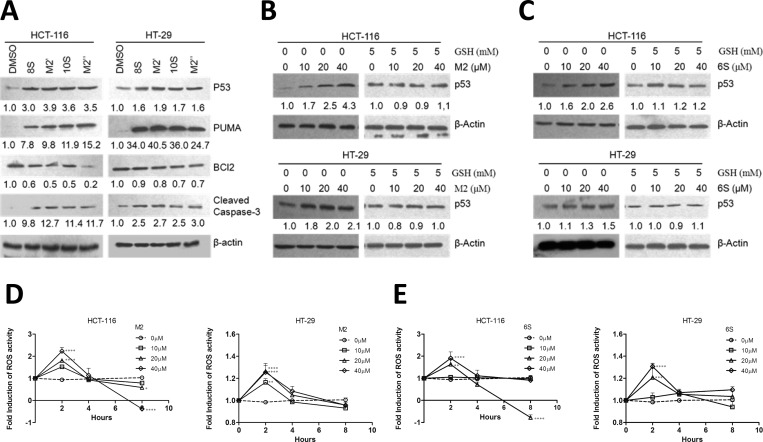
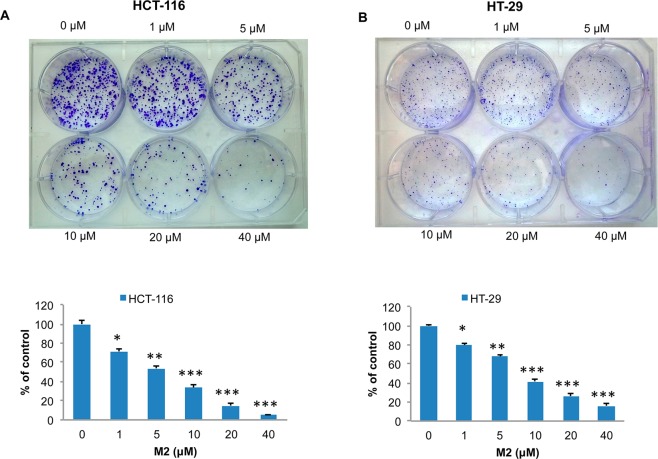
Shogaols, the major constituents of thermally processed ginger, have been proven to be highly effective anticancer agents. Our group has identified cysteine-conjugated shogaols (M2, M2', and M2″) as the major metabolites of [6]-, [8]-, and [10]-shogaol in human and found that M2 is a carrier of its parent molecule [6]-shogaol in cancer cells and in mice, while being less toxic to normal colon fibroblast cells. The objectives of this study are to determine whether M2' and M2″ behave in a similar manner to M2, in both metabolism and efficacy as anticancer agents, and to further explore the biological pro-apoptotic mechanisms of the cysteine-conjugated shogaols against human colon cancer cells HCT-116 and HT-29. Our results show that [8]- and [10]-shogaol have similar metabolic profiles to [6]-shogaol and exhibit similar toxicity toward human colon cancer cells. M2' and M2″ both show low toxicity against normal colon cells but retain potency against colon cancer cells, suggesting that they have similar activity to M2. We further demonstrate that the cysteine-conjugated shogaols can cause cancer cell death through the activation of the mitochondrial apoptotic pathway. Our results show that oxidative stress activates a p53 pathway that ultimately leads to p53 up-regulated modulator of apoptosis (PUMA) induction and down-regulation of B-cell lymphoma 2 (Bcl-2), followed by cytochrome c release, perturbation of inhibitory interactions of X-linked inhibitor of apoptosis protein (XIAP) with caspases, and finally caspase 9 and 3 activation and cleavage. A brief screen of the markers attenuated by the proapoptotic activity of M2 revealed similar results for [8]- and [10]-shogaol and their respective cysteine-conjugated metabolites M2' and M2″. This study highlights the cysteine-conjugated metabolites of shogaols as novel dietary colon cancer preventive agents.
姜辣素是热加工生姜的主要成分,已被证明是高效的抗癌剂。我们的研究小组已确定半胱氨酸共轭姜辣素(M2、M2'和M2″)是[6]-、[8]-和[10]-姜辣素在人体内的主要代谢产物,并发现M2是其母体分子[6]-姜辣素在癌细胞和小鼠体内的载体,而对正常结肠成纤维细胞的毒性较小。本研究的目的是确定M2'和M2″在代谢和作为抗癌剂的功效方面是否与M2表现相似,并进一步探索半胱氨酸共轭姜辣素对人结肠癌细胞HCT-116和HT-29的生物学促凋亡机制。我们的结果表明,[8]-和[10]-姜辣素具有与[6]-姜辣素相似的代谢谱,并对人结肠癌细胞表现出相似的毒性。M2'和M2″对正常结肠细胞均表现出低毒性,但对结肠癌细胞仍具有效力,表明它们与M2具有相似的活性。我们进一步证明,半胱氨酸共轭姜辣素可通过激活线粒体凋亡途径导致癌细胞死亡。我们的结果表明,氧化应激激活p53途径,最终导致p53上调凋亡调节因子(PUMA)的诱导和B细胞淋巴瘤2(Bcl-2)的下调,随后细胞色素c释放,凋亡抑制蛋白(XIAP)与半胱天冬酶抑制相互作用的扰动,最终半胱天冬酶9和3激活和裂解。对被M2的促凋亡活性减弱的标志物进行的简要筛选显示,[8]-和[10]-姜辣素及其各自的半胱氨酸共轭代谢产物M2'和M2″的结果相似。本研究强调了姜辣素的半胱氨酸共轭代谢产物作为新型膳食结肠癌预防剂的作用。