Blennow Kaj, Dubois Bruno, Fagan Anne M, Lewczuk Piotr, de Leon Mony J, Hampel Harald
Department of Neuroscience and Physiology, Clinical Neurochemistry Laboratory, Sahlgrenska University Hospital, University of Gothenburg, Mölndal, Sweden.
Institute for Memory and Alzheimer's Disease, Institute of Neurology, Pitié-Salpêtrière Hospital Group, Pierre and Marie Curie University, Paris, France.
Alzheimers Dement. 2015 Jan;11(1):58-69. doi: 10.1016/j.jalz.2014.02.004. Epub 2014 May 3.
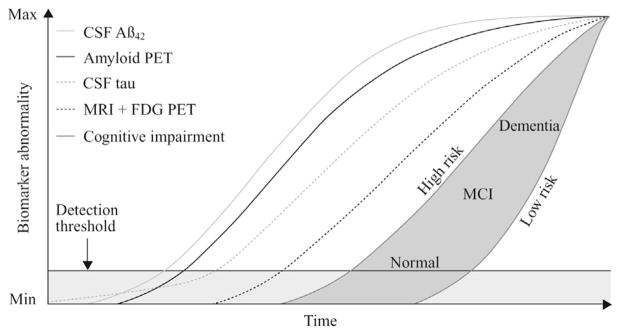
Several potential disease-modifying drugs for Alzheimer's disease (AD) have failed to show any effect on disease progression in clinical trials, conceivably because the AD subjects are already too advanced to derive clinical benefit from treatment and because diagnosis based on clinical criteria alone introduces a high misdiagnosis rate. Thus, well-validated biomarkers for early detection and accurate diagnosis are crucial. Low cerebrospinal fluid (CSF) concentrations of the amyloid-β (Aβ1-42) peptide, in combination with high total tau and phosphorylated tau, are sensitive and specific biomarkers highly predictive of progression to AD dementia in patients with mild cognitive impairment. However, interlaboratory variations in the results seen with currently available immunoassays are of concern. Recent worldwide standardization efforts and quality control programs include standard operating procedures for both preanalytical (e.g., lumbar puncture and sample handling) and analytical (e.g., preparation of calibration curve) procedures. Efforts are also ongoing to develop highly reproducible assays on fully automated instruments. These global standardization and harmonization measures will provide the basis for the generalized international application of CSF biomarkers for both clinical trials and routine clinical diagnosis of AD.
几种潜在的用于治疗阿尔茨海默病(AD)的疾病修饰药物在临床试验中未能显示出对疾病进展有任何效果,这可能是因为AD患者病情已经过于严重,无法从治疗中获得临床益处,也因为仅基于临床标准的诊断存在较高的误诊率。因此,经过充分验证的用于早期检测和准确诊断的生物标志物至关重要。脑脊液(CSF)中淀粉样β蛋白(Aβ1-42)肽浓度较低,同时总tau蛋白和磷酸化tau蛋白水平较高,是轻度认知障碍患者进展为AD痴呆的高度敏感且特异的生物标志物,对疾病进展具有高度预测性。然而,目前可用的免疫测定法所得到的结果在不同实验室之间存在差异,这令人担忧。近期全球范围内的标准化努力和质量控制计划包括针对分析前(如腰椎穿刺和样本处理)和分析过程(如校准曲线的制备)的标准操作程序。人们也在不断努力开发在全自动仪器上具有高度可重复性的检测方法。这些全球标准化和协调措施将为CSF生物标志物在AD的临床试验和常规临床诊断中的广泛国际应用提供基础。