Chun Rene F, Liu Philip T, Modlin Robert L, Adams John S, Hewison Martin
Department of Orthopaedic Surgery, Orthopedic Hospital Research Center, David Geffen School of Medicine, University of California at Los Angeles Los Angeles, CA, USA.
Division of Dermatology, Department of Medicine, David Geffen School of Medicine, University of California at Los Angeles Los Angeles, CA, USA.
Front Physiol. 2014 Apr 21;5:151. doi: 10.3389/fphys.2014.00151. eCollection 2014.
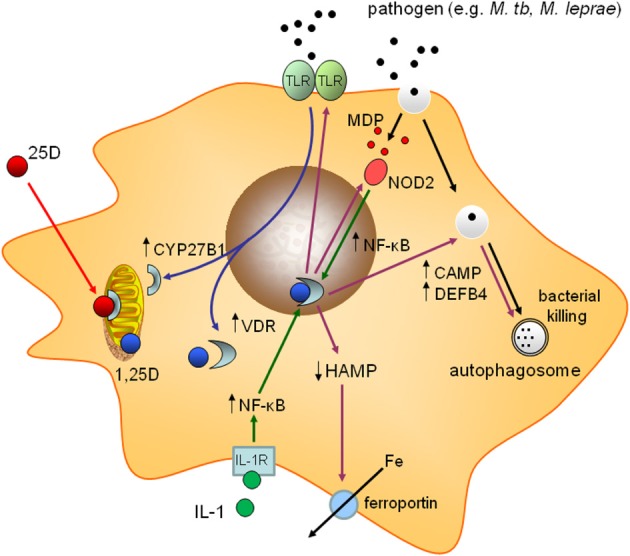
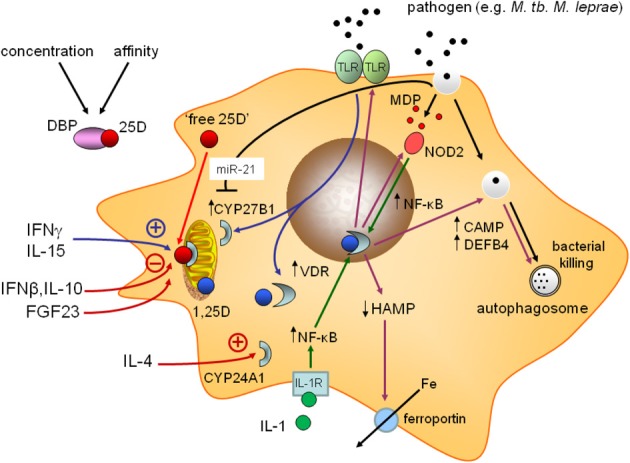
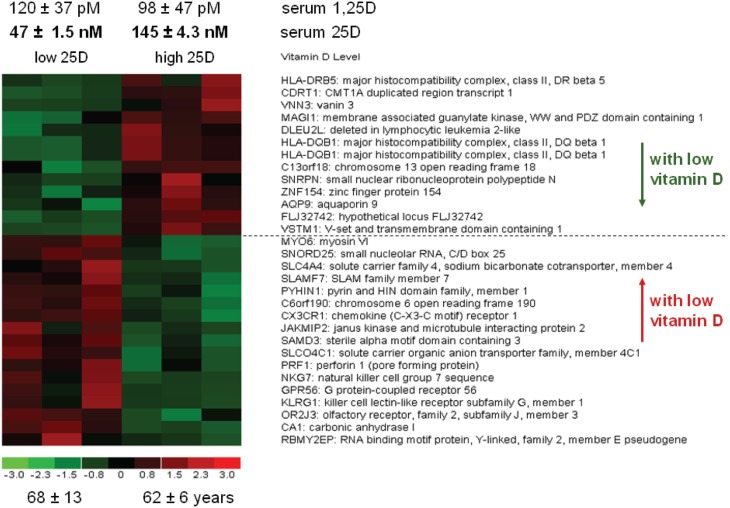
Immunomodulatory responses to the active form of vitamin D (1,25-dihydroxyvitamin D, 1,25D) have been recognized for many years, but it is only in the last 5 years that the potential role of this in normal human immune function has been recognized. Genome-wide analyses have played a pivotal role in redefining our perspective on vitamin D and immunity. The description of increased vitamin D receptor (VDR) and 1α-hydroxylase (CYP27B1) expression in macrophages following a pathogen challenge, has underlined the importance of intracrine vitamin D as key mediator of innate immune function. It is now clear that both macrophages and dendritic cells (DCs) are able to respond to 25-hydroxyvitamin D (25D), the major circulating vitamin D metabolite, thereby providing a link between the function of these cells and the variations in vitamin D status common to many humans. The identification of hundreds of primary 1,25D target genes in immune cells has also provided new insight into the role of vitamin D in the adaptive immune system, such as the modulation of antigen-presentation and T cells proliferation and phenotype, with the over-arching effects being to suppress inflammation and promote immune tolerance. In macrophages 1,25D promotes antimicrobial responses through the induction of antibacterial proteins, and stimulation of autophagy and autophagosome activity. In this way variations in 25D levels have the potential to influence both innate and adaptive immune responses. More recent genome-wide analyses have highlighted how cytokine signaling pathways can influence the intracrine vitamin D system and either enhance or abrogate responses to 25D. The current review will discuss the impact of intracrine vitamin D metabolism on both innate and adaptive immunity, whilst introducing the concept of disease-specific corruption of vitamin D metabolism and how this may alter the requirements for vitamin D in maintaining a healthy immune system in humans.
对活性形式的维生素D(1,25-二羟基维生素D,1,25D)的免疫调节反应已被认识多年,但直到最近5年,其在正常人体免疫功能中的潜在作用才被认识到。全基因组分析在重新定义我们对维生素D与免疫的看法方面发挥了关键作用。病原体攻击后巨噬细胞中维生素D受体(VDR)和1α-羟化酶(CYP27B1)表达增加的描述,突出了内分泌维生素D作为先天免疫功能关键介质的重要性。现在很清楚,巨噬细胞和树突状细胞(DCs)都能够对主要循环维生素D代谢物25-羟基维生素D(25D)作出反应,从而在这些细胞的功能与许多人常见的维生素D状态变化之间建立了联系。免疫细胞中数百个主要的1,25D靶基因的鉴定,也为维生素D在适应性免疫系统中的作用提供了新的见解,如对抗原呈递、T细胞增殖和表型的调节,总体效果是抑制炎症和促进免疫耐受。在巨噬细胞中,1,25D通过诱导抗菌蛋白以及刺激自噬和自噬体活性来促进抗菌反应。这样,25D水平的变化有可能影响先天和适应性免疫反应。最近的全基因组分析强调了细胞因子信号通路如何影响内分泌维生素D系统,并增强或消除对25D的反应。本综述将讨论内分泌维生素D代谢对先天和适应性免疫的影响,同时介绍维生素D代谢的疾病特异性破坏概念,以及这可能如何改变维持人类健康免疫系统所需的维生素D量。