ISSUL Institute of Sport Sciences University of Lausanne, Lausanne, Switzerland; Department of Physiology, University of Lausanne, Lausanne, Switzerland.
Faculty of Health Science, University of Adelaide, Adelaide, South Australia, Australia.
PLoS One. 2014 May 5;9(5):e95092. doi: 10.1371/journal.pone.0095092. eCollection 2014.
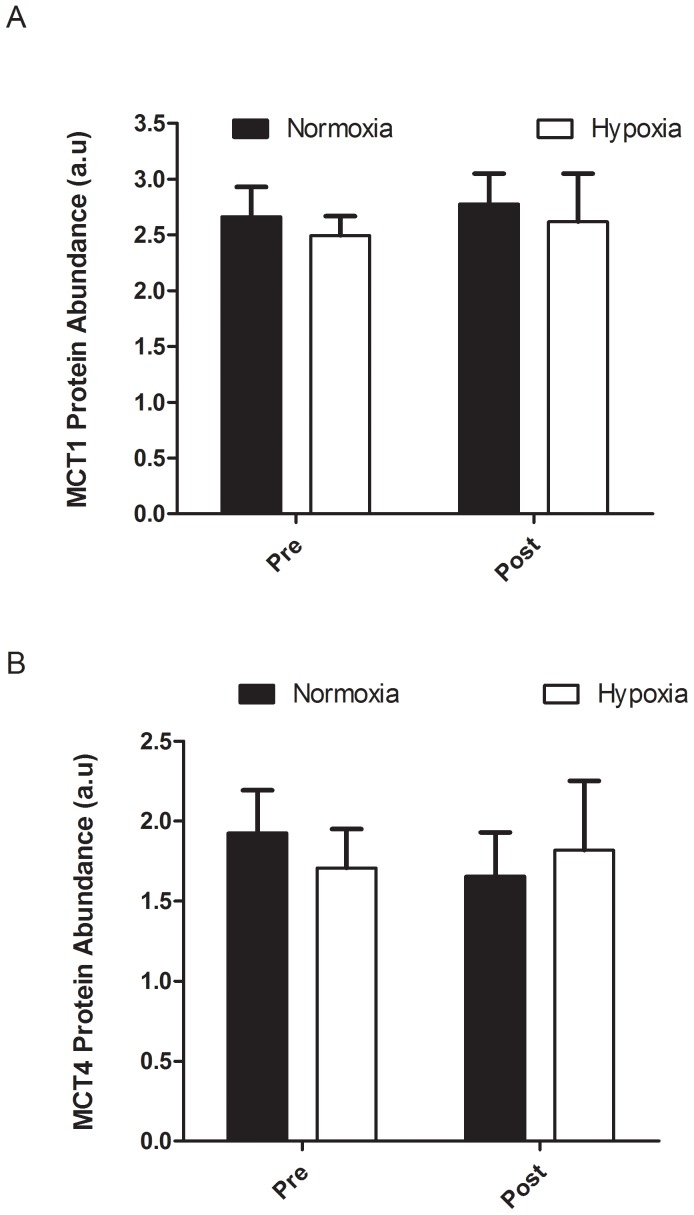
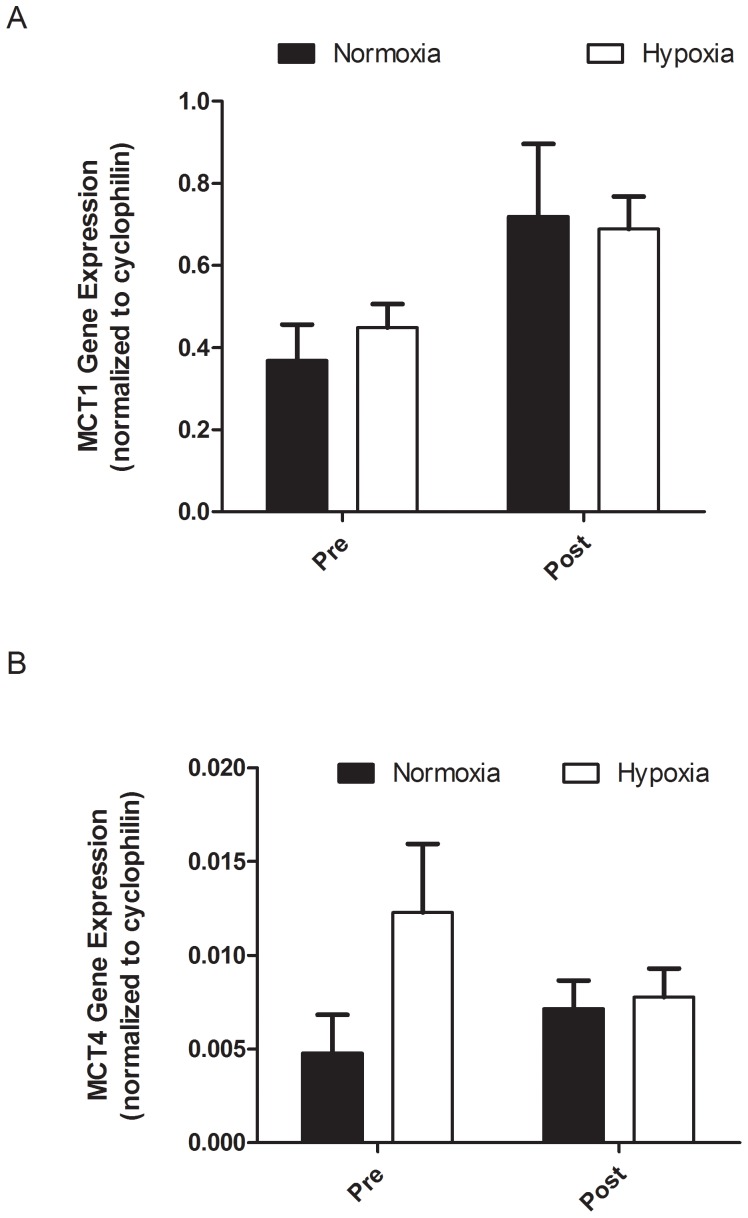
This study examined the effects of intermittent hypoxic training (IHT) on skeletal muscle monocarboxylate lactate transporter (MCT) expression and anaerobic performance in trained athletes. Cyclists were assigned to two interventions, either normoxic (N; n = 8; 150 mmHg PIO2) or hypoxic (H; n = 10; ∼3000 m, 100 mmHg PIO2) over a three week training (5×1 h-1h30 x week(-1)) period. Prior to and after training, an incremental exercise test to exhaustion (EXT) was performed in normoxia together with a 2 min time trial (TT). Biopsy samples from the vastus lateralis were analyzed for MCT1 and MCT4 using immuno-blotting techniques. The peak power output (PPO) increased (p<0.05) after training (7.2% and 6.6% for N and H, respectively), but VO2max showed no significant change. The average power output in the TT improved significantly (7.3% and 6.4% for N and H, respectively). No differences were found in MCT1 and MCT4 protein content, before and after the training in either the N or H group. These results indicate there are no additional benefits of IHT when compared to similar normoxic training. Hence, the addition of the hypoxic stimulus on anaerobic performance or MCT expression after a three-week training period is ineffective.
本研究旨在探讨间歇性低氧训练(IHT)对训练有素的运动员骨骼肌单羧酸转运蛋白(MCT)表达和无氧性能的影响。将自行车运动员分为两组,分别接受常氧(N;n=8;150 mmHg PIO2)或低氧(H;n=10;~3000 m,100 mmHg PIO2)干预,为期三周的训练(5×1 h-1h30 x 周(-1))。在训练前后,在常氧下进行递增至力竭的运动试验(EXT)和 2 分钟计时试验(TT)。使用免疫印迹技术分析股外侧肌的 MCT1 和 MCT4。峰值功率输出(PPO)在训练后增加(N 和 H 组分别增加 7.2%和 6.6%),但 VO2max 没有显著变化。TT 的平均功率输出显著提高(N 和 H 组分别提高 7.3%和 6.4%)。在 N 或 H 组中,无论是在训练前还是训练后,MCT1 和 MCT4 蛋白含量均无差异。这些结果表明,与类似的常氧训练相比,IHT 没有额外的益处。因此,在三周的训练期后,添加低氧刺激对无氧性能或 MCT 表达没有效果。