Maciejczyk Marcin, Palka Tomasz, Wiecek Magdalena, Szygula Zbigniew
Department of Physiology and Biochemistry, University of Physical Education, Kraków, Poland.
Department of Sport Medicine and Nutrition, University of Physical Education, Kraków, Poland.
Sci Rep. 2024 Oct 2;14(1):22879. doi: 10.1038/s41598-024-74686-w.
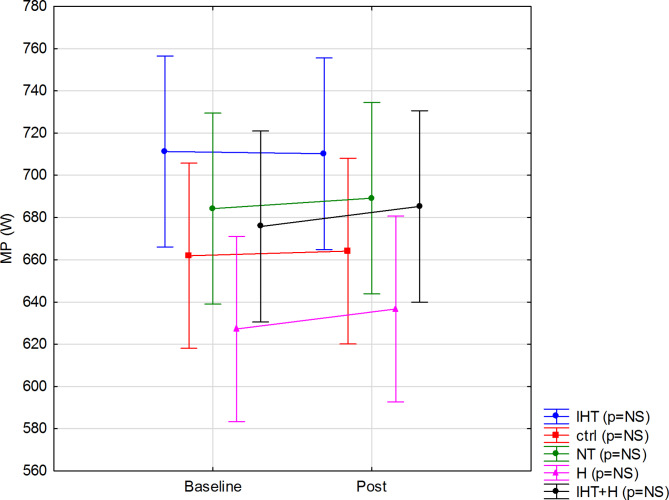
Physical training in heat or hypoxia can improve physical performance. The purpose of this parallel group study was to investigate the concurrent effect of training performed simultaneously in heat (31 °C) and hypoxia (FIO = 14.4%) on anaerobic capacity in young men. For the study, 80 non-trained men were recruited and divided into 5 groups (16 participants per group): control, non-training (CTRL); training in normoxia and thermoneutral conditions (NT: 21 °C, FIO = 20.95%); training in normoxia and heat (H: 31 °C, FIO = 20.95%); training in hypoxia and thermoneutral conditions (IHT: 21 °C, FIO = 14.4%), and training in hypoxia and heat (IHT + H: 31 °C, FIO = 14.4%). Before and after physical training, the participants performed the Wingate Test, in which peak power and mean power were measured. Physical training lasted 4 weeks and the participants exercised 3 times a week for 60 min, performing interval training. Only the IHT and IHT + H groups showed significant increases in absolute peak power (p < 0.001, ES = 0.36 and p = 0.02, ES = 0.26, respectively). There were no significant changes (p = 0.18) after training in mean power. Hypoxia appeared to be an environmental factor that significantly improved peak power, but not mean power. Heat, added to hypoxia, did not increase cycling anaerobic power. Also, training only in heat did not significantly affect anaerobic power. The inclusion of heat and/or hypoxia in training did not induce negative effects, i.e., a reduction in peak and mean power as measured in the Wingate Test.
在高温或低氧环境下进行体育训练可以提高身体机能。这项平行组研究的目的是调查在高温(31°C)和低氧(FIO = 14.4%)环境下同时进行训练对年轻男性无氧能力的协同影响。在该研究中,招募了80名未经训练的男性,并将他们分为5组(每组16名参与者):对照组,不进行训练(CTRL);在常氧和热中性条件下训练(NT:21°C,FIO = 20.95%);在常氧和高温条件下训练(H:31°C,FIO = 20.95%);在低氧和热中性条件下训练(IHT:21°C,FIO = 14.4%),以及在低氧和高温条件下训练(IHT + H:31°C,FIO = 14.4%)。在体育训练前后,参与者进行了温盖特测试,测量了峰值功率和平均功率。体育训练持续4周,参与者每周锻炼3次,每次60分钟,进行间歇训练。只有IHT组和IHT + H组的绝对峰值功率有显著增加(分别为p < 0.001,ES = 0.36和p = 0.02,ES = 0.26)。训练后平均功率没有显著变化(p = 0.18)。低氧似乎是一个能显著提高峰值功率,但不能提高平均功率的环境因素。在低氧环境中加入高温,并没有增加骑行无氧功率。此外,仅在高温环境下训练对无氧功率没有显著影响。在训练中加入高温和/或低氧并没有产生负面影响,即温盖特测试中测量的峰值和平均功率没有降低。