Kizaka S, Hakura A
Research Institute for Microbial Diseases, Osaka University, Japan.
Mol Cell Biol. 1989 Dec;9(12):5669-75. doi: 10.1128/mcb.9.12.5669-5675.1989.
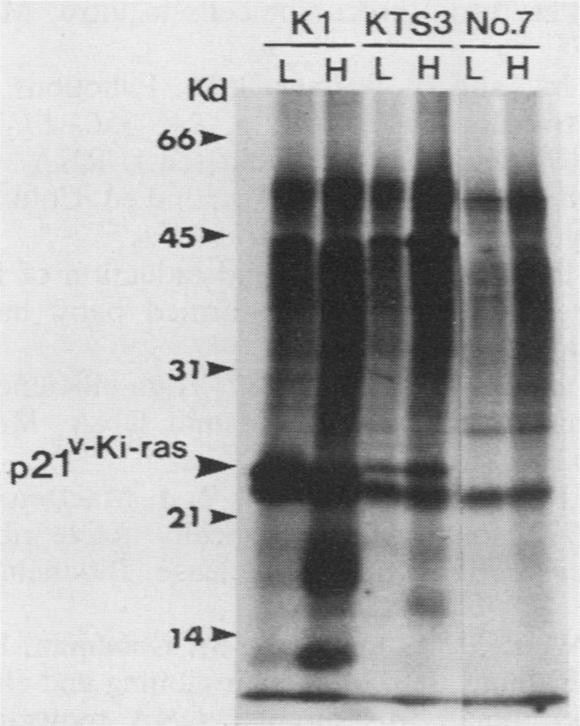
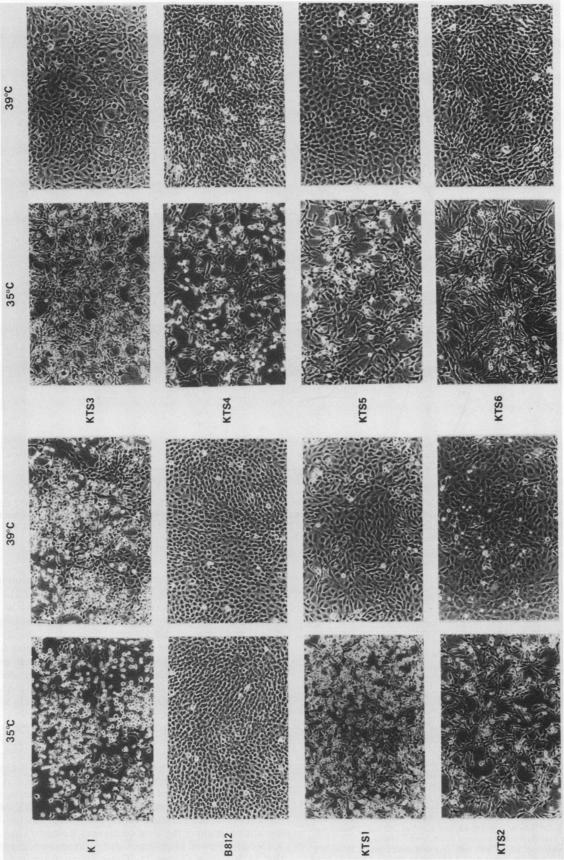
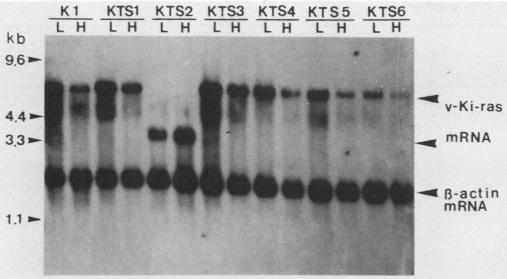
We previously isolated a Fisher rat fibroblast mutant, B812, that has the unique property of temperature-dependent transformation by various oncogenic retroviruses. At the permissive temperature (35 degrees C), this mutant was sensitive to oncogenic transformation and formed foci on a dish at the same frequency as did the parental fibroblast cell line. When Kirsten murine sarcoma virus (Ki-MSV) was applied to the cells, the frequency of focus formation decreased more than 25-fold at the nonpermissive temperature (39 degrees C), whereas the cells expressed nearly the same level of the ras transcript as well as the ras protein. The temperature-restricted focus formation was fully reversible and was completely suppressed upon fusion with the wild-type parent cell. In addition to ras, the mos, fos, src, and erbB-2 oncogenes transformed this mutant with the same temperature dependence as described above; polyomavirus middle T antigen, adenovirus type 12, and human papillomavirus 16-E67 also transformed, but without temperature dependence. These results suggest that ras, fos, mos, src, and erbB-2 use a common cellular pathway for transforming cells.
我们之前分离出了一种费希尔大鼠成纤维细胞突变体B812,它具有被多种致癌逆转录病毒进行温度依赖性转化的独特特性。在允许温度(35摄氏度)下,该突变体对致癌转化敏感,并且在培养皿上形成集落的频率与亲代成纤维细胞系相同。当将 Kirsten 小鼠肉瘤病毒(Ki-MSV)应用于细胞时,在非允许温度(39摄氏度)下集落形成频率降低超过25倍,而细胞中ras转录本以及ras蛋白的表达水平几乎相同。温度限制下的集落形成是完全可逆的,并且在与野生型亲代细胞融合后被完全抑制。除了ras之外,mos、fos、src和erbB-2癌基因以与上述相同的温度依赖性转化该突变体;多瘤病毒中T抗原、12型腺病毒和人乳头瘤病毒16-E67也能转化,但不具有温度依赖性。这些结果表明,ras、fos、mos、src和erbB-2利用共同的细胞途径来转化细胞。