Trinka Eugen, Höfler Julia, Zerbs Alexander, Brigo Francesco
Department of Neurology, Christian Doppler Klinik, Centre for Cognitive Neuroscience Salzburg, Paracelsus Medical University Salzburg, Ignaz Harrerstrasse 79, 5020, Salzburg, Austria,
CNS Drugs. 2014 Jul;28(7):623-39. doi: 10.1007/s40263-014-0167-1.
The effectiveness of valproate (VPA) in the treatment of focal and generalized epilepsies is well established. The drug has a wide spectrum of action, good tolerability, and has been available as an injectable formulation since 1993. Despite the lack of class A evidence, it has been used extensively in various forms of status epilepticus (SE).
Our aim was to present a systematic review of data from randomized and non-randomized controlled trials to evaluate the efficacy and safety of intravenous VPA for the treatment of SE.
Data sources included MEDLINE, back tracing of references in pertinent studies, and contact with the manufacturer of VPA (Sanofi-Aventis).
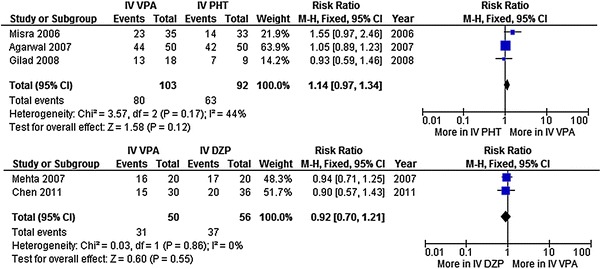
Overall, the search strategy yielded 433 results (425 MEDLINE, seven congress abstracts, one unpublished study); after excluding duplicate publications and case reports, 30 studies were identified (the earliest was published in 1993, the most recent in 2012); ten were controlled (six randomized controlled trials, four non-randomized controlled studies), and 20 uncontrolled trials (eight prospective observational studies, 12 retrospective case series). The cumulative literature describes the experiences of 860 patients with various forms of SE treated with intravenous VPA. The overall response rate to abrogate SE was 70.9% (601/848; 95% confidence interval [CI] 67.8-73.9). Response rates to intravenous VPA were better in children than in adults and did not differ between the SE types. The most commonly reported effective doses were between 15 and 45 mg/kg in bolus (6 mg/kg/min) followed by 1-3 mg/kg/h infusion. Safety studies of intravenous VPA administration in patients with SE showed a low incidence of adverse events overall (<10%), mainly dizziness, thrombocytopenia, and mild hypotension, which was independent of infusion rates. Of note, good cardiovascular and respiratory tolerability was observed in these studies, even at high doses and fast infusion rates (up to 30 mg/kg at 10 mg/kg/min), despite multiple morbidities or other antiepileptic drugs. The most serious concern relates to the possibility of acute encephalopathy, sometimes related to hepatic abnormalities or hyperammonemia.
The published experience is consistent with VPA being a safe and effective therapeutic option for patients with established SE who have previously failed conventional first-line treatment with benzodiazepines, but high-quality randomized controlled trials are needed to inform clinicians on its comparative effectiveness in SE.
丙戊酸盐(VPA)治疗局灶性和全身性癫痫的有效性已得到充分证实。该药物作用谱广,耐受性良好,自1993年以来已有注射用剂型。尽管缺乏A级证据,但它已被广泛用于各种形式的癫痫持续状态(SE)。
我们的目的是对随机和非随机对照试验的数据进行系统评价,以评估静脉注射VPA治疗SE的疗效和安全性。
数据来源包括MEDLINE、相关研究参考文献的回溯以及与VPA制造商(赛诺菲-安万特)的联系。
总体而言,检索策略产生了433条结果(425条MEDLINE记录、7篇会议摘要、1项未发表的研究);排除重复发表的文献和病例报告后,确定了30项研究(最早发表于1993年,最新发表于2012年);10项为对照研究(6项随机对照试验、4项非随机对照研究),20项为非对照试验(8项前瞻性观察性研究、12项回顾性病例系列研究)。累积文献描述了860例接受静脉注射VPA治疗的各种形式SE患者的经验。消除SE的总体有效率为70.9%(601/848;95%置信区间[CI]67.8-73.9)。儿童对静脉注射VPA的有效率高于成人,且不同SE类型之间无差异。最常报告的有效剂量为静脉推注15至45mg/kg(6mg/kg/min),随后以1-3mg/kg/h输注。对SE患者静脉注射VPA的安全性研究表明,总体不良事件发生率较低(<10%),主要为头晕、血小板减少和轻度低血压,且与输注速率无关。值得注意的是,在这些研究中,即使在高剂量和快速输注速率(10mg/kg/min时高达30mg/kg)下,尽管存在多种疾病或使用其他抗癫痫药物,仍观察到良好的心血管和呼吸耐受性。最严重的问题是急性脑病的可能性,有时与肝脏异常或高氨血症有关。
已发表的经验表明,对于先前使用苯二氮䓬类药物进行传统一线治疗失败的确诊SE患者,VPA是一种安全有效的治疗选择,但需要高质量的随机对照试验,以便为临床医生提供其在SE中的相对有效性信息。