Panagopoulos Ioannis, Gorunova Ludmila, Bjerkehagen Bodil, Boye Kjetil, Heim Sverre
Section for Cancer Cytogenetics, Institute for Cancer Genetics and Informatics, The Norwegian Radium Hospital, Oslo University Hospital, Oslo, Norway.
Department of Pathology, The Norwegian Radium Hospital, Oslo University Hospital, Oslo, Norway.
Oncol Rep. 2014 Jul;32(1):40-4. doi: 10.3892/or.2014.3180. Epub 2014 May 15.
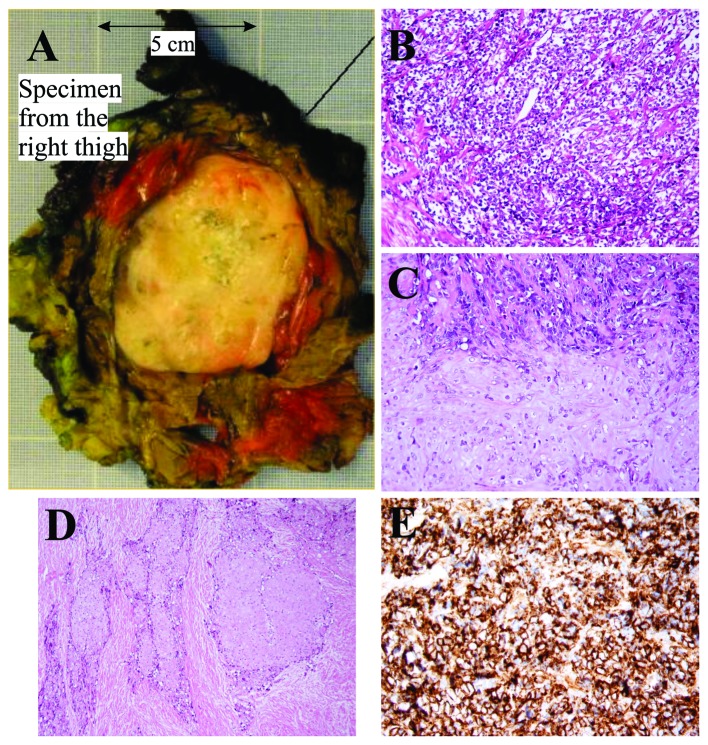
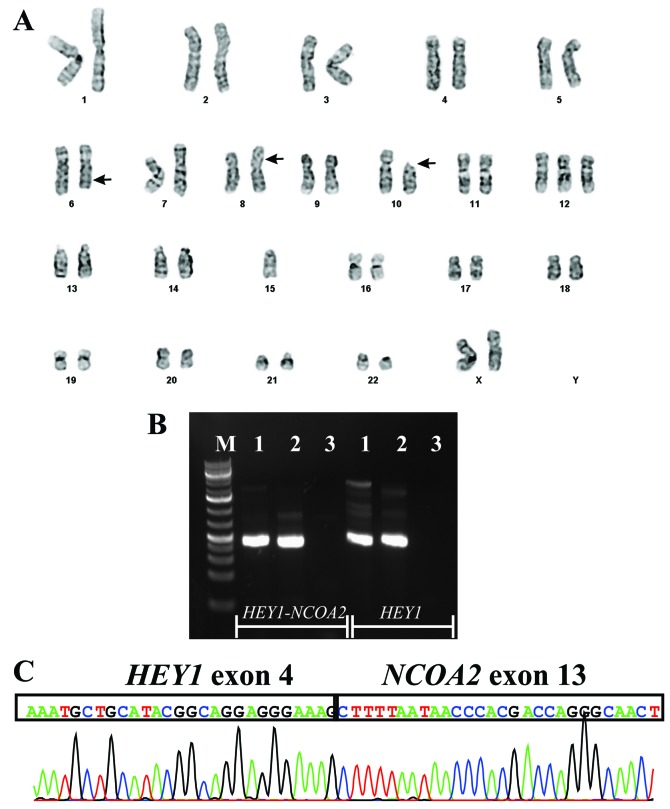
Mesenchymal chondrosarcomas are fast-growing tumors that account for 2-10% of primary chondrosarcomas. Cytogenetic information is restricted to 12 cases that did not show a specific aberration pattern. Recently, two fusion genes were described in mesenchymal chondrosarcomas: a recurrent HEY1-NCOA2 found in tumors that had not been cytogenetically characterized and an IRF2BP2-CDX1 found in a tumor carrying a t(1;5)(q42;q32) translocation as the sole chromosomal abnormality. Here, we present the cytogenetic and molecular genetic analysis of a mesenchymal chondrosarcoma in which the patient had two histologically indistinguishable tumor lesions, one in the neck and one in the thigh. An abnormal clone with the G-banding karyotype 46,XX,add(6)(q23),add(8)(p23),del(10)(p11),+12,-15[6] was found in the neck tumor whereas a normal karyotype, 46,XX, was found in the tumor of the thigh. RT-PCR and Sanger sequencing showed that exon 4 of HEY1 was fused to exon 13 of NCOA2 in the sample from the thigh lesion; we did not have spare material to perform a similar analysis of the neck tumor. Examining the published karyotypes we observed numerical or structural aberrations of chromosome 8 in the majority of the karyotyped mesenchymal chondrosarcomas. Chromosome 8 was also structurally affected in the present study. The pathogenetic mechanisms behind this nonrandom involvement are unknown, but the presence on 8q of two genes, HEY1 and NCOA2, now known to be involved in mesenchymal chondrosarcoma tumorigenesis is, of course, suggestive.
间叶性软骨肉瘤是一种生长迅速的肿瘤,占原发性软骨肉瘤的2% - 10%。细胞遗传学信息仅限于12例病例,这些病例未显示出特定的畸变模式。最近,在间叶性软骨肉瘤中发现了两种融合基因:一种是在未进行细胞遗传学特征分析的肿瘤中发现的复发性HEY1 - NCOA2,另一种是在携带t(1;5)(q42;q32)易位作为唯一染色体异常的肿瘤中发现的IRF2BP2 - CDX1。在此,我们报告一例间叶性软骨肉瘤的细胞遗传学和分子遗传学分析,该患者有两个组织学上难以区分的肿瘤病灶,一个在颈部,一个在大腿。在颈部肿瘤中发现了一个具有G显带核型46,XX,add(6)(q23),add(8)(p23),del(10)(p11),+12,-15[6]的异常克隆,而在大腿肿瘤中发现了正常核型46,XX。逆转录聚合酶链反应(RT-PCR)和桑格测序显示,来自大腿病灶的样本中HEY1的第4外显子与NCOA2的第13外显子融合;我们没有多余的材料对颈部肿瘤进行类似分析。检查已发表的核型,我们发现在大多数已进行核型分析的间叶性软骨肉瘤中,染色体8存在数目或结构异常。在本研究中,染色体8也受到了结构影响。这种非随机受累背后的致病机制尚不清楚,但8q上存在两个现在已知参与间叶性软骨肉瘤肿瘤发生的基因HEY1和NCOA2,这当然具有提示意义。