Bossers Willem J R, Scherder Erik J A, Boersma Froukje, Hortobágyi Tibor, van der Woude Lucas H V, van Heuvelen Marieke J G
University of Groningen, University Medical Center Groningen, Center for Human Movement Sciences, Groningen, The Netherlands.
University of Groningen, University Medical Center Groningen, Center for Human Movement Sciences, Groningen, The Netherlands; VU University, Department of Clinical Neuropsychology, Amsterdam, The Netherlands.
PLoS One. 2014 May 20;9(5):e97577. doi: 10.1371/journal.pone.0097577. eCollection 2014.
We examined the feasibility of a combined aerobic and strength training program in institutionalized dementia patients and studied the effects on cognitive and physical function.
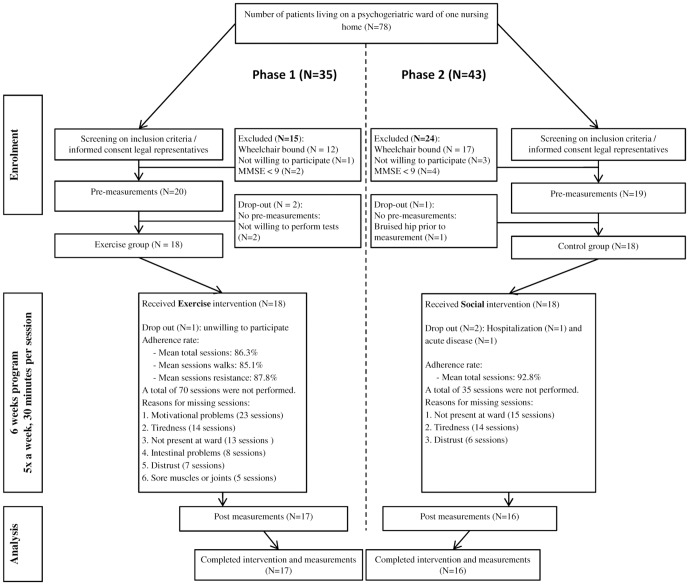
Thirty-three patients with dementia, recruited from one nursing home, participated in this non-randomized pilot study (25 women; age = 85.2±4.9 years; Mini Mental State Examination = 16.8±4.0). In phase 1 of the study, seventeen patients in the Exercise group (EG) received a combined aerobic and strength training program for six weeks, five times per week, 30 minutes per session, in an individually supervised format and successfully concluded the pre and posttests. In phase 2 of the study, sixteen patients in the Social group (SG) received social visits at the same frequency, duration, and format and successfully concluded the pre and posttests.
Indices of feasibility showed that the recruitment and adherence rate, respectively were 46.2% and 86.3%. All EG patients completed the exercise program according to protocol without adverse events. After the six-week program, no significant differences on cognitive function tests were found between the EG and SG. There was a moderate effect size in favor for the EG for the Visual Memory Span Forward; a visual attention test. There were significant differences between groups in favor for the EG with moderate to large effects for the physical tests Walking Speed (p = .003), Six-Minute Walk Test (p = .031), and isometric quadriceps strength (p = .012).
The present pilot study showed that it is feasible to conduct a combined aerobic and strength training program in institutionalized patients with dementia. The selective cognitive visual attention improvements and more robust changes in motor function in favor of EG vs. SG could serve as a basis for large randomized clinical trials.
trialregister.nl 1230.
我们研究了在机构化痴呆患者中开展有氧和力量训练相结合项目的可行性,并研究其对认知和身体功能的影响。
从一家疗养院招募的33名痴呆患者参与了这项非随机试点研究(25名女性;年龄 = 85.2±4.9岁;简易精神状态检查表 = 16.8±4.0)。在研究的第1阶段,运动组(EG)的17名患者接受了为期六周、每周五次、每次30分钟的有氧和力量训练相结合的项目,以个体监督的形式进行,并成功完成了前后测试。在研究的第2阶段,社交组(SG)的16名患者以相同的频率、持续时间和形式接受社交探访,并成功完成了前后测试。
可行性指标显示,招募率和依从率分别为46.2%和86.3%。所有EG组患者均按方案完成了锻炼项目,无不良事件发生。六周项目结束后,EG组和SG组在认知功能测试方面未发现显著差异。在视觉记忆广度前向测试(一项视觉注意力测试)中,EG组有中等效应量优势。在身体测试方面,两组存在显著差异,EG组在步行速度(p = 0.003)、六分钟步行测试(p = 0.031)和等长股四头肌力量(p = 0.012)方面有中等至较大效应量优势。
本试点研究表明,在机构化痴呆患者中开展有氧和力量训练相结合的项目是可行的。与SG组相比,EG组在选择性认知视觉注意力改善和运动功能方面有更显著的变化,可为大型随机临床试验提供依据。
trialregister.nl 1230