Misganaw Awoke, Mariam Damen Haile, Ali Ahmed, Araya Tekebash
J Health Popul Nutr. 2014 Mar;32(1):1-13.
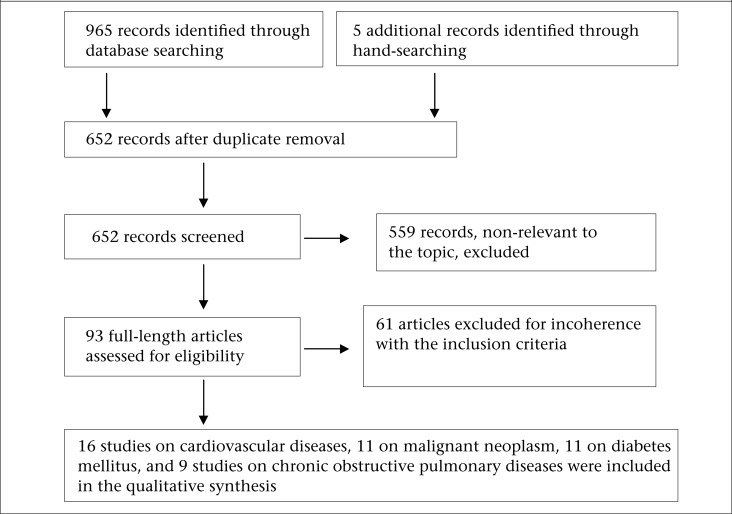
Impact of non-communicable diseases is not well-documented in Ethiopia. We aimed to document the prevalence and mortality associated with four major non-communicable diseases in Ethiopia: cardiovascular disease, cancer, diabetes, and chronic obstructive pulmonary disease. Associated risk factors: hypertension, tobacco-use, harmful use of alcohol, overweight/obesity, and khat-chewing were also studied. Systematic review of peer-reviewed and grey literature between 1960 and 2011 was done using PubMed search engines and local libraries to identify prevalence studies on the four diseases. In total, 32 studies were found, and half of these studies were from Addis Ababa. Two hospital-based studies reviewed the prevalence of cardiovascular disease and found a prevalence of 7.2% and 24%; a hospital-based study reviewed cancer prevalence and found a prevalence of 0.3%; two hospital-based studies reviewed diabetes prevalence and found a prevalence of 0.5% and 1.2%; and two hospital-based studies reviewed prevalence of asthma and found a prevalence of 1% and 3.5%. Few community-based studies were done on the prevalence of diabetes and chronic pulmonary obstructive disease among the population. Several studies reviewed the impact of these diseases on mortality: cardiovascular disease accounts for 24% of deaths in Addis Ababa, cancer causes 10% of deaths in the urban settings and 2% deaths in rural setting, and diabetes causes 5% and chronic obstructive pulmonary disease causes 3% of deaths. Several studies reviewed the impact of these diseases on hospital admissions: cardiovascular disease accounts for 3%-12.6% and found to have increased between 1970s and 2000s; cancer accounts for 1.1%-2.8%, diabetes accounts for 0.5%-1.2%, and chronic obstructive diseases account for 2.7%-4.3% of morbidity. Overall, the major non-communicable diseases and related risk factors are highly prevalent, and evidence-based interventions should be designed.
埃塞俄比亚非传染性疾病的影响尚无充分记录。我们旨在记录埃塞俄比亚四种主要非传染性疾病的患病率和死亡率,这四种疾病分别是心血管疾病、癌症、糖尿病和慢性阻塞性肺疾病。同时还研究了相关风险因素,包括高血压、烟草使用、有害饮酒、超重/肥胖以及恰特草咀嚼。利用PubMed搜索引擎和当地图书馆对1960年至2011年间同行评审文献和灰色文献进行系统回顾,以确定这四种疾病的患病率研究。总共找到了32项研究,其中一半来自亚的斯亚贝巴。两项基于医院的研究回顾了心血管疾病的患病率,分别为7.2%和24%;一项基于医院的研究回顾了癌症患病率,为0.3%;两项基于医院的研究回顾了糖尿病患病率,分别为0.5%和1.2%;两项基于医院的研究回顾了哮喘患病率,分别为1%和3.5%。针对人群中糖尿病和慢性阻塞性肺疾病患病率的社区研究较少。多项研究回顾了这些疾病对死亡率的影响:心血管疾病占亚的斯亚贝巴死亡人数的24%,癌症在城市地区导致10%的死亡,在农村地区导致2%的死亡,糖尿病导致5%的死亡,慢性阻塞性肺疾病导致3%的死亡。多项研究回顾了这些疾病对住院率的影响:心血管疾病占3%-12.6%,且在20世纪70年代至21世纪初有所增加;癌症占1.1%-2.8%,糖尿病占0.5%-1.2%,慢性阻塞性疾病占发病率的2.7%-4.3%。总体而言,主要非传染性疾病及相关风险因素非常普遍,应制定基于证据的干预措施。