
网络成瘾青少年的额叶-基底神经节连接受损。
Impaired frontal-basal ganglia connectivity in adolescents with internet addiction.
作者信息
Li Baojuan, Friston Karl J, Liu Jian, Liu Yang, Zhang Guopeng, Cao Fenglin, Su Linyan, Yao Shuqiao, Lu Hongbing, Hu Dewen
机构信息
1] School of Biomedical Engineering, Fourth Military Medical University, Xi'an, Shaanxi, 710032, China [2] Department of Automatic Control, College of Mechatronics and Automation, National University of Defense Technology, Changsha, Hunan 410073, P.R. China.
The Wellcome Trust Centre for Neuroimaging, University College London, Queen Square, London WC1N 3BG UK.
出版信息
Sci Rep. 2014 May 22;4:5027. doi: 10.1038/srep05027.
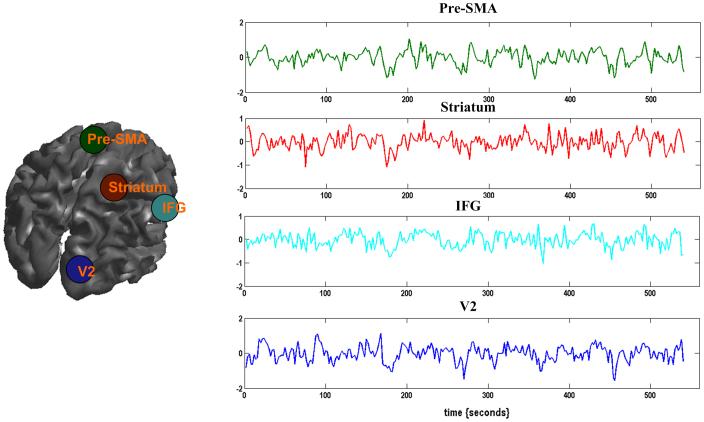
Understanding the neural basis of poor impulse control in Internet addiction (IA) is important for understanding the neurobiological mechanisms of this syndrome. The current study investigated how neuronal pathways implicated in response inhibition were affected in IA using a Go-Stop paradigm and functional magnetic resonance imaging (fMRI). Twenty-three control subjects aged 15.2±0.5 years (mean±S.D.) and eighteen IA subjects aged 15.1±1.4 years were studied. Effective connectivity within the response inhibition network was quantified using (stochastic) dynamic causal modeling (DCM). The results showed that the indirect frontal-basal ganglia pathway was engaged by response inhibition in healthy subjects. However, we did not detect any equivalent effective connectivity in the IA group. This suggests the IA subjects fail to recruit this pathway and inhibit unwanted actions. This study provides a clear link between Internet addiction as a behavioral disorder and aberrant connectivity in the response inhibition network.
了解网络成瘾(IA)中冲动控制能力差的神经基础对于理解该综合征的神经生物学机制至关重要。当前的研究使用停止信号范式和功能磁共振成像(fMRI)来探究参与反应抑制的神经通路在网络成瘾中是如何受到影响的。研究了23名年龄为15.2±0.5岁(均值±标准差)的对照受试者和18名年龄为15.1±1.4岁的网络成瘾受试者。使用(随机)动态因果模型(DCM)对反应抑制网络内的有效连接进行量化。结果显示,在健康受试者中,间接的额叶 - 基底神经节通路参与了反应抑制。然而,在网络成瘾组中未检测到任何等效的有效连接。这表明网络成瘾受试者无法激活该通路并抑制不必要的行为。这项研究在作为一种行为障碍的网络成瘾与反应抑制网络中异常连接之间建立了明确的联系。


 Zotero 插件