Baldwin Andrew J
Physical and Theoretical Chemistry Laboratory, University of Oxford, Oxford OX1 3QZ, UK.
J Magn Reson. 2014 Jul;244(100):114-24. doi: 10.1016/j.jmr.2014.02.023. Epub 2014 Apr 13.
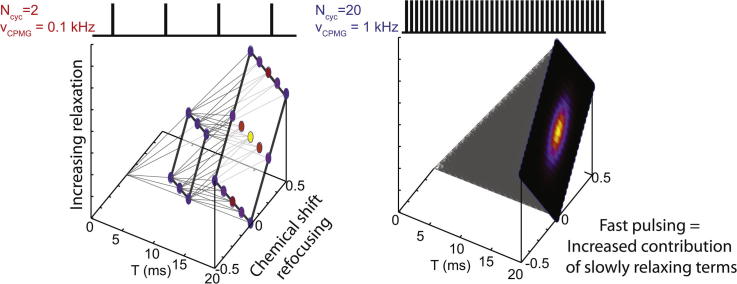
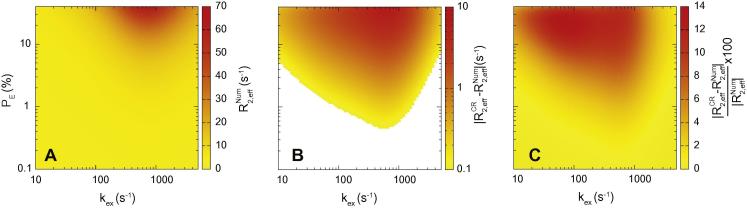
The Carr-Purcell-Meiboom-Gill (CPMG) experiment is widely used to quantitatively analyse the effects of chemical exchange on NMR spectra. In a CPMG experiment, the effective transverse relaxation rate, R2,eff, is typically measured as a function of the pulse frequency, νCPMG. Here, an exact expression for how R2,eff varies with νCPMG is derived for the commonly encountered scenario of two-site chemical exchange of in-phase magnetisation. This result, summarised in Appendix A, generalises a frequently used equation derived by Carver and Richards, published in 1972. The expression enables more rapid analysis of CPMG data by both speeding up calculation of R2,eff over numerical methods by a factor of ca. 130, and yields exact derivatives for use in data analysis. Moreover, the derivation provides insight into the physical principles behind the experiment.
卡尔-珀塞尔-梅博姆-吉尔(CPMG)实验被广泛用于定量分析化学交换对核磁共振谱的影响。在CPMG实验中,有效横向弛豫率(R_{2,eff})通常作为脉冲频率(\nu_{CPMG})的函数进行测量。在此,针对同相磁化强度的两点化学交换这一常见情况,推导出了(R_{2,eff})随(\nu_{CPMG})变化的精确表达式。该结果总结在附录A中,推广了1972年发表的由卡弗和理查兹推导的一个常用方程。该表达式通过将(R_{2,eff})的计算速度比数值方法加快约130倍,实现了对CPMG数据更快速的分析,并产生用于数据分析的精确导数。此外,该推导深入揭示了实验背后的物理原理。