Devasenapathy Niveditha, George Mathew Sunil, Ghosh Jerath Suparna, Singh Archna, Negandhi Himanshu, Alagh Gursimran, Shankar Anuraj H, Zodpey Sanjay
Indian Institute of Public Health-Delhi, Public Health Foundation of India, Gurgaon, Haryana, India.
Department of Biochemistry, All India Institute of Medical Sciences, New Delhi, India.
BMJ Open. 2014 May 22;4(5):e004401. doi: 10.1136/bmjopen-2013-004401.
Increasing institutional births is an important strategy for attaining Millennium Development Goal -5. However, rapid growth of low income and migrant populations in urban settings in low-income and middle-income countries, including India, presents unique challenges for programmes to improve utilisation of institutional care. Better understanding of the factors influencing home or institutional birth among the urban poor is urgently needed to enhance programme impact. To measure the prevalence of home and institutional births in an urban slum population and identify factors influencing these events.
Cross-sectional survey using quantitative and qualitative methods.
Urban poor settlements in Delhi, India.
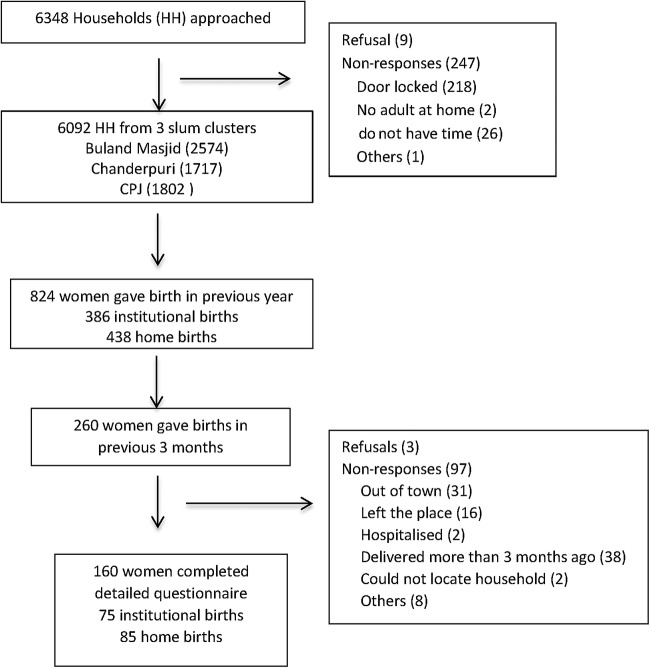
A house-to-house survey was conducted of all households in three slum clusters in north-east Delhi (n=32 034 individuals). Data on birthing place and sociodemographic characteristics were collected using structured questionnaires (n=6092 households). Detailed information on pregnancy and postnatal care was obtained from women who gave birth in the past 3 months (n=160). Focus group discussions and in-depth interviews were conducted with stakeholders from the community and healthcare facilities.
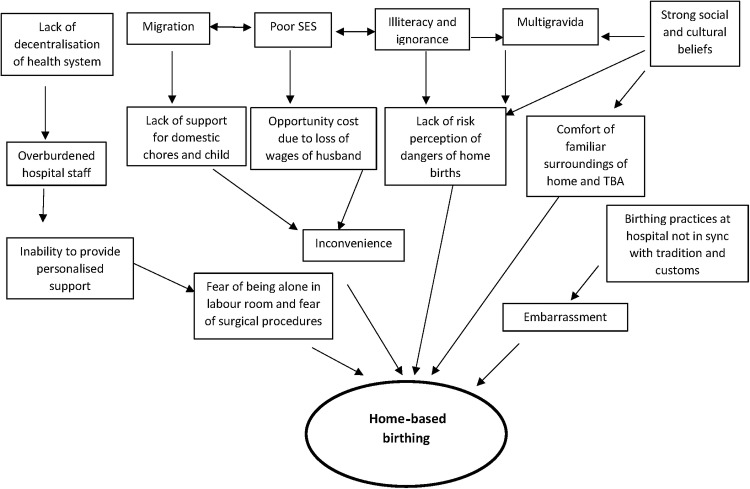
Of the 824 women who gave birth in the previous year, 53% (95% CI 49.7 to 56.6) had given birth at home. In adjusted analyses, multiparity, low literacy and migrant status were independently predictive of home births. Fear of hospitals (36%), comfort of home (20.7%) and lack of social support for child care (12.2%) emerged as the primary reasons for home births.
Home births are frequent among the urban poor. This study highlights the urgent need for improvements in the quality and hospitality of client services and need for family support as the key modifiable factors affecting over two-thirds of this population. These findings should inform the design of strategies to promote institutional births.
增加机构分娩是实现千年发展目标5的一项重要战略。然而,在包括印度在内的低收入和中等收入国家的城市地区,低收入和流动人口的迅速增长给改善机构护理利用情况的项目带来了独特挑战。迫切需要更好地了解影响城市贫困人口在家分娩或机构分娩的因素,以提高项目影响力。旨在测量城市贫民窟人口中在家分娩和机构分娩的发生率,并确定影响这些事件的因素。
采用定量和定性方法的横断面调查。
印度德里的城市贫困住区。
对德里东北部三个贫民窟集群中的所有家庭进行逐户调查(n = 32034人)。使用结构化问卷收集了分娩地点和社会人口学特征的数据(n = 6092户)。从过去3个月内分娩的妇女那里获得了关于孕期和产后护理的详细信息(n = 160人)。与社区和医疗机构的利益相关者进行了焦点小组讨论和深入访谈。
在上一年分娩的824名妇女中,53%(95%可信区间49.7至56.6)在家分娩。在调整分析中,多胎妊娠、低识字率和移民身份是在家分娩的独立预测因素。害怕医院(36%)、家中舒适(20.7%)以及缺乏育儿的社会支持(12.2%)成为在家分娩的主要原因。
城市贫困人口中在家分娩的情况很常见。本研究强调迫切需要改善客户服务的质量和接待情况,以及需要家庭支持,因为这些关键的可改变因素影响着超过三分之二的这一人群。这些研究结果应为促进机构分娩的策略设计提供参考。