Institute of Environmental Health, Center for Public Health, Medical University of Vienna, Kinderspitalgasse 15, A-1090 Vienna, Austria.
Int J Environ Res Public Health. 2014 May 19;11(5):5445-61. doi: 10.3390/ijerph110505445.
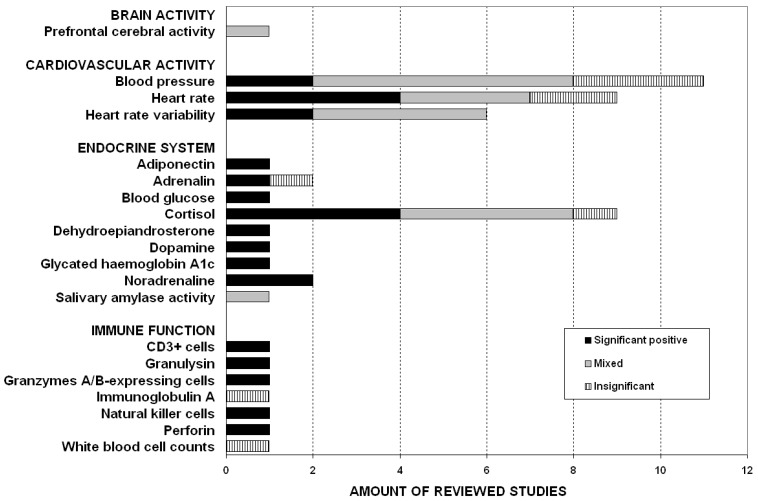
Natural environments offer a high potential for human well-being, restoration and stress recovery in terms of allostatic load. A growing body of literature is investigating psychological and physiological health benefits of contact with Nature. So far, a synthesis of physiological health outcomes of direct outdoor nature experiences and its potential for improving Public Health is missing. We were interested in summarizing the outcomes of studies that investigated physiological outcomes of experiencing Nature measuring at least one physiological parameter during the last two decades. Studies on effects of indoor or simulated Nature exposure via videos or photos, animal contact, and wood as building material were excluded from further analysis. As an online literature research delivered heterogeneous data inappropriate for quantitative synthesis approaches, we descriptively summarized and narratively synthesized studies. The procedure started with 1,187 titles. Research articles in English language published in international peer-reviewed journals that investigated the effects of natural outdoor environments on humans by were included. We identified 17 relevant articles reporting on effects of Nature by measuring 20 different physiological parameters. We assigned these parameters to one of the four body systems brain activity, cardiovascular system, endocrine system, and immune function. These studies reported mainly direct and positive effects, however, our analyses revealed heterogeneous outcomes regarding significance of results. Most of the studies were conducted in Japan, based on quite small samples, predominantly with male students as participants in a cross-sectional design. In general, our narrative review provided an ambiguous illustration of the effects outdoor nature exerted on physiological parameters. However, the majority of studies reported significant positive effects. A harmonizing effect of Nature, especially on physiological stress reactions, was found across all body systems. From a Public Health perspective, interdisciplinary work on utilizing benefits of Nature regarding health promotion, disease prevention, and nature-based therapy should be optimized in order to eventually diminish given methodological limitations from mono-disciplinary studies.
自然环境在应激负荷方面为人类的健康、恢复和压力缓解提供了巨大的潜力。越来越多的文献研究了与自然接触对心理和生理健康的益处。到目前为止,直接户外自然体验对生理健康结果的综合影响及其对改善公共健康的潜力还没有被研究过。我们感兴趣的是总结过去二十年中研究自然体验对生理结果的研究的结果,这些研究至少测量了一个生理参数。室内或模拟自然暴露的研究,如通过视频或照片、动物接触和木材作为建筑材料,不包括在进一步的分析中。由于在线文献研究提供了不适合定量综合方法的异质数据,我们对研究进行了描述性总结和叙述性综合。这一过程始于 1187 个标题。我们纳入了国际同行评议期刊上发表的以英语撰写的研究文章,这些文章通过测量 20 个不同的生理参数来研究自然户外环境对人类的影响。我们确定了 17 篇相关文章,这些文章报告了通过测量 20 个不同的生理参数来研究自然对人类的影响。我们将这些参数分配到四个身体系统之一:大脑活动、心血管系统、内分泌系统和免疫系统。这些研究报告的主要是直接和积极的影响,然而,我们的分析显示,关于结果的意义存在异质性。大多数研究都是在日本进行的,样本量较小,主要是男性学生作为横断面设计的参与者。总的来说,我们的叙述性综述对户外自然对生理参数的影响提供了一个模糊的说明。然而,大多数研究报告了显著的积极影响。我们发现,自然对所有身体系统的生理应激反应都有协调作用。从公共卫生的角度来看,应该优化关于利用自然促进健康、预防疾病和基于自然的治疗的跨学科工作,以最终减少单一学科研究的方法学限制。